dailynewsnblog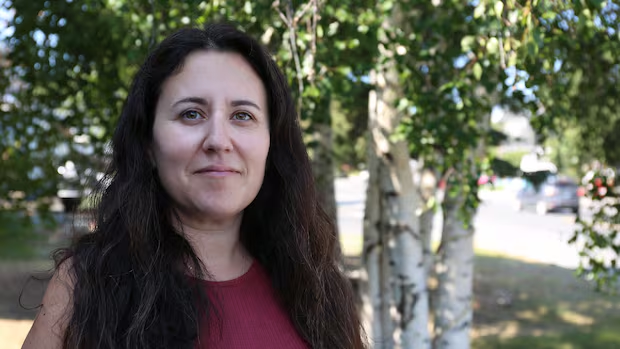
When Catherine Blondin’s relatives fled from Fort Simpson to Yellowknife because of wildfires, she opened her door to them. It was a stressful time, so she decided to book a session with her therapist.
That’s when her therapist had to break the news: the federal program that funded her counselling was on hold – and there was no timeline for when she would be able to get approved for more sessions through the program.
She and her daughter relied on the program to work through intergenerational residential school trauma in their family.
“It’s scary,” she said. “You need that continuing care in order for something like counseling to be successful.”
Blondin, like many others in the N.W.T., gets counselling through an Indigenous Services Canada (ISC) program that offers therapy for residential school survivors and their families, the Indian Residential Schools Resolution Health Support Program.
Even though federal approval to renew funding for the program came in March, patients and therapists have spent weeks in limbo as renewals and new intakes for counselling offered through the program were put on hold in late May.
Blondin, another client of the program, and two providers of the service shared their concerns with CBC News about what the pause on the program meant for care, the program’s future, and their trust in the federal government’s commitment toward reconciliation.
Accessing care
Through the program, counseling patients get pre-approved for counselling over the period of a year, and then need to get re-approved.
Blondin said it took her time to find the right therapist, but since she did over two years ago, having access to the program has changed her life.
“I want to see us be happy, healthy Indigenous people, we’re very strong and resilient because we’ve had to be,” she said. “But we need that continuity of care in order to make that healing impactful.”
Blondin said she is committed to receiving counseling regardless of the program’s availability. Since her daughter also uses the program, it has so far played a big part in making counseling accessible to her family up until now.
“So either it comes out of pocket or I have to stop.”

Meanwhile in Fort Smith, Betty Bird has also been trying to understand what the hold means for the program’s future as someone who has used it for decades and often encourages others to do the same.
Bird’s grandmother attended residential school, and Bird herself started school the year after her local day school turned into a regular school, she said.
“None of the abuse stopped and my school years were not happy at all,” she said.
Bird credits therapy for creating a “turning point” in her life, and she now accesses it on and off as needed.
“I can honestly say that my issues took the back seat and I was in the driver seat,” she said. “From my grandma to my grandson, we have made strides in becoming a healthier family.”

Bird said she found out the program was on hold by chance when someone she was helping access it was denied entry into the program.
She wants Ottawa to know she believes the program is still needed in the North, where alternatives are scarce.
“You’re dealing with people’s pain, people’s trauma” she said. “You haven’t fulfilled your obligation to get us to a place where we’re ready to take over.”
Both Blondin and Bird said the sudden hold and the lack of information around it undermined their trust in the federal government’s commitment to reconciliation.
Bird said it was “disheartening” to see little transparency from the federal government about the hold on the program.
“As a Métis woman, I’m still kicked to the curb again,” she said. “That’s how it feels.”
‘A continuation of harm’
Blondin and Bird are not the only ones feeling let down.
“I just find it to be very frustrating, because this program exists because of the harms of colonial systems and this program pause is just feeling like a continuation of harm,” said an Indigenous counselling therapist who offers therapy through the program.
CBC News has agreed not to identify them because they fear speaking publicly may cause them to lose future contract work with ISC.
Throughout the pause, they have continued to provide free counselling to eight clients to avoid causing harm to them by interrupting their service, and avoided telling them about the pause unless asked.
They said they have had to turn away potential new clients during the pause.
CBC News also spoke with another contracted provider of the program, whose identity is also not being disclosed out of their fear for their potential future work with ISC.
Both providers stressed that the pause placed therapists in the situation of having to choose between ethical care for their clients and their own financial wellbeing for an undetermined period of time.
Neither counselor received instructions from the government about what to tell their clients about the program pause when they were informed about it in late May.
The second service provider said they have been providing counseling through the program for over five years and had yet to see a pause like this.
They stressed the importance of continuing, uninterrupted care for people recovering from complex trauma.
“Interruptions in access have the potential to increase distress, and it can delay recovery,” they said.
They also said it has the potential to discourage clients from returning to therapy.
“Once trust has been broken, it can be very difficult to rebuild.”
They said the pause affects about 60 of their clients.
As of Monday afternoon, neither counselor had received notice from ISC that the program was no longer on hold.
Ottawa’s response
CBC News requested an interview with ISC to clarify where things stand with the program, but the department declined and instead provided a written statement.
It notes that Minister Mandy Gull-Masty announced in March $630 million in renewal funding over two year for a range of programs, including the one the Indian Residential Schools Resolution Health Support Program is funded through.

“At the end of fiscal year 25-26, delays were experienced in invoice approval and payments,” Jacinthe Goulet, a spokesperson for ISC, wrote in a statement. “ISC has now received its funding and should be approving invoices within service standards.”
ISC did not respond to CBC News’ questions about whether this meant the hold was lifted, if it affected other regions, and how many people it affected by deadline. The federal department also did not respond to questions asking to clarify what caused the delays, and when it received the funding.
“We recognise that uncertainty and delays in service approvals may have caused challenges for some clients and service providers, and we sincerely regret any inconvenience or impacts experienced,” Goulet wrote in the original statement.
Former residential school students and their families can call the 24-hour National Indian Residential School Crisis Line toll free at 1-866-925-4419.