dailynewsnblog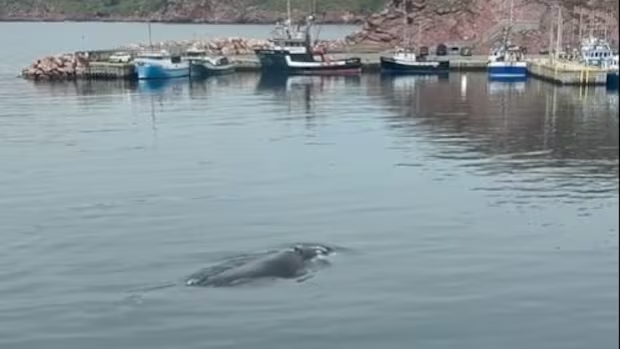

Listen to this article
Estimated 4 minutes
The audio version of this article is generated by AI-based technology. Mispronunciations can occur. We are working with our partners to continually review and improve the results.
There are only about 380 North Atlantic right whales in the world and earlier this month, Kristinn Skulason was able to see one just out his office window in Bay de Verde, a town in Newfoundland’s Conception Bay.
The regional manager with Quinlan Brothers Ltd. said he didn’t know the type of whale it was at first. He was only entertained by its location, being so close to shore.
“I have been here 28 years. I don’t remember seeing a whale inside, in the harbour. We see them outside the breakwater every year when the capelin is on the go,” he told CBC Radio’s The Broadcast.
“This was unusual and I just picked up my phone and started to video and take a few pictures,” he said.
The images and video were shared with friends, then more widely on social media.
Right whale named Goldfish
Skulason was soon receiving messages from “people in the whale world,” as he called them. They told him it was a right whale — an unusual sighting for his area. The sighting was reported to the Department of Fisheries and Oceans.
He was told the whale, named Goldfish, was last seen in the Gulf of St. Lawrence in 2023.
“I was speechless for a minute, but I’m glad I took a video,” he said.

Brett Gilchrist, a director of national programs with DFO working in Ottawa, confirmed the identification of Goldfish. He said right whales actually have a range reaching from Iceland in the north, over to Europe and south to the Gulf of Mexico.
When they are in Canada in numbers, they’re typically chasing copepods — small crustaceans serving as an important food source. They tend to aggregate in the Bay of Fundy or the Gulf of St. Lawrence.
“This whale was probably looking for a source of food,” Gilchrist said, noting it was just the one right whale reported on Newfoundland’s north coast and recorded by DFO.
On review of available photos and video, the animal appears to be healthy, he said.
No fisheries closure in this case: DFO
In areas where right whales are known to gather in number there are particular measures taken by DFO in an effort to protect them from entanglements in fishing gear. The fisheries management area where a whale is sighted will be closed for 15 days, or until the whale is confirmed to have left the area. In the case of more than one sighting, 15 days can become a seasonal closure.
“In and around where this whale was spotted, there is no specific expectation that they’re aggregating in large numbers,” Gilchrist added.
Bay de Verde and other areas where sightings are rarer are handled on a case by case basis, he explained.
DFO did issue a “notice of vigilance” in this case. The department is asking all fish harvesters in the area to work with “heightened caution.”
North Atlantic right whales are large, slow-moving, baleen whales. Unlike the humpback whale, they have short fins and they are typically dark in colour.
Anyone who thinks they have seen a right whale is encouraged to take note of the date and time, and if at all possible a GPS location, the behaviour – feeding, travelling, diving – and note any unique features or markings. Photographs are encouraged. At the same time, there are regulations against approaching the animals, so be sure to use your zoom.
You may not need any zoom of course, if they’re just outside your office window.
Download our free CBC News app to sign up for push alerts for CBC Newfoundland and Labrador. Sign up for our daily headlines newsletter here. Click here to visit our landing page.