dailynewsnblog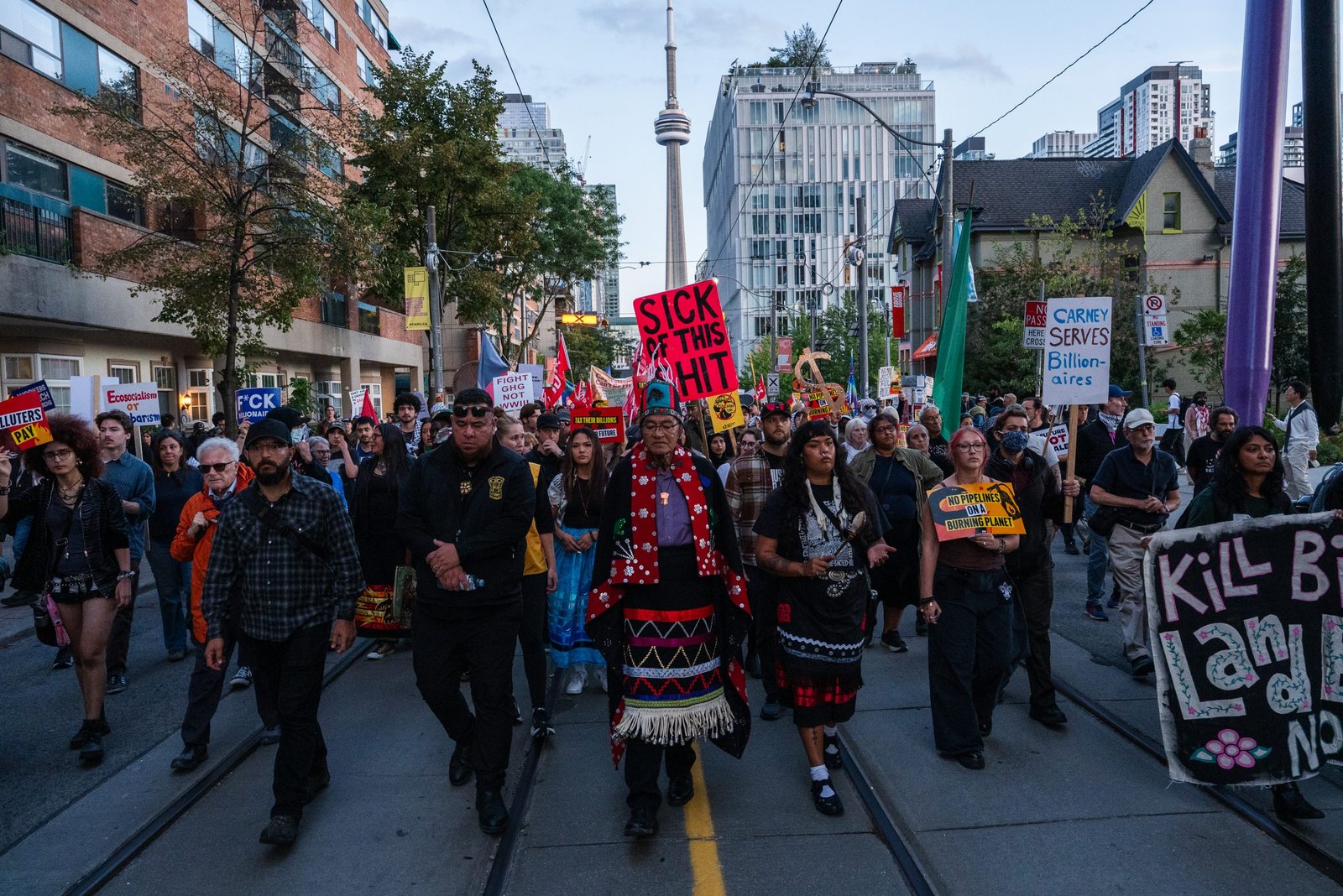
Here’s what the activist media is reporting on this week.
In a headline splashed over a full-screen image of Prime Minister Mark Carney striding past a sign promoting the now-wrapped Canada Investment Summit, Ricochet contributor Christo Aivalis accuses the newly-majority federal Liberal government of waging a “war on workers” that “would make the right to strike meaningless,” he warns.
“When a plurality of Canadians voted for Mark Carney’s Liberal Party in 2025, their hope was a leader who would protect and preserve Canadian values from the American onslaught of Donald Trump,” he notes.
“Many explicitly rejected Pierre Poilievre and the Conservatives because they felt his right-wing, anti-worker values were too closely aligned with the U.S. Republican Party.”
Now, with a year and change in government on the record, “it might disappoint” those same Canadians that Carney “is not only continuing Justin Trudeau’s controversial labour relations regime, but quickly expanding his attack upon the working class, couching in it neutral buzzwords like ‘modernization’ all while making it clear that the goal is to make the capitalist class happy by assuring them Canadian workers have fewer rights than they used to,” he contends.
In fact, citing “more candid reporting from CTV” and other media outlets, “Carney’s objective is to go even farther than Trudeau and Stephen Harper, (and) not only use back-to-work legislation, but propose new legislation that ‘will be aimed at introducing binding mediation before strike action is taken,” which is a “shocking escalation of anti-labour policy, even for the already right-wing Mark Carney,” he contends.
“Put another way, corporations feel the government’s anti-labour tools aren’t strong enough, and that the only way to ensure investors are happy is to stop strikes before they can even manifest,” he concludes.
“But this defeats the whole purpose of strikes: they are indeed rare, but when they do happen, they must be disruptive to enact vital economic victories that benefit union members and the wider working class.”
Meanwhile, The Breach podcast host Desmond Cole and managing editor Martin Lukacs explore how the investment summit ultimately “maple-washed a giant corporate giveaway,” while conceding that, at least in the short term, it seems to have been a “major political success” for Carney and the Liberals.
“In the wake of Trump’s continuing attacks on the country, Canadians were treated to this grand display of a consummately skilled banker prime minister, summoning the world’s economic movers and shakers to save our country and our economy,” Lukacs noted.
“At the same time, he sent a message to the corporate class here and abroad that … far from saving our country, he’s actually just selling it off.”
Also keeping a close eye on what emerged from the summit: Canadians for Tax Fairness director Jared A. Walker and economist Silas Xuereb, who co-wrote an explainer for Canadian Dimension readers on the “massive corporate tax cut” that Carney announced “just a few short hours after protesters marched against the selling off of Canada’s public assets” — namely, the Productivity Mega Deduction, which “will cost a government already in desperate need of tax revenue another $8.5 billion each year,” they estimate.
“Just like his plans for airport privatization, this measure further erodes Canada’s public capacity to decide how to use our resources, transferring more of that control to foreign private corporations — and they already have quite a lot of it,” they point out.
“Instead of ensuring our sovereignty, the Carney government is auctioning off more and more control over Canada’s economy to whichever foreign oligarch has the deepest pockets.”
What’s more, “the evidence of the last half-century is very clear: Decades of corporate tax cuts have not led to the increased investment governments keep using to justify them,” they argue.
“Carney is absolutely right that Canada needs more investment—especially in light of Trump’s trade war. But we can’t keep trying the same old trickle-down tactics that have failed us time and time again, all while creating nearly unprecedented wealth inequality and making us more reliant on the United States.”
Elsewhere on the site, Willy Marz — which, as per his bio, is “the pen name of a writer and union activist in Ontario’s Niagara region” — invites readers to “raise a glass” to the Liquor Control Board of Ontario, which “makes the inconvenient case that public ownership can be efficient, profitable, and serve the public interest,” but is nevertheless under threat of being “dismantled and possibly privatized,” he laments.
“The LCBO … has existed for a century, and generated around $120 billion in dividends for the province of Ontario, as well as providing about $43 billion dollars in wages to workers throughout the province,” he notes.
“Besides making money, its original primary function was to rebuild the industry and market for beverage alcohol destroyed during Prohibition. The corporation’s long-term ability to generate dramatically greater sales and move vastly larger volumes rested principally on its success in developing the industry, creating markets, and applying technology and organizational innovation—not simply on extracting more work from fewer or more precariously employed workers.”
Given those numbers, “it would be fair to conclude that Premier Doug Ford must be a fool to deprive the province of this revenue-generating enterprise,” he suggests.
“But we can uncover the logic to his apparently irrational decision. For decades the neoliberal hard right in Ontario has been baying for blood over this corporation. Why? Precisely because it works so well, it is the perfect advertisement for public ownership. They are not trying to kill a corporation, they are trying to conceal the truth: public ownership can and does work.”
Over at Rabble, Tamara Lorincz marks the 30th anniversary of the Arctic Council — “the leading intergovernmental forum that has helped create peace and cooperation in the polar region,” as she notes — by sounding the alarm over the threat posed by the North Atlantic Treaty Organization’s newly launched Arctic Sentry program, and the “carbon-intensive military exercises and installations are turning the Inuit territories into a battleground, fueling the climate crisis, and raising alarms in Russia.”
In 2022, the “high-level political work of the Arctic Council was paused by the seven NATO Arctic states after Russia’s invasion of Ukraine (or start of its special military operation),” she explains.
“Nevertheless, in the past four years, the working groups have continued with different levels of Russian engagement,” but “NATO’s expanding presence in the Arctic is dangerously creating conditions for a conflict with Russia similar to what occurred in Ukraine,” she argues.
“The Carney government must take the initiative and de-escalate military tensions in the Arctic and re-engage diplomatically with Russia, our Arctic neighbour. Canada needs to reprioritize the Arctic Council as the preeminent institution to keep the region a zone of peace and cooperation.”
Rounding out the progressive-left circuit, The Maple’s Alex Cosh recaps Carney’s comments in response to U.S. President Donald Trump’s latest address to the United Nations General Assembly — and, more specifically, his “threat to completely destroy Iran”— which, he notes, the prime minister “downplayed” by describing as “the language of war” while speaking with reporters in New York.
“In April, Trump similarly threatened to wipe out a ‘whole civilization’ if Iran did not immediately comply with his war demands,” Cosh recalls.
“Carney responded by suggesting that all parties to the conflict should ‘choose their words’ more carefully, but offered no direct criticism of Trump or any call for restraint. The U.S.-Israeli war of aggression against Iran has so far killed up to 3,636 Iranian civilians and resulted in a spike in oil prices after Iran restricted shipping through the Strait of Hormuz.”
Trending on the right-of-centre side of the Canadian activist mediaverse:
- Rebel News is claiming victory in its recently launched court battle over pro-unity Forever Canadian’s “undisclosed finances” — which, as recounted in last week’s R2RR, led the avowedly-right-leaning outlet, a registered third-party advertiser in its own right, to file a legal challenge to force Elections Alberta to explain why the group was seemingly exempt from the standard reporting requirements, which, as Sheila Gunn Reid explains, the group has now announced will be followed from this point on.
- The Rebel team has also added nearly 9,000 signatures to a petition that calls on Carney to “publish the terms” of any new alliance with the European Union. “Put them before the House of Commons. Debate them in Canada, on the record, and hold a vote. Until you do: No to the EU.”
- Juno News regular Alex Dhaliwal amplifies Conservative MP Dean Allison’s reaction to media reports that the Canadian Air Transport Security Authority “plans to deploy biometric technology for pre-board passenger screening between 2026 and 2031,” the “goal” of which, as per Allison, “is to barcode people like livestock,” while predicting that “soon, there will be no privacy at all.”
- In a separate dispatch to the Juno network, Dhaliwal reveals that Ottawa-area Liberal MP Anita Vandenbeld “was decorated by former Kosovo president Hashim Thaçi and later called it a ‘particular honour’ to welcome him to Canada — years before he was convicted of war crimes.”