dailynewsnblog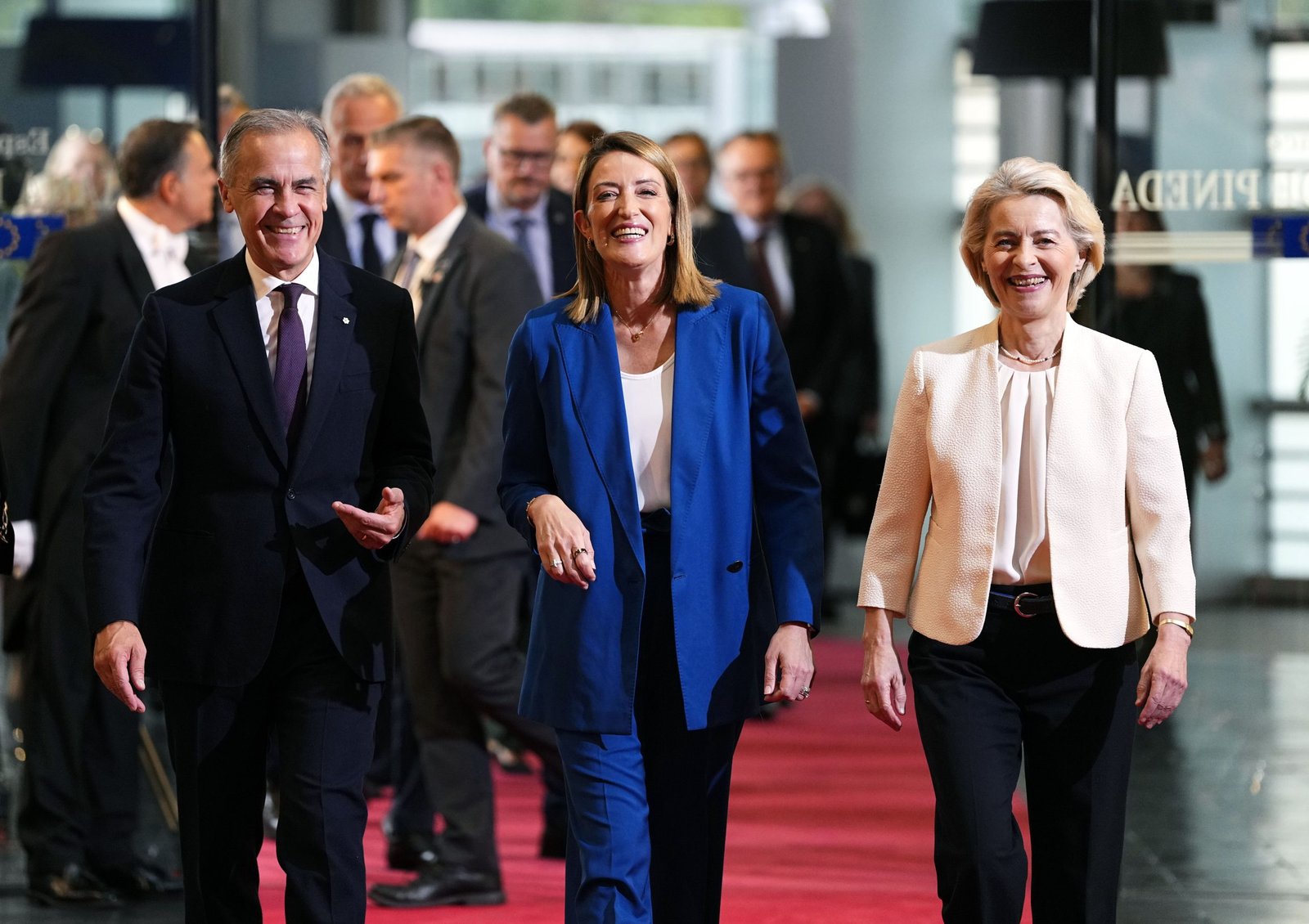
President of the European Commission Ursula von der Leyen’s provocative offer to make Canada an “associate member” of the European Union may look like the first big step towards Prime Minister Mark Carney’s ambition of a forging a great alliance of the middle powers, building upon his famous speech at Davos that lamented the collapse of “the international rules-based order.” But, as has been widely reported in the media since, “associate member” is an empty phrase. Just as he failed to disclose the text of the draft trade agreement with the US which his negotiators walked away from at the eleventh hour, Carney will not explain what Canada intends to do with its relationship to the EU.
Associate member of the EU cannot refer to a military partnership because Canada is already in NATO, not that NATO has anything to do with the EU – several EU Member States are not even in it. It cannot mean that Canada will sign up to the European Convention on Human Rights, as this treaty is also not part of the EU, despite the name (although the EU does require ECHR accession of all EU Members).
Canada already has a free trade agreement with the bloc – the Comprehensive Economic and Trade Agreement (CETA). It is true that the agreement is ten years old and could do with updating, for example by including material on data flows and electronic commerce. Several EU Member States have not yet ratified CETA, the practical consequences of which means that the investment protections (for Canadian companies establishing a presence in the EU) remain ineffectual. If associate member indicates Canada’s entry into the EU’s Single Market to further reduce trade barriers, like health and safety inspections on food, Canada will almost certainly have to pay an annual fee in the billions of dollars for the privilege. It will also mean open borders for EU citizens, accepting all EU laws with no role in their formulation as well as subordinating to the jurisdiction of the European Court of Justice (ECJ).
Canada’s associate EU membership may be similar to what the United Kingdom is currently pursuing via its “reset.” This involves “dynamic alignment” to reduce border checks on agriculture and food by creating a common regulatory area between the UK and the EU while falling short of the Single Market’s free movement of people. Under such an arrangement, when EU rules change the UK must update its own rules correspondingly even though it has no say in their creation. It also subjects the UK to the jurisdiction of a foreign court (the ECJ) unlike a conventional free trade agreement where disputes are settled by neutral international tribunals (as in the USMCA). Surely this cannot be what Carney is planning because we were told by him last month that Canada would not surrender its sovereignty to get a better trade deal with the US.
Adopting EU agrifood rules would almost certainly breach Canada’s obligations under its free trade agreements with third countries including the mega-regional Comprehensive Progressive Trans-Pacific Partnership (CPTPP) comprising 15 per cent of global GDP and consisting of some of the fastest growing economies in the world. This conflict arises because EU law is grounded in the risk-averse Precautionary Principle (over-regulate to avoid even the most unlikely dangers) whereas the CPTPP requires that agrifood regulations must be based on sound scientific evidence and genuine risks. Japan, Australia and other CPTPP partners may complain if their products are suddenly unwelcome in Canada because it is stuck following EU rules. Dynamic alignment would almost certainly foreclose any chance of renewing the USMCA, since the US is unlikely to sign a trade agreement that doesn’t cover food or agriculture. More trade with the EU will never compensate for these losses.
Closer ties with the EU will likely come with further demands, as the UK is now experiencing. One of these involves adhering to the EU’s carbon emissions trading scheme which requires adoption of its controversial carbon-border adjustment mechanism (CBAM) through which tariffs are imposed on imported goods in a manner that reflects the carbon intensity of their production. In addition to raising prices for consumers, Canada’s other trade partners might claim that the CBAM amounts to discrimination if the EU’s tariff calculation methodology does not recognise equivalent climate policies in exporting countries. It is doubtful that the EU’s CBAM would survive legal challenge under World Trade Organization (WTO) rules, because while it is plausibly designed to address climate change, it could easily be viewed as arbitrary protectionism. Would Canada choose the EU over the WTO, surely one of the last bastions of the rules-based international order?
All of this illustrates that “associate member of the EU” is just empty rhetoric from Carney, who makes grandiose speeches that are thin on detail. If some kind of enhanced partnership with the EU does come to fruition, it will likely amount to little more than the status quo, much like President Trump’s new deal with Greenland. In talking up the “alliance of the future” Carney hinted at scant benefits that might arise, including Canadian membership in the Erasmus+ programme (university student exchange) and the European investment programme in research and innovation (costing billions with little evidence of genuine innovation), as well as the “creation of an integrated financial services market” which is already on the agenda of the CETA’s Financial Services Committee and which meets regularly.
When speculation about the von Der Leyen announcement intensified, Carney dismissed the notion that Canada would join the EU as a full member, which would require Canada to terminate all of its free trade agreements and pay hundreds of billions of dollars per year to Brussels not to mention adopting the euro currency, none of which is in the interests of Canadians. The situation bears a striking resemblance to his supposed trade deal with China announced earlier this year which Carney later walked back.
Far from a sweeping reconstruction of the world-order via a bold alliance of middle-powers, “associate membership” of the EU is more vacuity and bluster from a Prime Minister who should be taking action. Carney evidently says much that he does not mean and, worse, he does not follow through. The EU is a valued trading partner and Canada should get on with updating CETA. But most of all, Canada must get back to the negotiating table with the US.
David Collins is Professor of International Economic Law at City St George’s, University of London and Senior Fellow at the Macdonald Laurier Institute.
The views, opinions and positions expressed by all iPolitics columnists and contributors are the author’s alone. They do not inherently or expressly reflect the views, opinions and/or positions of iPolitics.