dailynewsnblog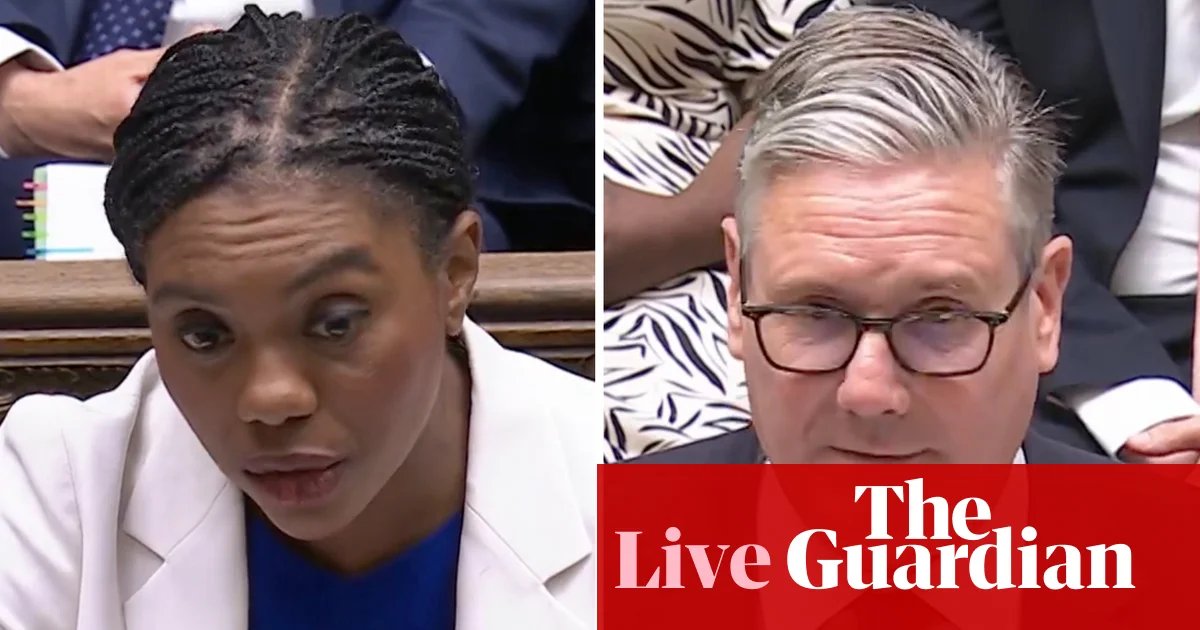
Badenoch urges Burnham to condemn defence investment plan
Badenoch says the government is facing a moment of danger unlike anything seen when they were in power. She says Burnham should come out and condemn this plan if he does not want to be seen complicit in it. If Labour cannot defend the country, what is the point of them?
Starmer says the Tories won’t defend their record, because they can’t. And they won’t apologise either. They sit their pretending it won’t happen.
He says NHS waiting lists are falling at their fastest rate for 17 years.
Key events
Ed Davey, the Lib Dem leader, says the wars in Ukraine and Iran show the threat from drones. The UK needs the best possible missile defence system. But the Dip plans fall short. Why has the PM left the UK so vulnerable? And why hasn’t he adopted the Lib Dem plan for defence bonds
Starmer says the Dip gives the UK what it needs to fight now and in the future.
He says he has looked at the defence bonds plan, but they are just borrowing by another name.
And he says Davey sat in a cabinet that cut defence spending by 22%.
Davey says Starmer will share his concern about the way race hate is being normalised by people in this country, including some people in this house.
He talks about a friend of Indian ancestry who had Reform UK activists come to their house and say, under a Reform UK government, their citizenship should be revoked.
Starmer says racism should be called out by all MPs in this country.
He refers to the plaque in the Commons commemorating Jo Cox, and says at a recent event to mark the 10th anniversary of her death he had to say that he did not think the situation had got better over the past decade.
Badenoch urges Burnham to condemn defence investment plan
Badenoch says the government is facing a moment of danger unlike anything seen when they were in power. She says Burnham should come out and condemn this plan if he does not want to be seen complicit in it. If Labour cannot defend the country, what is the point of them?
Starmer says the Tories won’t defend their record, because they can’t. And they won’t apologise either. They sit their pretending it won’t happen.
He says NHS waiting lists are falling at their fastest rate for 17 years.
Starmer says budget headroom will enable government to fund £5bn black hole in defence investment plan
Badenoch says Lord Dannatt, the former head of the army, said yesterday the plan was inadequate. She says Badenoch. is in this mess because he would not cut welfare. The only way to get the money is to increase taxes, increase borrowing or cut welfare.
Starmer says the last budget had more than £22bn of headroom. That gives the government the abillity to take these sorts of decisions. He says the Tories do not understand that because they lost control of the public finances.
Starmer won’t confirm that Burnham has agreed to fund defence investment plan
Badenoch says the funding should have been in the last budget. She quotes from the Times criticising the defence investment plan.
And she asks again if Burnham knew about the £5bn black hole.
Starmer says he won’t take lectures from Badenoch on this. They hollowed out the armed forces. The Tories are just trying to pretend their 14 years in power did not happen.
He says any Labour PM would stand behind this plan.
Starmer accuses Badenoch of ‘faux outrage’ over £5bn shortfall in defence investment plan funding
Badenoch says the chief of the defence staff is an honourable man making do with very little. Poland and Germany have increased defence spending. And Russia is spending 10% of GDP on defence.
Has Andy Burnham agreed to fund the £5bn shortfall?
Starmer says the Tories cut defence and increased welfare spending by £88bn.
He says he has found £15bn more for defence outside a budget and outside a spending review.
He says the last Tory government announced an NHS investment plan, while saying they would explain the funding at the next budget. He accuses Badenoch of “faux outrage”.
Badenoch says this settlement is not fair for our troops.
John Healey said, when he resigned, that he was having to take decisions that would make the country less safe. How can the PM stand there and say this is enough?
Starmer says this is the biggest upgrade to defence capacity since the 1980s. He quotes the defence chiefs welcoming it, and the Nato secretary general too. He says the Tories cut defence spending. He has boosted defence spending, he says. The Tories missed recruitment targets. Labour has put defence pay up, he says.
Kemi Badenoch says she agrees with Starmer about Venezuela – and the Lib Dems.
She says the armed forces said they needed £28bn for defence. Why is Starmer only giving them half of that?
Starmer says the government is making a record investment in defence. It is what is needed to keep the country safe.
Al Pinkerton (Lib Dem) says a site chosen for a hospital relocation in his Surrey Heath constituency is unsuitable.
Starmer says this hospital is in the front of the queue for new projects. But Pinkerton has demanded a new hospital while objecting to the site. He says Pinkerton complained the new site would remove a golf course. He jokes that demanding a hospital but standing up for golf courses is very Lib Dem.
Keir Starmer starts by saying MPs are thinking of the people of Venezuela.
He says Sunday marks the 70th anniversary of the NHS. He says waiting times are falling, and he welcomes the deal with resident doctors on pay.
Burnham ‘a true patriot’ who will keep the country safe, says defence secretary Dan Jarvis

Dan Sabbagh
Dan Sabbagh is the Guardian’s defence and security editor.
Andy Burnham is a “true patriot” who will provide the money needed to maintain Britain’s security when he becomes prime minister, the new defence secretary, Dan Jarvis, said on a visit to a factory in Cambridge today.
Speaking a day after publication of the defence investment plan, Jarvis insisted the UK would meet a Nato commitment to lift defence spending to 3.5% of GDP – and that the prime minister-in-waiting would help. He said:
I’ve known Andy Burnham for more than 15 years, he is a true patriot, and I absolutely believe that he will make sure that we have the resources that we need to field the kind of capabilities that are required given the nature of the world that we’re operating in.
The minister added the UK had made “an ironcast” commitment to Nato allies to spend 3.5% of GDP on defence, and that there needs to be “a trajectory to it” in future years. The spending plan leaves defence at 2.7% of GDP in 2030. He said:
I know what we need to do to keep Britain safe, and I’m absolutely confident that Andy Burnham, as the next prime minister, knows that as well, and we’ll make sure in the context of the next spending review that we’ve got the resources we need to keep the country safe.
The spending plan, agreed after months of cabinet wrangling, leaves the UK over £25bn a year in real terms short of the final target. Concern about the difference led to the resignation of Jarvis’s predecessor John Healey earlier this month.
Starmer faces Badenoch at PMQs
PMQs is starting soon.
Here is the list of MPs down to ask a question.
CMA launches review of early years education and childcare services in England

Sally Weale
Sally Weale is a Guardian education correspondent.
The Competition and Markets Authority (CMA) has launched a review of early years education and childcare services in England, amid concerns about the hidden costs parents face, pressures on nurseries and the growing presence of private equity providers in the market.
It follows a request by education secretary Bridget Phillipson who expressed her concerns in an article in the Guardian in May that too many parents are still not feeling the benefits of the government’s £9.5bn investment in funded childcare.
She wrote:
The vast majority of nurseries and childminders are doing a brilliant job – but we have to ask hard questions every time we hear stories of families hit with hidden charges, restricted hours or excessive deposits that bear no relation to what parents are actually paying.
Phillipson also raised concerns about a doubling in the number of nurseries backed by private equity and investment firms. For every £5 spent at an investment-backed nursery in England, she said more than £1 ends up as profit – double what other private nurseries make and seven times more than non-profits.
Sarah Cardell, CMA chief executive, said:
We know how important it is to find affordable providers close to home that parents can trust. But too many families are struggling to find the right place at an affordable price, with providers also under real pressure.
We’re going to take a close look at where change may be needed as part of our commitment to support economic growth and household prosperity, so the system works well for families and providers alike.
Neil Leitch, chief executive of the Early Years Alliance, which represents 14,000 childcare providers, said:
For all the positive rhetoric on the importance of the early years, the fact is that sustained underfunding – across successive governments – has left far too many settings with no choice but to raise fees and prices or risk permanent closure, while many families still face a postcode lottery when it comes to finding early years places.
There are more than 53,000 childcare providers in England, providing an estimated 1.6bn places for children aged 0-4 in a sector with an estimated annual value of £14bn to the economy. The CMA findings will inform a wider government review of childcare provision.
For more on private equity, this Guardian explainer launched earlier this week on the impact private equity has had in the veterinary medicine sector is excellent.
Swinney says Burnham wrong to say people in Dundee feel as distant from Holyrood as they do from Westminster
John Swinney has rejected Andy Burnham’s claim that parts of Scotland feel as distant from Holyrood as they do from Westminster, the Press Association reports.
In his speech in Manchester on Monday, Burnham, who is set to become PM later this month, said:
[The work of No 10. North] will be about offering new opportunities to extend devolution in Scotland, Wales and Northern Ireland by taking power deeper down.
The people of Dundee and Bangor feel just as distant from Holyrood and the Senedd as they do from Westminster.
Asked about this comment, Swinney told the Press Association:
I don’t agree with them that areas feel distant from Holyrood.
The city of Dundee just re-elected SNP members of the Scottish parliament and the Labour party got terrible results in the city.
I don’t really think Andy Burnham is in a strong position to lecture me about all of these questions.
I think rather than offering us these polemics, if Andy Burnham is going to become the prime minister, he should have a substantive discussion with the Scottish government and me about how we empower and strengthen the powers of the Scottish parliament …
He’s spent years telling us that Whitehall doesn’t work, that Westminster is broken, and that means he’s got to devolve more powers to the Scottish parliament, and in that respect, I’ll be a willing partner in making sure that’s the case.
Swinney also said he did not want to see elected mayors in Scotland.
What I agree with is having empowered and strong local authorities, as we have in Scotland. I want to make sure they’ve got more power and more scope to increase economic performance in individual localities.
Andy Burnham has not yet become PM, but already the rightwing papers are exploring how best to present him negatively in the eyes of their readers.
Yesterday the Daily Mail splashed on a story saying Burnham wants “to run Britain part-time from Manchester”. The 10-word intro managed to simultaneously imply that Burnham would be working from home a bit, not fully committed to the job, and anti-London.
Today the Telegraph has got an even more ingenious line of attack. It is running a headline saying: “Burnham could ‘turbocharge North-South house price divide’.” The story says house prices are growing at 3.9% in the north and north-west, compared to just 0.1% in the south-east, and it quotes someone from a property search company saying: “A huge injection of government spending into the north could create a Burnham bounce that accelerates northern price growth further.” While this sounds like a grave injustice to homeowners in the south (where Telegraph readers live), they might have been reassured if the article had included figures showing that house prices on average are far higher in the south than in the north. Burnham’s political project is all about reducing that divide, not turbocharging it.
Andy Burnham’s team is “properly furious” about the £5bn black hole in the funding for the defence investment plan, according to Sam Coates from Sky News. On his podcast this morning, Coates said:
I am old enough to remember when Rachel Reeves and Keir Starmer came into government complaining from every hilltop that the Tories did just similar by cutting budgets and failing to fully fund them.
It’s no wonder that Team Burnham are, for the first time in this transition I think, properly furious, right? They’ve really avoided briefing until now, but it was made clear to me yesterday they are cross about this because they didn’t know and it’s a big headache.
To be fair, compared to some of the other budget and public policy problems facing a Burnham administration, having to find £5bn over four years (it’s a cumulative figure, not an annual figure) may not be welcome but it’s hardly the biggest challenge they will be facing.
Housebuilding in Scotland at lowest level for almost a decade, figures show

Robyn Vinter
Robyn Vinter is a Guardian reporter covering Scotland.
Housebuilding in Scotland is down to its lowest level in nearly a decade, official figures show.
Apart from 2020-21, when Covid impacted housebuilding, completions were the lowest since 2016-17, Scottish government statistics show.
A total of 17,268 new homes were built, and 14,955 homes were started in Scotland in 2025-26, a 10% and 4% drop respectively on the previous year.
Critics have said at the current rate of progress, the Scottish government’s target to deliver 110,000 affordable homes by 2032 will be missed by a significant margin.
Scottish Labour housing spokesperson Mark Griffin said:
Scotland’s housing emergency is causing misery for families all over the country and this fall in housebuilding will fan the flames of the crisis.
The Lib Dem MSP Morven-May MacCallum said the “chopping and changing of housing policy must end”. She added:
Too many Scots have nowhere to live or are paying through the nose. Housebuilding is going in the wrong direction and this needs to change.
Announcing spending plan while deferring saying where all money coming from ‘not unusual’, says minister
Luke Pollard, a defence minister, has been giving interviews this morning. Speaking to Times Radio, he defended the government’s decision to defer explaining how around one third of the £15bn defence investment plan (Dip) will be funded until the budget in the autumn. He claimed that leaving a hole in spending plans like this was “not unusual”.
He said:
We’ve announced a £15bn increase in defence spending, which is a huge boost for our readiness and helps us buy the kit and equipment that we need.
Of the £15 billion extra spending power that we now have, the Treasury set out how £10bn or so of that will be spent … £4.7bn will be set out at the autumn budget. And that’s not unusual for governments to do.
When Rachel Reeves announced a U-turn on the winter fuel payments cut last summer, costing £1.25bn, she also put off explaining how it would be funded until the budget later in the year.
In his interviews Pollard also declined to comment on reports that Andy Burnham and his team were not told about the £5bn black hole in the plans until the figures were published yesterday. Pollard told the Today programme that he only saw details of how the £15bn would be raised yesterday, and that he was “not involved” in the talks with the Burnham operation.
Burnham is expected to become PM in just under three weeks.
Ministers ‘furious’ over cuts to road projects to fund defence plan
Here is Jessica Elgot’s story about the backlash over the proposed road scheme cuts that will part-fund the defence investment plan.
Starmer to take penultimate PMQs as he faces backlash over ‘poisoned chalice’ defence investment plan
Good morning. Yesterday Keir Starmer published the defence investment plan (Dip), which was probably the last substantial announcement of his premiership. Today he is facing what will probably be his second last PMQs (he is expected to be at the Nato summit next Wednesday, and he’ll have his swansong on 15 July), and the session is likely to be dominated by complaints about the Dip.
Broadly, there are three distinct criticisms.
1) ‘It doesn’t raise defence spending by anything like enough.’ This is what military chiefs (in private) and retired military leaders (on TV) have been saying for ages. Yesterday the Institute for Fiscal Studies in effect agreed. In a briefing, it said the rise in defence spending under Labour had been “substantial”. But the problem is that last year, under pressure from Donald Trump, Keir Starmer and other Nato leaders committed to raising defence spending to 3.5% of GDP by 2035 and, as the IFS explains, despite the increase announced yesterday, there is as yet no credible path to get there.
2) ‘It is not even properly funded.’ As Kiran Stacey and Dan Sabbagh explain in the Guardian’s splash story, the Dip amounts to a £15bn spending increase – but there is as yet no explanation as to where the money will come from to fund almost £5bn of this.
That is a problem for Andy Burnham, who was not briefed on the black hole ahead of the publication of the Dip yesterday, and for his chancellor. Last night Liam Fox, the former Tory defence secretary, said that Starmer was leaving a “poisoned chalice” for his successor.
3) ‘And the bits that are funded are in part funded by cuts that are not popular.’ Some of the Dip is being funded by the cancellation of road projects, and this has angered Labour MPs whose constituencies are affected. Hamish Falconer is a Foreign Office minister, and normally ministers don’t criticise government decisions in public. But he is also MP for Lincoln and last night he posted a message on social media saying he was “disappointed” by the threat to the A46 Newark bypass widening scheme. In the Commons Jonathan Davies, MP for Mid Derbyshire, said shelving the A38 Derby Junctions scheme would be “a brake on economic growth”. And last night Claire Ward, the Labour mayor for the East Midlands, complained her region was disproportionately affected. She told the the Cathy Newman Show on Sky:
What I’m complaining about today is that the East Midlands would appear to be the only region that has been told it is sacrificing its road investments programme in order to be able to contribute to the Dip.
Here is the agenda for the day.
9.30am: MPs hold a debate in Westminster Hall on the case for banning MPs from having second jobs.
Morning: Dan Jarvis, the defence secretary, is on a visit in Cambridgeshire.
Noon: Keir Starmer faces Kemi Badenoch at PMQs.
2.15pm: Police chiefs give evidence to the joint committee on human rights on the policing of protests.
If you want to contact me, please post a message below the line when comments are open (between 10am and 3pm), or message me on social media. I can’t read all the messages BTL, but if you put “Andrew” in a message aimed at me, I am more likely to see it because I search for posts containing that word.
If you want to flag something up urgently, it is best to use social media. You can reach me on Bluesky at @andrewsparrowgdn.bsky.social. The Guardian has given up posting from its official accounts on X, but individual Guardian journalists are there, I still have my account, and if you message me there at @AndrewSparrow, I will see it and respond if necessary.
I find it very helpful when readers point out mistakes, even minor typos. No error is too small to correct. And I find your questions very interesting too. I can’t promise to reply to them all, but I will try to reply to as many as I can, either BTL or sometimes in the blog.