dailynewsnblog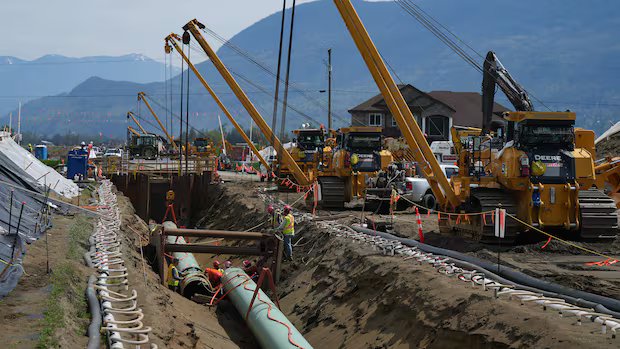
Pipeline announcements seem to be in abundance at the moment, with ambitions to see more Alberta crude flowing both east and west.
But whether or not these plans are realized, the reality is that boosting Canadian oil and gas production will mean more emissions to further warm our already overheated planet.
Ontario Premier Doug Ford joined his Alberta counterpart at the Calgary Stampede on Monday to unveil the proposed route for a pipeline to carry 500,000 barrels of Alberta crude to refineries in southwestern Ontario.
That was just days after Smith was standing alongside Prime Minister Mark Carney, also in Calgary, to announce a planned route for another oil pipeline from the Alberta oilsands to transport more than a million barrels a day to British Columbia’s South Coast.
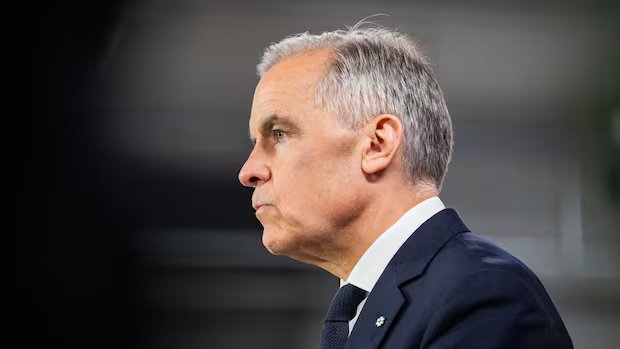
Carney says the choices being made now to secure “Canada’s energy future” will certainly increase the country’s carbon emissions in the “next few years.”
But as decision makers promote planned pipeline developments as key to economic prosperity, energy security and national unity, experts say producing more oil to burn will come at a greater cost to the climate and Canadians.
“We see Canadian communities being threatened by increasingly severe climate change effects,” said Rick Smith, president of the Canadian Climate Institute. “These effects are also going to get worse year over year.”

Alberta and Ontario’s premiers have unveiled the proposed route for a 3,300-kilometre pipeline that would transport oil from Western Canada to refineries in southern Ontario. The Northern Shield energy corridor would start at Hardisty, Alta., pass near Regina and Winnipeg, and end in Sarnia. What’s still unknown are an estimated price tag, timeline and details about whether private investors are involved.
More ‘fuel on the fire’
Even after they are approved, it would be several more years before oil is flowing in either direction.
By that point, average global surface temperatures are expected to have surpassed 1.5 C above pre-industrial levels, a threshold seen as a tipping point to limit further weather extremes.
Caroline Brouillette, executive director of Climate Action Network Canada said we’re already nearing that benchmark, with 2026 on track to be one of the hottest years on record along with the past three years.
She notes that Carney referred to “biblical weather in Ottawa” that delayed his announcement with Premier Smith as parts of Ontario, Quebec and Atlantic Canada were in the grips of a heat wave.
And like the scorching heat still hitting Europe at the same time, the extreme temperatures were a result of fossil fuel-driven climate change.

“It is not a problem for later. It is a problem that is here and now, and we need to stop literally pouring more fuel on the fire,” Brouillette said.
Scientists with World Weather Attribution say that heat this severe would be “virtually impossible” without the level of greenhouse gas emissions in our atmosphere and that “a rapid phase out of fossil fuels is critical” to prevent even hotter temperatures.
The consequences of that are deadly.
More than 40 deaths in the U.S. have been attributed to last week’s heat wave, while at least 3,700 excess deaths — so far — have been recorded since last month’s historic heatwave. Those numbers are only preliminary and could rise further.
What On Earth24:07Heat is killing us. Is air conditioning the only fix?
As Europe tallies thousands of deaths, there are calls for way more AC. In North America, where a heat dome is disrupting holidays, air conditioning is common — but it can also contribute to inequity and emissions. As a Chief Heat Ambassador, Jane Gilbert is grappling with this paradox. She shares ways to protect lives as climate change heats our world.
A path to lower emissions?
Carney, in his June 30 video, acknowledged “climate change is worsening” but said there is a need for Canada to also be a part of a solution to the global energy crisis — and that includes being a reliable source of fuel.
“The truth is nobody knows how long the global economy will rely on conventional energy. But while it does, as much of that energy as possible should come from Canada,” Carney said.
That oil, he stated, should be “produced responsibly” and with “a clear focus of lowering emissions over time.”
Canada’s oil and gas sector already accounts for 30 per cent of the country’s emissions, which Brouillette points out is a proportion that continues to grow while other sectors are decreasing.
That accounting does not include the emissions produced when Canadian oil is exported and burned overseas.
Carney has tied the Alberta pipeline agreement to the advancement of the Pathways Project, a proposed carbon capture, utilization and storage (CCUS) development that would aim to transport and store 16 million tonnes of CO2 a year from the oilsands by 2045.
What On Earth4:27EXPLAINER: Carbon capture in a nutshell
Soon-to-be former Liberal MP Stephen Guilbeault, who quit Carney’s government over its “backsliding” on climate action, says that even if Pathways gets realized — which he doesn’t think will ever happen — it won’t “change the equation” when it comes to fighting climate change.
“There’s nothing in the announcement … that gives anyone any confidence that it’s going to be more than just talking,” he said.
The Canadian Climate Institute’s Smith adds that it was the oil and gas sector itself that came up with the original concept for the Pathways Project but that, even if it can make a dent in curbing emissions, the corporations will need to “put their money where their mouth is” to make it happen.
“The Canadian oil and gas industry repeats literally on a daily basis that it wants to be the greenest oil and gas industry in the world,” he said. “If that is the industry’s own objective, it needs to get a move on in making that a reality.”

Alberta has formally submitted a proposal to Ottawa’s major projects office for an oil pipeline that will travel through southern British Columbia. Power & Politics hears from Quebec Liberal MP Steven Guilbeault, the country’s former environment minister, about his concerns over the toll this new pipeline could take on both the planet and the Canadian people.
What about oil demand?
The Alberta government insists the global demand for oil “will remain strong for decades,” particularly in Asian markets, and that more pipelines will allow more the province’s oil and gas to be exported.
The International Energy Agency, in its most recent World Energy Outlook published in November, forecast global oil demand could keep growing until at least mid-century under current policies.
But if governments were to stick with stated policies that include growing reliance on renewable sources of energy and increasing electrification, the IEA forecasts oil consumption peaking in 2030 and then dropping thereafter.
Rick Smith thinks it’s a “bad bet” to assume there will be a desire for increased Canadian oil and gas by the time either of these proposed projects would be operational — if they’re even built at all.
“Our thinking as Canadians that the world is going to be in for some ever-increasing appetite for our oil and gas over the next few decades is just completely wrong,” he said.
He says sales of battery-operated electric vehicles going “bonkers” globally — due in part to lower prices and financial incentives, as well as the higher price of oil — while alternatives are outpacing conventional fossil fuel-powered energy sources like oil, gas and coal.
Smith’s encouraged by what may have gotten missed in Carney’s Forward Guidance video, saying the prime minister offered a “very exciting vision for clean electricity,” which includes bolstering low-emitting energy sources like hydro, wind, solar and nuclear power.
But, he said, “far more political capital” is focused at the moment on the development of conventional fossil fuel energy sources.
“[It’s] far better for us to face up to what’s actually happening in the world and to start doubling down on another natural Canadian advantage, which is clean electricity,” he said.

China is the world’s undisputed EV leader, making up 70 per cent of of global production. CBC’s Lisa Xing breaks down what’s driving its market dominance and what it could mean for Canada as it prepares to open the door to Chinese-made EVs.