dailynewsnblog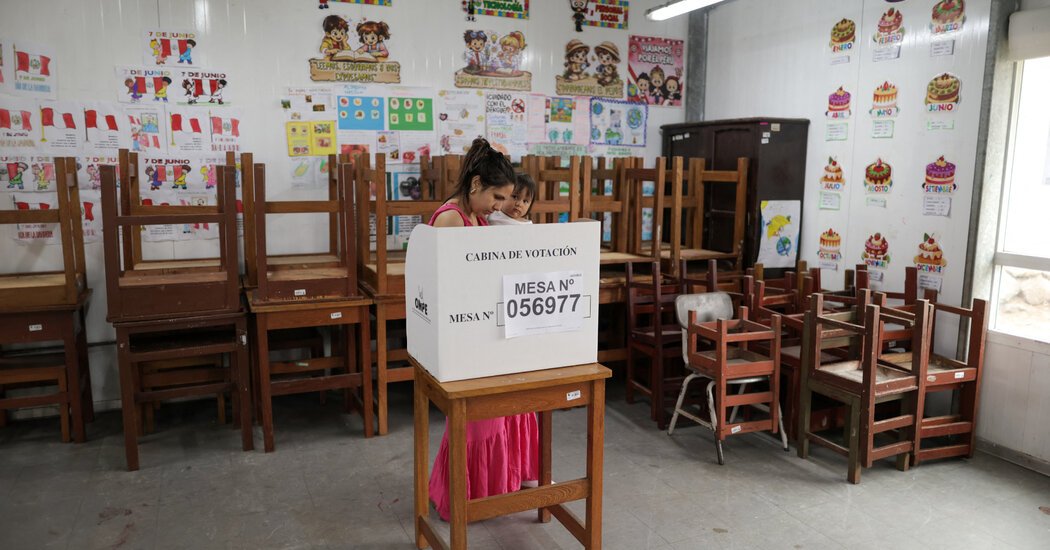
Peru’s presidential runoff Sunday was too close to call as preliminary results came in, setting the stage for days or potentially weeks of counting. An exit poll showed the two candidates locked in a statistical tie, though the conservative candidate, Keiko Fujimori, had a slight edge.
The race pitted Ms. Fujimori against Roberto Sánchez, a leftist lawmaker and political heir to a jailed former president, Pedro Castillo. Ms. Fujimori’s father was Alberto Fujimori, an authoritarian president in the 1990s who was credited with dismantling brutal leftist rebel groups, but at the cost of unraveling Peru’s democracy.
Mr. Sánchez spent the campaign’s final weeks pivoting toward the center as he sought to court undecided moderates. He promised to maintain fiscally responsible policies, protect private property and preserve the central bank’s autonomy.
Ms. Fujimori, by contrast, catered to her right-wing base as a tough-on-crime candidate, and framed Mr. Sánchez as a communist and a would-be authoritarian who would torpedo private investment.
The race comes as an anti-incumbent wave shifts Latin America toward the political right Law-and-order governments have already transformed Argentina, Bolivia and Ecuador.
As polls closed in Peru, the exit data, published by the firm Ipsos, showed an electorate deeply split along geographic lines. Ms. Fujimori held a commanding lead in urban centers, while Mr. Sánchez dominated the rural electorate.
The official count, with less than 24 percent of the vote counted, showed Ms. Fujimori in the lead with 53 percent and Mr. Sánchez with 47 percent, but it did not yet reflect balloting in Sánchez strongholds.
Speaking Sunday night after Ms. Fujimori took the lead in some preliminary results, Mr. Sánchez called for calm, and for respect for the official results. But he also urged his party monitors to remain vigilant.
“We believe, with much enthusiasm, that it is the job of our party monitors to defend the vote of deep Peru,” Mr. Sánchez said.
Electoral officials said at a news conference that the final audited count would take about a month to complete, raising the possibility of an extended period of political instability.
The tensions surrounding the vote set off fears of voter suppression Sunday morning after isolated reports of pre-marked or damaged ballots emerged. Left-leaning social media accounts said that ballots pre-marked for Ms. Fujimori had surfaced in an affluent Lima suburb, while right-wing networks said ballots rigged for Mr. Sánchez had been found in the rural highlands.
Peru’s independent civil rights office briefly escalated anxieties by calling the irregularities an “attempted fraud” before reversing course hours later to say that the flawed ballots had affected only about 20 polling booths nationwide with no adverse impact on the vote.
Seeking to project an image of control at a Sunday afternoon news conference, Peru’s top electoral officials rejected the possibility of systematic fraud and said a handful of isolated irregularities had been quickly resolved.
The head of the attorney general’s office on crime prevention Alfonso Barrenechea told local news media that 7,000 representatives were policing the vote. He said that the system’s guardrails had successfully handled localized threats, and that investigators had intercepted and replaced between 60 and 90 manipulated ballots at 12 polling stations nationwide.