dailynewsnblog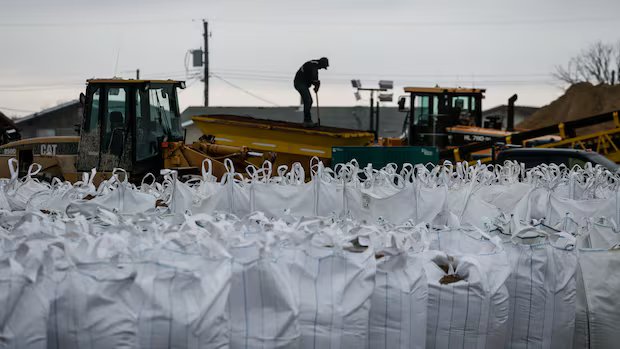

Listen to this article
Estimated 5 minutes
The audio version of this article is generated by AI-based technology. Mispronunciations can occur. We are working with our partners to continually review and improve the results.
Two First Nations in Manitoba’s Interlake region have declared a state of emergency ahead of a potentially devastating flood.
Peguis First Nation Chief Stan Bird announced the community will be taking the step in a video posted to social media Saturday afternoon, saying evacuations will be required with flooding set to begin within days.
“Based on information this morning, the flood risk is now a certainty,” Bird said in the video, adding that the latest forecast predicts a flood similar to one that caused the evacuation of more than 1,000 people in 2022.
“While there is uncertainty regarding when we will be overcome by the rising water, flooding will be extensive,” he said.
Northeast of Peguis, Fisher River Cree Nation also declared a state of emergency. A band council resolution issued Saturday evening said conditions could result in road closures and potential power outages, putting the First Nation at risk.
Before the announcement, Chief David Crate told CBC News that the community was preparing to evacuate some residents.
“We have a 32-bed personal care home here,” he said. “Through our health unit here, we have a number of individuals that are on dialysis. Those individuals will be evacuated from the community when it’s time.”
Premier Wab Kinew said while visiting Peguis earlier this week that the province’s Hydrologic Forecast Centre believe a late-season storm will cause the Fisher River to overflow this coming week.
The province had warned there was a high risk of flooding in the Fisher River basin, with warming temperatures set to melt the snow.
The state of emergency declarations come as work to protect homes and other buildings from the flood in both communities continues.
In Peguis, hundreds of people, including residents, contractors, volunteers and provincial staff members have been working around the clock this past week, with the leadership saying more than 200 homes needed protection ahead of the spring runoff.
“It is absolutely essential homeowners allow the crews to complete the protective work required,” Bird said in the video.
“If flood protection is denied by homeowners, there’s a strong likelihood crews will not return.”

Peguis, which is about 160 kilometres north of Winnipeg, has nearly 4,000 registered members living on reserve, according to federal government figures.
Bird said Saturday Peguis is finalizing implementation of an evacuation plan, which will be shared with the community once it’s complete.
“Emergency numbers will be provided,” he said. “The registration process will be very clear, and there will be a point of contact in the various evacuee locations, everything we can possibly think of … to ensure we avoid the chaos and pandemonium.”
The First Nation’s multiplex has been set up to work as an emergency co-ordination hub and evacuation centre, being able to house about 300 people according to officials.
“It is important that you do not panic and overwhelm the flood centre with calls,” Bird said.
Fisher River Cree Nation prepares for evacuations
Per Fisher River Cree Nation’s state of emergency declaration, sandbags and dams were being set up around flood-prone homes and infrastructure within the community, which has about 1,500 members living on reserve.
Crate said about 40 residences in the First Nation need flood protection, some of which have already been secured with sandbags.
The emergency declaration also warns that road access to the community through Peguis may be impacted, potentially limiting access to Fisher River to a single road that will become essential for food and supply deliveries, and to transport people requiring medical care.
Crate said the community has been working to build up that alternate road since the 2022 flood.
“If the Provincial Highway 224 goes underwater through Peguis, which it did in 2022, we do have a secondary road here that we can use,” he said.
Fisher River said the state of emergency will enable them to enforce mandatory evacuations if necessary, also allowing for the mobilization of resources and for accessing emergency funding from the government.
Fisher River’s schools will continue to operate after the state of emergency is declared, Crate said, with leadership deciding later based on the conditions whether they should be shut down.
“We prepare every year, but there’s apprehension every year,” Crate said.
“The unknown, whether or not the flood situation is going to be a severe flood or is it just going to be a minor impact on the community. So yeah, there’s apprehension.”