dailynewsnblog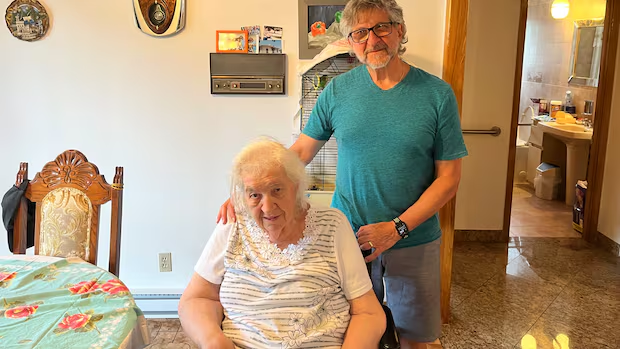
“I need some help.”
That’s the message 93-year-old Rosanna Montesi wants her local public clinic and health authorities to hear.
Montesi’s plea comes after a bad fall at her home in Montréal-Nord on May 12 landed her at the Santa-Cabrini hospital where she was treated for scrapes and bruises.
Montesi fell and hit her head while attempting to go out on her balcony.
“Although she didn’t break anything, she hurt the left side of her body so she has pain in her shoulder, pain in her hip,” said Montesi’s son Tom Ansuini.
Ansuini said his mother was released from the hospital the next day, on the condition that the family arrange for regular home-care visits with her neighbourhood CLSC, which is how government-run clinics are called in Quebec.
Now, more than two months later, the family is still waiting for the Montréal-Nord CLSC to send a social worker to visit Montesi at her home to assess the situation and evaluate her needs.
Ansuini said the requirement was put in place by the hospital because his mother is at risk of falling again and needs help with daily tasks, such as bathing, getting dressed and meal preparation.
“I’m no longer able to do everything the way I used to,” Montesi said.
‘Disappointed and deceived,’ son says
Ansuini said there have been a lot of back-and-forth phone calls with the CLSC, including assurances from co-ordinators that a social worker would be sent to visit the home.
“I am deeply disappointed and deceived in what they promised and what they delivered,” he said. “I am asking that we hurry this process along and that we make it less tedious.”
Paul Brunet, president of the Quebec Council for the Protection of Patients, a non-profit patients’ rights advocacy group, said such a long delay is unacceptable.
Brunet said he was surprised to hear of the situation since CLSCs were ordered “to admit more patients, more elders, more people at home to raise the number of help and home-care services that they were already given.”
In January, Health Minister Sonia Bélanger unveiled the province’s home-care support policy which aims to help Quebecers remain in their own homes for as long as possible — with CLSCs becoming the primary point of entry for services for seniors.
FADOQ, a seniors’ advocacy group, told CBC in an email that it doesn’t comment on individual cases but said the situation highlights the need for more funding, and human resources for home-care services and support.
The Association des médecins gériatres du Québec, the medical association representing specialist geriatricians, said in an email it “deplored the situation.”
The organization said it is concerned with the challenges associated with the needs of an aging population and is working to find solutions to better address those needs.

Montréal-Nord resident Rosanna Montesi fell on her balcony on May 12. A request for home care was sent before she was discharged from the hospital, but her son says they’re still waiting to hear back from the CLSC Montréal-Nord for an assessment.
Wait times can vary from 2 to 90 days, says Santé Québec
In an email statement to CBC News, a spokesperson for Santé Québec said it “understands that wait times can be a source of concern, particularly when the need for home care is identified following a hospital stay.”
Santé Québec said there’s no single average wait time and that it varies depending on the nature and urgency of the user’s needs.
Those needs are assessed by clinical teams, based on criteria established by the Ministry of Health and Social Services for CLSC service requests.
Each request is assigned a clinical priority level on a scale of one to four, which determines the expected response time. The delays can be as short as two days for priority one requests and as long as 90 days for priority four.
Santé Québec added that without knowing Montesi’s full clinical situation and the priority level assigned to her, it couldn’t say whether a two-month wait time was reasonable.
Recourse for patients
In the meantime, Ansuini said he is doing his best to help his mother, but the wait for help is taking its toll.
Ansuini said he used the services of a private care company for one week to get some respite, and, despite wonderful service, with a $2,400 price tag, it’s not something the family can afford long term.
“Bottom line is if we could have even a minimum service, it’s a large burden off of our backs. I’m not a caregiver, I do my best,” he said.
His mother acknowledged his efforts, saying Ansuini is “a very good son.”
Santé Québec said the family, or any user that has concerns about the services received or the wait times for care, can contact their facility.
The regional health authority that oversees the Montréal-Nord CLSC said the family can also call the Guichet d’accès au soutien à l’autonomie des personnes âgées (SAPA) to report any changes in the individual’s needs, which will allow for a re-evaluation of the request and, if necessary, an adjustment of the priority assigned to the file.
Brunet also recommended the family reach out to the CLSC’s ombudsman to file a complaint and push for an adequate evaluation to get the care Montesi needs and deserves.