dailynewsnblog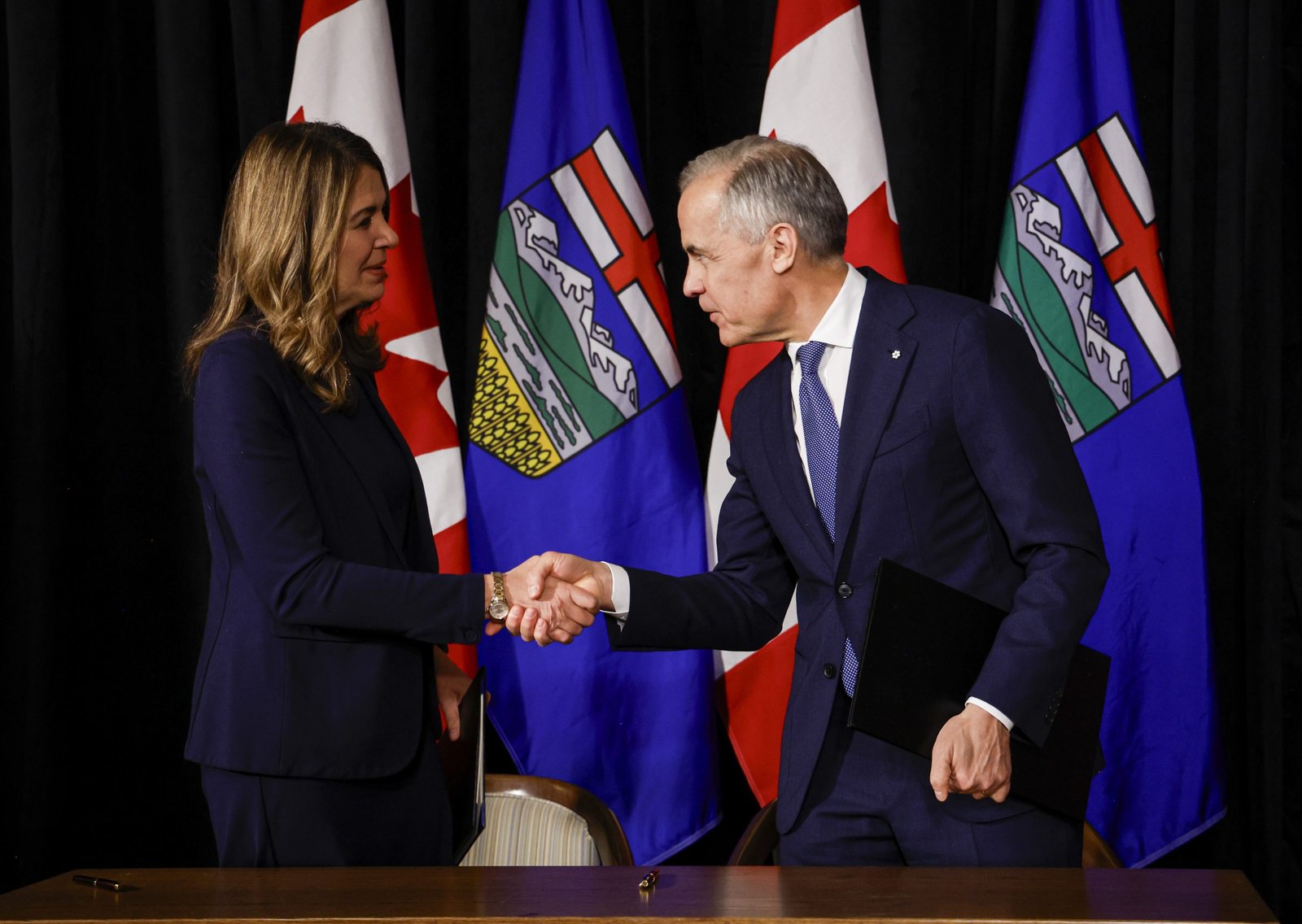
The agreement on carbon pricing is designed to encourage investment in the massive carbon capture project Pathways plus.
Prime Minister Mark Carney and Alberta Premier Danielle Smith have signed a deal on carbon pricing that injects much-needed certainty into carbon markets throughout the country.
Alberta has agreed to implement a minimum price for carbon credits that trade on the market starting in 2030. In turn, the Carney government has agreed to significantly roll back the previous “headline” prices.
Headline prices are typically much higher than the prices at which carbon credits actually trade for. A big part of the negotiations entailed looking at ways Alberta could fix its market.
Under the deal, the headline price on carbon in Alberta will increase to $100 per tonne next year, escalating to $115 in 2030, to reach $140 in 2040.
That price floor Alberta intends to apply will be much lower than the “headline” price, starting at $60 in 2030 to hit $110 by 2040.
During a technical briefing, a government official told reporters Ottawa expects the market will trade somewhere between Alberta’s minimum price floor and the federal headline price.
The deal also states that Canada will ensure the updated federal carbon pricing benchmark is consistent with the content of the agreement. This signals that the headline prices in the Alberta deal could apply to other provincial jurisdictions like Saskatchewan.

The government officials during the briefing could not say how this carbon pricing framework would translate into emissions reductions.
Modeling by the Canadian Climate Institute suggests the timeline and prices laid out in the agreement are unlikely to slash emissions.
Bringing certainty
But the agreement achieves a great degree of certainty for the market through carbon contracts for difference and by accounting for how various court challenges could play out.
Ottawa and Alberta are putting $600 million each on the table to help support carbon capture projects between 2030 and 2040.
These contracts for difference guarantee a fixed carbon price, shielding industry from policy shifts or legislative changes.
Whether $600 million will suffice remains questionable. This figure represents only a fraction of the projected $22 billion cost for Pathways—especially considering that Entropy, the only other firm to secure a federal contract for difference, received $200 million in 2023 for a much smaller scope.

Under the deal, Ottawa says it will foot Alberta’s share of the liabilities if the GHG pollution pricing act is repealed. Similarly, should Alberta repeal its carbon market legislation, or fail to live up to its commitments, it would assume the federal government’s share of liability.
The carbon market is designed to improve the economics of the Pathways carbon capture project, which is tied to the approval of a new pipeline under the terms of the Alberta-Ottawa energy agreement.
Carney reiterated the condition during a press conference on Thursday: “No pathways, no pipeline.”
A new version of Pathways?
The agreement released Friday, however, suggests that the scale of the Pathways project could be reduced significantly.
The project was initially described as having the potential to capture up to 40 megatons annually by 2050, but the agreement now outlines a three-phase timeline to reach 16 megatons.
In one stage, the target drops to 6 megatons, allowing companies to source the 10 more megatons through alternative methods.
Government officials said the construction of the new bitumen pipeline could begin in 2027, but no similar timeline can be guaranteed for Pathways.
Alberta, Canada and the major oil sands producers are expected to keep trilateral negotiations going in weeks to come.
More to follow…