dailynewsnblog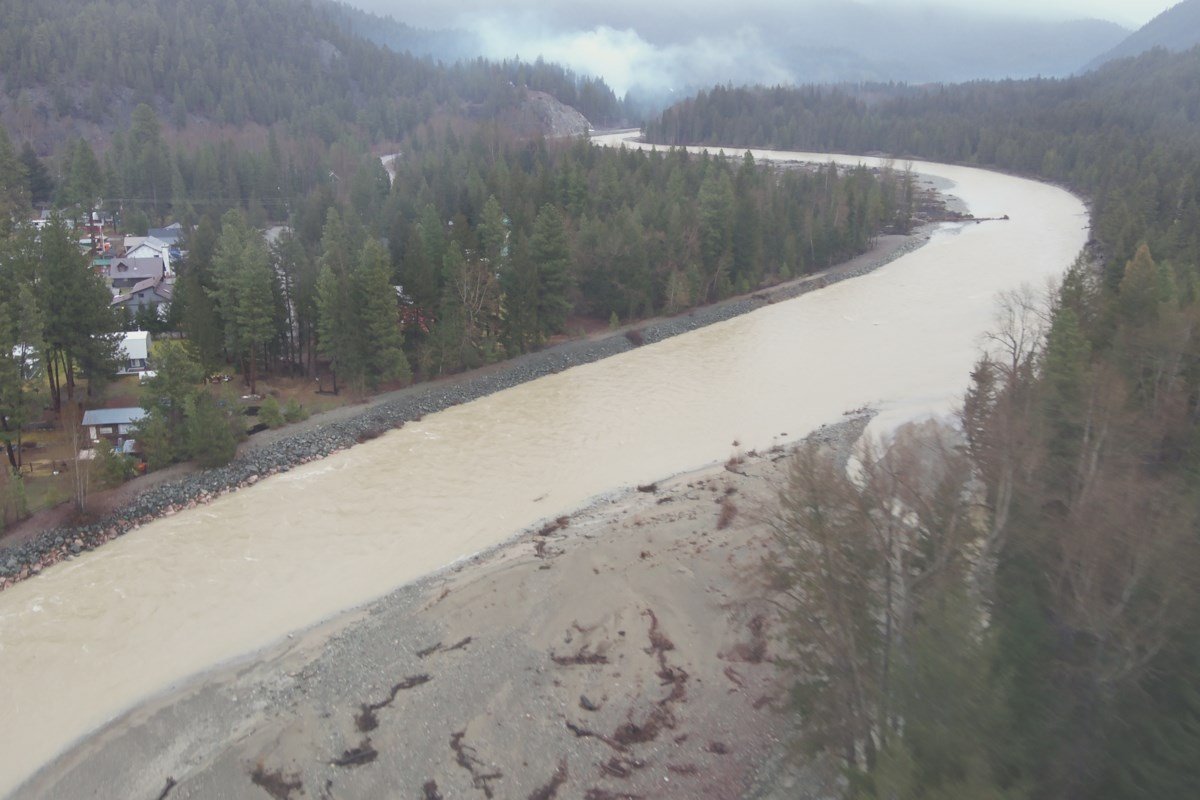
New modelling suggests Tulameen’s remaining flood defence could be overtopped as climate-driven storms intensify
B.C.’s rivers were already full when, in only 48 hours, a tropical band of moisture dropped a month’s worth of water on the province.
South of the Coquihalla Highway, the Tulameen River swelled. By the time it reached the community of the same name, it was carrying almost double the water that carved the Colorado River’s Grand Canyon.
The results were catastrophic: as the river burst its banks, it washed away flood defences, sinking 400 homes under metres of water.
In the nearly five years since the November 2021 floods, emergency officials like Tulameen fire chief Jody Woodford have spent countless hours managing smaller disasters, all while planning for the next big event.
“It’s just a totally different climate now. It’s scraping mountains and hillsides away,” she said. “We’re just at the whim of Mother Nature.”
The prospects of preventing another disaster are daunting. Today, a single stretch of dike a few hundred metres long is the community’s primary surviving flood defence.
Substandard and completely unmaintained, the barrier is what is known as an “orphan dike”—a piece of critical flood infrastructure trapped in a total governance vacuum. No local, regional, or provincial government authority claims ownership over it. And like another 105 unmanaged dikes across B.C., nobody is funding its repair.
The situation prompted the Regional District of the Okanagan-Similkameen to commission flood modelling in 2025. Carried out by TRUE Consulting, the results suggest there is a high chance rains driven by climate change will eventually slam into a bend in the Tulameen River and overtop the town’s remaining dike.
By 2041, a one-in-200-year flood event is projected to fill the Tulameen River with more water than it saw in 2021. And by 2071, worst-case scenario storms could more than double that flow.
Once breached, floodwaters are forecast to cut a path from the dike directly through the townsite, putting nearly everything underwater—the fire hall, hockey rink, local gas station and store, community centre and the hundreds of homes that would no longer be protected.
Just as the peak floodwaters recede, a delayed second wave of flooding is expected to come from Otter Lake to the north. At first, the waterbody is expected to act like a buffer, absorbing runoff from the Coquihalla and other watersheds. But eventually, modelling shows the lake is overwhelmed. That’s when a second flood wave pushes south, flanking the town under more water.
“It’s very sobering,” said Woodford, the town’s fire chief. “It’s only a matter of time.”
Last month, the regional district’s manager of emergency services, Sean Vaisler, flew over the Tulameen Valley by helicopter. From the air, he noted the scars of recent flooding were still clearly visible.
The old Kettle Valley Rail Trail remains knocked out by landslides. Streams once a foot wide are now four- to six-metre channels, he said. One of the only structures still hanging on is the unmanaged dike protecting Tulameen.
“Every event has compounded,” said Vaisler, pointing to the dike. “If that breaches, it would completely take out the entire community.”
A 23-year governance vacuum
B.C.’s orphan dike problem dates back to 2003, when the provincial government downloaded flood management responsibilities to local governments.
Many of the dikes—often built decades ago under emergency conditions with little planning by private landowners, historical industries or defunct entities—were left in poor condition and without oversight.
Regional districts and small municipalities have repeatedly claimed they lack the immense capital and specialized engineering resources needed to maintain or upgrade the orphaned flood structures to modern standards.
The situation puts thousands of people and billions of dollars worth of property and infrastructure at risk, concluded a 2020 report commissioned by the Fraser Basin Council.

Downstream of Tulameen, major orphaned dikes continue to threaten the towns of Princeton and Keremeos, where experts warn breached defences could trap floodwaters inside the community.
Others are concentrated next to rivers around Kamloops, in the Kootenays, and the Okanagan Valley. As of 2020, the assessment found more than 1,500 structures and $1.1 billion of property were threatened near Kelowna’s Mission Creek.
On B.C.’s central coast, a potential breach of the Thorsen Creek orphan dike near Bella Coola was found to put the Nuxalk Nation at the highest risk of mortality in the province.
Provincial reports from 2002 list at least 11 flood defences in a governance vacuum across the Lower Mainland. They range from a 440-metre structure on the Cheakamus river north of Squamish, to several kilometres of dikes protecting land around Coquitlam, Chilliwack and Cultus Lake.
Two orphan dikes provide B.C. communities direct protection from the sea—one defending up to 50 Port Renfrew-area buildings from a storm surge on Vancouver Island and another protecting a more than three-kilometre stretch of the City of Vancouver.
It’s not clear who built the South Vancouver Sea Dike. City staff said it was likely raised by landowners. Records from the province suggest it was constructed in 1948 in anticipation of a major Fraser River flood.
By 2020, the structure protected over 1,400 residents and $1.7 billion in property—more than any other orphan dike in the province.
An assessment carried out by the city in 2025 revealed multiple sections of the dike are in poor condition and overgrown with vegetation, said Amy Sidwell, the city’s director of sewers and drainage.
“That dike is definitely not to our current standard,” said Sidwell.
Unlike several orphan dikes in B.C., Vancouver has a memorandum of understanding with the province to manage portions of the dike on city property or in areas accessible to staff.
The agreement comes with no funding to maintain the dike, said Sidwell.
A city spokesperson added that the municipality spends up to $30,000 a year to inspect dikes. It also spent another $300,000 on planning and assessments for the sea dike—work that was partially funded by the province.
But those inspections completely miss sections built on private property—which make up more than 40 per cent of the entire sea dike.
Sidwell said Vancouver is prioritizing flood defences along the Fraser River. But it’s also limiting its own liability. In April 2026, the city passed a new flood management policy that only requires it to protect city-owned assets.
“We just don’t have enough funding to be able to protect all private property,” Sidwell said.
A multi-million-dollar liability trap
Liability is at the heart of B.C.’s orphan dike problem, several experts said.
More than five years ago, the Fraser Basin-commissioned study estimated it would cost more than $865 million to buy out land and upgrade all of B.C.’s orphaned dikes.
Today, Vaisler said that number could easily climb fourfold once inflation and detailed project costs are added up. Then there’s the ongoing upkeep of the dikes—for municipalities and regional districts, it’s a cost that would “completely break us,” said Vaisler.
The regional district has turned to local MLAs and MPs, as well as groups like the Union of B.C. Municipalities to advocate on their behalf. Most recently, Metro Vancouver agreed to petition the province to take action.
Currently, local and regional governments are forced to compete for a limited pot of government grant money when they should be working together, said Marcin Pachcinski, division manager in regional planning for Metro Vancouver.
“That’s not the best approach,” Pachcinski said. “Most local governments can barely take care of their own infrastructure.”
‘On pins and needles’
In 2024, the province launched a B.C. Flood Strategy, an ambitious plan that among other initiatives, seeks to find and fund a solution to its orphan dike problem.
Last year, Vancouver Coun. Lisa Dominato, who also chairs Metro Vancouver’s governance committee, met with Randene Neill, minister of water, land and resource stewardship, and Kelly Greene, minister of emergency management and climate readiness.
The ministers had a “sobering” message: there is no new funding for flood infrastructure, said Dominato.
“They pointed to existing grant programs that are already oversubscribed,” she recently told Business in Vancouver. “Having a flood strategy is great, but you really need to have funding behind it.”
Lee Toop, spokesperson for the ministry of water, land and resource stewardship, confirmed the B.C. government has not carried out any assessment of the province’s orphan dikes since the 2020 report.
“There is no estimate on the number of orphan dikes that have been upgraded currently available,” he said in an email.
Back in Tulameen, few are sure who built the community’s orphan dike. Woodford, the town’s fire chief, said local landowners likely piled the rocks up a century ago. Others suggested its origins date back to the mid-1800s when the Hudson’s Bay Company ran a horse brigade to shuttle animal pelts out of the valley.
Whatever the case, today the abandoned structure is a focal point of anxiety, said Bob Coyne, director for rural Princeton’s regional district.
“Every time it rains people are stressed out,” Coyne said. “Every time one of these atmospheric rivers comes, people are on pins and needles.”
Those feelings have been made worse by a cumulative sense that higher levels of government don’t consider small towns a priority, added Vaisler.
The emergency official said the region was given no warning before the floods hit in 2021. When governments did respond, Vaisler remembers watching a 60-vehicle convoy from the Canadian Armed Forces drive by without stopping on its way to the Lower Mainland.
In the years since, Vaisler said B.C. and Ottawa have improved communication, but that without a solution to the province’s orphan dike problem, there’s still a lack of trust among local authorities.
“There’s a lot of things that are going against us here,” said Vaisler.
In Tulameen, that includes no cell phone service. The local fire department has responded by installing Starlink satellite internet connections in their vehicles. The regional district has set up a mass notification system that broadcasts messages across text messages, email and social media.
Now, Vaisler said emergency officials are working on a plan to evacuate Tulameen as fast as possible.
“We can’t go on under the assumption that the abandoned dike system will hold,” said the town’s fire chief. “Everybody would be under water.”
BIV’s free newsletters cover daily business, real estate, B.C. politics and more. Sign up here for B.C.’s most important business news delivered directly to your inbox.