dailynewsnblog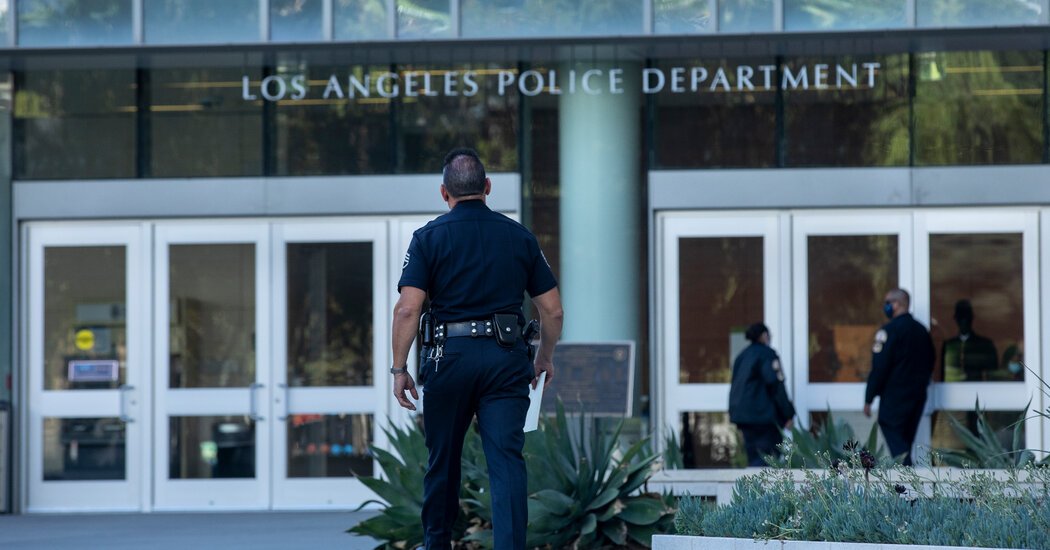
An officer with the Los Angeles Police Department has been charged with violating his colleagues’ privacy after he secretly recorded them making racist, homophobic and sexist comments, the county district attorney announced on Friday.
The officer, Daniel Flores, faces 16 felony counts of eavesdropping on or recording confidential communications. If convicted, he could spend up to 13 years in prison.
“Let me be clear about why this case is important — California is one of only a handful of states that requires consent from everyone involved who might be recorded,” Nathan Hochman, the Los Angeles County district attorney, said in a video statement about the case.
“It does not matter where you work or who you are — a neighbor, a co-worker, in this case a police officer,” he added. “The law in California protects every single person who lives here.”
Mr. Hochman added that his office condemned the remarks captured on the recordings, but he said that “one cannot simply choose to break the law because one wants to pursue a personal agenda.”
Alan Jackson, who is representing Mr. Flores in the criminal case against him, said on Friday that the charges sent a chilling message, not just to employees of the Police Department but to the community more broadly.
“If the D.A. truly believes that exposing bigotry is a personal agenda rather than the duty of every sworn peace officer, we have a profound crisis of leadership,” Mr. Jackson said. “It’s not just terrifying, it is a clear and calculated message.”
The eavesdropping allegations that Mr. Flores faces could have been charged as misdemeanors or felonies.
The charges stem from recordings that Mr. Flores made over the course of 2024, when he was working in a unit of the Los Angeles Police Department that was responsible for recruiting new officers.
In a lawsuit that Mr. Flores filed in June in Los Angeles County Superior Court against the department, he said that he had been with the L.A.P.D. since 2013 and had begun to experience intense stress after his sergeant was replaced by a new supervisor in 2021.
According to the lawsuit, which alleges workplace harassment, the new supervisor “regularly and repeatedly made derogatory statements” about women, gay and lesbian people and people who were Asian, Black or Latino, and encouraged racist, sexist and homophobic discourse within the department. By 2023, Mr. Flores says in the lawsuit, he was so troubled and stressed by the constant hostility that he was becoming physically ill and had to take a medical leave.
Mr. Flores then decided to conduct “what he believed to be a lawful investigation as a police officer” and report his findings to internal affairs, his complaint says. According to the lawsuit, he recorded fellow officers and superiors referring to Black people, women and Asian American candidates in derogatory terms and disparaging gay and lesbian people.
He also, according to the complaint, heard the officers demeaning Latino colleagues as “sweatshop” workers and saying that Fernando Valenzuela, the Mexican-born Dodgers superstar, had died because he “ate too many tacos.” In January 2025, he submitted his complaint to the Los Angeles police commission and the department’s internal affairs unit.
After The Los Angeles Times reported on the recordings last year, the Police Department opened an internal investigation, and the taped remarks were denounced across the board by city leaders.
The police chief, Jim McDonnell, and the police union said that such talk was particularly reprehensible in the aftermath of George Floyd’s murder and the Covid-19 pandemic, as police departments across the nation, rocked by widespread abuse claims, were straining to attract new recruits.
The city’s personnel department opened an investigation into the case’s possible impact on police recruitment, and officials said at the time that several members of Officer Flores’s unit had been ordered to stay at home pending completion of the investigation. The department also opened a separate administrative investigation into Officer Flores over possible policy violations.
On Friday, a spokesman for the department declined to comment on whether and how the officers had ultimately been disciplined, saying that he could not comment on personnel matters. Chief McDonnell expressed appreciation for the district attorney’s “careful review of this matter” and said he supported “the legal process now underway. “
“The L.A.P.D.’s internal affairs division conducted a thorough investigation, identified criminal conduct and presented the facts for filing consideration, as is our responsibility when potential criminal conduct by an employee is discovered,” the chief said in a statement. “I am committed to ensuring the workplace is professional, respectful and free from misconduct, and any employee who violates those standards will be held accountable.”
Laurie Levenson, a longtime Loyola Law School professor, said it was “unusual” that the district attorney had chosen to file felony charges against Mr. Flores.
“It is true that it’s illegal in California to record someone without their knowledge,” she said. But, she said, California’s recording restrictions have some exceptions, allowing the police to secretly tape conversations in certain cases if they are acting within the scope of their authority, for example. The law is also less clear if the taping is done in a public area where participants might reasonably expect to be overheard.
“What the district attorney is saying is that two wrongs don’t make a right,” Ms. Levenson said. “Even though he deplores the remarks of the L.A.P.D. employees being taped, it was still illegal for this other officer to eavesdrop.”
She added, however, that Mr. Hochman had not specified how Mr. Flores might have legally brought the abusive language to the department’s attention, or how he might have gathered evidence to prove his claim of workplace harassment.
“I do think there will be a fight over this,” she said.
Mr. Flores is set to be arraigned on Aug. 10.