
 dailynewsnblog
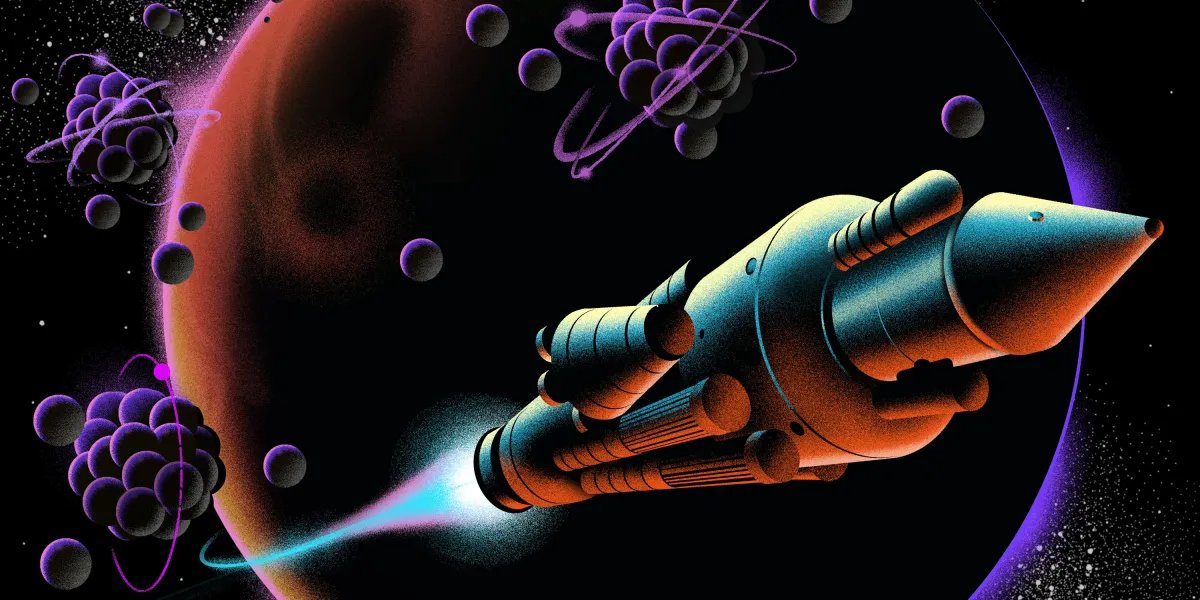
Still, developing space propulsion using reactors has been slow going. The US has started—and terminated—several programs looking into it over the past 75 years. The latest casualty was DRACO, a collaboration between NASA and the Department of Defense, which ended in 2025. The project was canceled because of high experimentation costs, an inability to compete with conventional rocket propulsion on price, and difficulty ensuring that ground tests could be performed safely and effectively. (You are creating an incredibly powerful nuclear reaction, after all.)
The progress
After much wavering, it now appears that nuclear-powered interplanetary travel is a $2 billion bet NASA is willing to make. The agency is pursuing an approach called nuclear electric propulsion, which uses the neutrons produced in a self-sustaining, uranium-atom-splitting reaction to create heat and ultimately electricity. The electricity is used to ionize a gas, which is blasted out of the spacecraft with the help of magnetic fields, generating thrust. The approach “is very low thrust, but very efficient,” says Sebastian Corbisiero, the US Department of Energy’s national technical director of space reactor programs. “So you can use it for a long period of time.”
What might such a rocket look like? A presentation by Steve Sinacore, program director of NASA’s SR-1 program, offers some clues. So far, the concept art makes the craft look like a colossal fletched arrow. The back will house the power-and-propulsion system, while the tip will hold a uranium-filled nuclear reactor with a capacity of at least 20 kilowatts. (For context, a typical nuclear plant on Earth is about 50,000 times more powerful.) The “fletches” on SR-1 are large fins that help cool the reactor by radiating heat into space.
Like many other pieces of space hardware, the reactor will need to be put through its paces on the ground before it’s cleared for the rough rocket trip to space. “Going through the launch safely is going to be a challenge,” says Middleburgh. “You are being shaken, rattled, and rolled.” For safety reasons, the reactor will be switched on around two days post-launch, when it’s comfortably far from Earth. Uranium isn’t tremendously dangerous by itself, but that can’t be said of the waste products that emerge when the reactor is running. If SR-1 works as planned, its journey to Mars will take about a year.
Will this novel form of space propulsion actually reach the Red Planet by 2029? It’s possible. NASA says the Idaho National Laboratory, which is building SR-1’s reactor, is making progress and is on target for a late-2028 launch. “Procurement of major components is underway, and integration work on the power and propulsion element is advancing steadily,” Sinacore told MIT Technology Review. The outlook will get even sunnier if the Artemis program, which aims to start laying the foundations for a base on the lunar south pole by the decade’s end, keeps to its own bold deadline.
“It’s an aggressive timeline,” says Lindsey Holmes, who is vice president of advanced projects at Analytical Mechanics Associates, an aerospace company in Virginia. She suspects the push is being driven partly by China’s and Russia’s own deep-space nuclear ambitions. The two countries have spoken about plans to place a reactor on the moon’s surface in the mid-2030s to power a jointly operated lunar base. Whether it flies or fails in space, SR-1’s development should help NASA put its own reactor on the moon; the technology involved in the two projects is broadly similar, given that the lunar surface, like space itself, is a vacuum. If an interplanetary nuclear-powered spacecraft works, a nuclear reactor on the moon should too.
Progress meter . . . . . . . . . . . . 6

Most of the technology for SR-1 already exists; it’s going to come down to piecing it all together and then seeing how it performs in space.