dailynewsnblog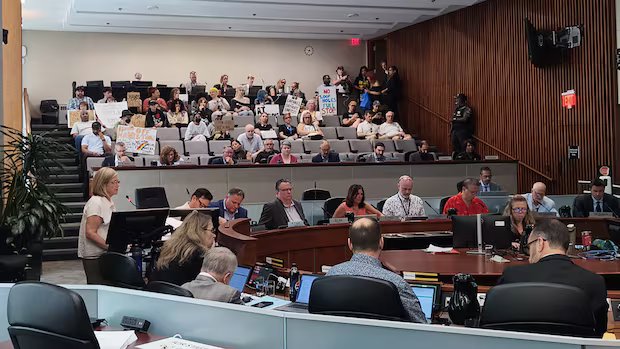
Hamilton won’t be imposing a temporary ban on the development of data centres, council has decided.
The vote was split 10 against and six in favour of what they were calling an interim control bylaw that would have paused development on data centres in the city for one year. Such a ban would have given the city time to assess and develop further governance rules around facilities that house equipment such as network servers, storage drives and information technology (IT).
The bylaw “won’t stand up, it won’t work,” said Coun. Jeff Beattie, who voted against it.
Several councillors and Mayor Andrea Horwath spoke before the vote.
Those who opposed the proposed moratorium said it would deter investment that is ready to be made in the city. They said they had also had received information in a private session earlier in the day that prompted concern the bylaw would be found to be out of council’s jurisdiction, cause costly legal battles and that one of two data centre proposals would be exempt from it.
Those in favour of a temporary ban, including Coun. Nrinder Nann, who moved the initial motion, argued the city’s zoning codes were created before data centres, other levels of government have gone forward with data centre projects before regulations have been put in place, and that pausing to think about local impacts and new rules would be the city doing “due diligence.”
“I am proud to vote in favour,” Nann said Wednesday afternoon. “You cannot trade off human and environmental health for somebody else to make profit… [We] need to approach this new industry with new guardrails now, not later.”
Horwath voted against the ban, saying she is in favour of studies on the projects. But she noted the one major proposal was a non-profit organization supporting post-secondary institutions that would use the facility, provide construction and other kinds of jobs, and said that Hamilton should “take hold of this opportunity.”
Protesters showed up early
Before the vote, protesters arrived early in morning, as they have for other sessions debating the issue in recent months.
The growth of artificial intelligence (AI) has accelerated the development of data centres, which has in turn sparked protests across Canada, over issues such as the amount of water and energy needed to run these sites.
“Shame,” some people in the council chamber yelled after the vote.

Before the 9:30 a.m. ET meeting began, under skies yellowed from wildfire smoke, residents holding signs of “people over profits” and “dump the data centre” gathered outside city hall.
Inside, the lobby outside the council chambers was packed with more than 50 protesters chanting “the people united, will never be defeated.” They filed into the chamber gallery when the meeting began, holding anti-data-centre signs and filling many seats, but their numbers began to dwindle after councillors voted to move the discussion to the end of the meeting, well into the afternoon.
“We’ve been very loud today and our councillors refused to listen. They refused to listen to the people,” Hamilton resident Eleri McNab told CBC Hamilton after the vote.
Mayor called for special meeting Tuesday
Wednesday’s contentious meeting followed the special meeting a day earlier that was scheduled by Horwath for councillors to learn about data centres and hear from project proponents.
Presenters included a University of Waterloo computer science professor, Dr. Martin Karsten, Dr. Michael Schull, chief executive officer of the Digital Research Alliance of Canada, and Dr. Gianni Parise, vice-president of research at McMaster University.
They said the term “data centre” can include a wide range of facilities and not all have the negative impacts some protesters fear. They also said there was a need to build these facilities within Canada.
“Currently we can only service about 20 per cent of the demand for supercomputer capacity in Canada with the resources that we have available,” said Schull. “[Researchers are] turning to commercial cloud providers because they can’t wait and they need access to [data storage.]”
The meeting drew criticism from members of a group opposed to such developments who said it looked “like a public lobbying pitch.” All speakers were connected to data centre proposals.
Horwath said it was important for councillors to get a good grasp of the issue before voting.
“I understand and respect the fact that people in our community have strong and differing views on this issue,” she said in a statement on Friday. “It is imperative that council fully understands the issues before us, which is fundamental to responsible and good governance. That is exactly what this meeting is intended to do.”
Vote followed loud campaign against data centres
Councillors voted to move forward to explore the creation of a ban in June. If it had passed, it would likely have been a first in Canada.
Currently, the facilities that securely store, process and distribute digital information are governed by local and provincial rules that apply generally to industry.
Supporters of a Hamilton moratorium have told CBC Hamilton that stronger local regulations could help ensure the environment is protected and citizens benefit from big developments. Critics of the moratorium said regulations aren’t inherently good and a moratorium could drive business away from the city.
There are at least two proposed projects in Hamilton:
- A pitch to the federal government by the Digital Research Alliance of Canada (DRAC) “to build, own and operate a National AI Compute Facility” at a waterfront development called Steelport. The former steel mill site is owned by real estate and infrastructure investment company Slate Asset Management. Slate has declined to comment on whether it’s held discussions with any large AI firms, such as Meta or OpenAI.
- A proposal by s2e, an Ontario company that’s pitching a data centre and “innovation hub” to McMaster University for the former Hamilton Spectator building on Frid Street. The west-end building is owned by McMaster Innovation Park, which supports business startups.
Residents backing the moratorium said it would give the city time to study a land use that’s never been properly contemplated.
They have raised concerns about possible noise, water and heat impacts of a data centre, especially near neighbourhoods already bearing the brunt of Hamilton’s industrial burden, such as near Steelport.
Others argue a large data centre could strain the power grid and drive up utility bills, while offering few long-term jobs.
Data centres have also become a proxy for broader critiques about the rapid rise of AI, from workforce disruptions to misinformation.
How they voted on the proposed bylaw (moratorium):
In favour of:
Councillors Alex Wilson, Matt Francis, Cameron Kroetsch, Nrinder Nann, Esther Pauls and Tom Jackson.
Against:
Mayor Andrea Horwath, and Councillors Jeff Beattie, Maureen Wilson, Ted McMeekin, Brad Clark, Mike Spadafora, Rob Cooper, Craig Cassar, Mark Tadeson and Tammy Hwang.