dailynewsnblog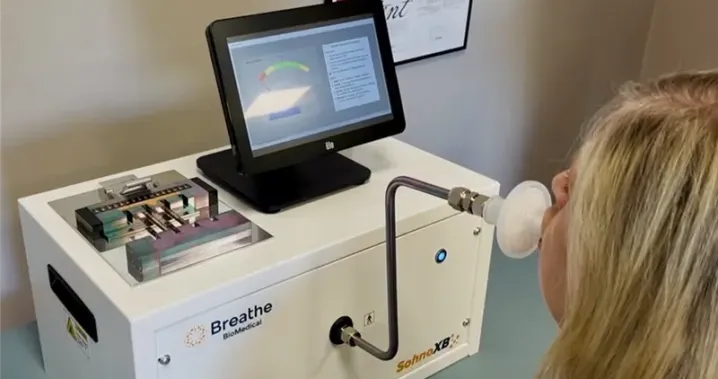
A new breath test could revolutionize breast cancer screening if approved following a series of North American studies.

Moncton-based company Breathe BioMedical has developed a test that can detect signs of breast cancer by analyzing breath samples in women of all breast density types.
“It’s very exciting to see a new technology that potentially could be able to reach the masses, the capacity wouldn’t be an issue, and that we’d be able to find cancer early,” says Jennie Dale, founder and executive director of national non-profit Dense Breasts Canada.
Mammography is currently considered the gold standard screening tool, Dale says, but it is far from perfect.
She says a typical mammogram is less than 50 per cent accurate for women with dense breasts, creating the need for supplemental screening in the form of ultrasounds, MRIs and contrast-enhanced mammography.
“What we’re trying to do is build a test that sits between mammography and these more costly downstream tests,” says Breathe BioMedical CEO Bill Dawes.
The study has already been launched across the United States, says Dawes, and now Breathe BioMedical has set its sights on Canada.
“We had our first start at the Vitalité Health Network here in Moncton,” he says, “and we’re looking to roll out provincially with more sites here in New Brunswick, sites in the future potentially in Nova Scotia, Ontario and points west.”

Get weekly health news
Receive the latest medical news and health information delivered to you every Sunday.
According to Dawes, the breath test at the heart of this study is quick and can be administered by anyone who has had at least two hours of training.
Principal investigator for the Moncton site, Dr. Jocelyne Hébert, says the feedback from study participants has been positive so far.
“Patients are quite excited that we are working on a tool that is non-invasive,” she says. “Patients have been calling to undergo the test and we’ve been managing those calls to explain that this study currently is not open to the general population. It is for a very specific group of patients.”
Right now, Hébert says the test is only being offered to patients who have had a suspicious mammogram, where a biopsy has been ordered.
Participants are asked to blow into the breath sampler, she says, which collects their VOCs — volatile organic components — for analysis.
Their breath is then sent back to Breathe BioMedical’s lab to look for VOC patterns indicative of breast cancer.
“It’s like a signature for breast cancer in your breath,” Hébert explains. “Hopefully, we can identify the specific pattern and be able to have a screening test, which will be non-invasive.”
The test is currently generating results at an 88 per cent accuracy rate — something the company hopes to improve upon throughout the study.
Breathe BioMedical is also working with Horizon Health Network and the IWK in Halifax to bring study sites online at their locations as well.
In a statement, Nova Scotia Health Minister Michelle Thompson writes: “Our government will always look for more and better ways to help detect and treat breast cancer.”
Adding: “The Breast Health Research Unit at IWK participates in many research initiatives to improve breast cancer outcomes for patients in Nova Scotia. We are aware of ongoing work between the Breast Health Research Unit and Breathe BioMedical to open IWK Health as a research site for their technology, pending regulatory and legal approvals. We look forward to learning more as this work progresses.”
An exciting development for advocates like Dale, who have long petitioned for readily accessible supplemental screening for women with dense breasts in Atlantic Canada.
“In New Brunswick and in Nova Scotia and Newfoundland and PEI, women are unable to access supplemental screening. They’re at a real disadvantage,” Dale says. “So, this is a potential option.”
If approved, Dawes says the company hopes to begin rolling out the test by 2030.
“We believe in the future that this test will be deployed in mobile settings, in fixed settings, potentially even pharmacy-based settings,” he says.
In the meantime, Dale says she hopes the Atlantic provinces will reconsider increasing access to supplemental screening.
© 2026 Global News, a division of Corus Entertainment Inc.