dailynewsnblog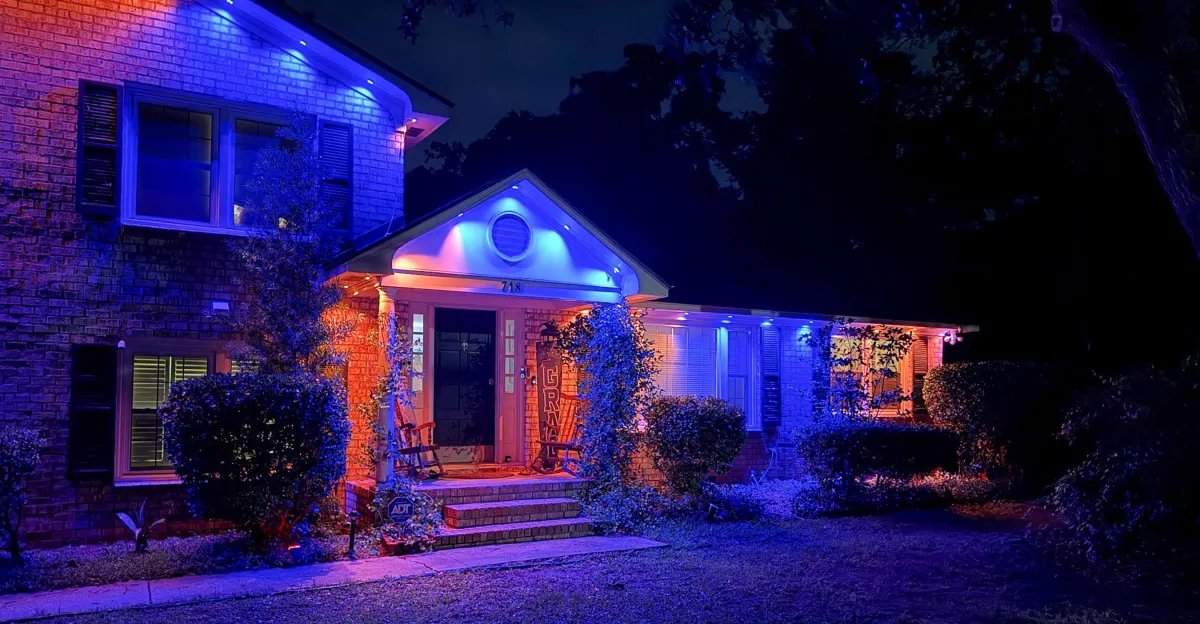
I’ll admit it. I was wrong. Wildly colorful lighting is delightful for your smart home — well, outdoors, at least.
Smart lighting is one of my favorite features of the smart home — it combines convenience with ambiance, letting you change the entire look of your room with just a press of a button. But, other than the occasional pop of color, mostly in my kids’ rooms and outdoors around the holidays, I’ve never found much use for color-changing lights. I prefer the subtler effects of tunable white light combined with dimming to set the scene indoors, and that preference also extended to outdoor lighting. Until this summer.
With an influx of new outdoor lighting products over the last year or so, I decided to see how far outdoor smart lighting has come: Are products with color-changing and gradient lighting, along with RGBICW (where you get colors and whites and can control LEDs individually), worth the extra investment, or are they still more garish than gorgeous?
To find out, I tested various string lights, “permanent” exterior lighting, a giant lamppost, and a wall of light in my yard. Overall, smart outdoor lighting has come a long way, and while there’s still potential to go over the top, today’s options offer a surprisingly effective blend of fun and style — if you stick with one brand. I focused on Govee for this article because it offers one of the broadest lineups and has a few truly wild options, including that 8-foot wall of light.

Strategically placed architectural lighting has always had the potential to elevate a home’s curb appeal or your backyard party vibe, but connected, color-changing outdoor lighting offers several advantages. First, one setup works year-round. Instead of changing out your lights for different seasons, you can just use an app to change the look. And if you’re investing in smart lighting, having the option to add color gives you more flexibility.
I have Govee permanent outdoor Prism lights installed on my home, and while most of the time I stick with an elegant white light, in the last few months I’ve decorated my eaves with a variety of colors. These include shades of pink for Valentine’s Day, green and gold for St. Patrick’s Day, pretty pastels for Easter, red, white, and blue for Memorial Day, orange and purple for when my son got accepted to Clemson University, and then his school colors — orange and blue — for his graduation this month. (I just can’t seem to escape orange.)
Second, there’s the benefit of connectivity; app control lets you set your lights on a schedule, set sunrise and sunset routines, and easily control them with voice commands. Paired with motion sensors, outdoor lights can be an excellent safety feature, illuminating a path as you walk along it or lighting up dark areas of your yard. I set up Govee’s outdoor lamppost in my backyard, and when I go out at night to check on the chickens, it lights up as I approach. This is where I’ve found outdoor lighting to be the biggest benefit in my yard, extending my garden’s usability past twilight.
Today, colored outdoor lighting still works best if you stick to one brand. That’s because many of the most impressive features — such as dynamic lighting — rely on proprietary apps. Dynamic lighting is the catch-all term for colorful, synchronized, and animated lighting effects. These effects can also sync with music, TVs, or computers to create a more immersive experience. Outdoors, music sync is the most useful, helping create an instant party atmosphere.

There are plenty of good outdoor lighting options with strong dynamic lighting features, including Nanoleaf, Philips Hue, Lifx, GE Cync, and Home Depot’s Hampton Bay, but for sheer variety and a broad price range, it’s hard to beat Govee. Its ecosystem has grown exponentially over the last few years, with entries in every category and some entirely new ones, and it’s significantly less expensive than Hue’s outdoor range, which is the closest in terms of number of options.
Nearly all Govee’s newer products support the Matter interoperability standard, and all of them work with Alexa and Google Home for voice control and pairing with other lights. I have an Amazon Alexa routine where I say, “Alexa, glow up the garden,” and all the lights come on. (Matter doesn’t support dynamic lighting yet, but it can handle color-changing, scheduling, and on/off controls).
Govee uses Bluetooth and Wi-Fi for setup and control. I’ve found its Wi-Fi connectivity can be temperamental — that’s one reason I prefer Philips Hue for my indoor lights, with its rock-solid Zigbee connectivity. But with Bluetooth as a fallback, you can control Govee lights with your phone as long as you’re near them, which is generally when you want to change colors or turn on scenes. Govee’s app is less polished than some competitors, but it offers a huge amount of flexibility once you learn your way around.
I’ve found Govee’s AI Lighting Bot handy when none of the preset scenes fit, and I didn’t want to spend time creating my own. For my son’s graduation, I asked it to create a “playful scene using orange and blue” on the Govee permanent outdoor lights I installed at the front of my house, and it produced a lovely rippling effect that undulated across the eaves.
The most fun we’ve had with the AI Lighting Bot, though, has been with Govee’s Lightwall. At almost 8 feet wide, this curtain-style light comes with its own frame, so you can put it anywhere in your yard for a serious light show — think outdoor movie screen.
During the Kentucky Derby, my husband asked Govee to conjure up a suitable scene, and it did a decent job of simulating horses and jockeys racing. Its 35fps wasn’t near movie quality, but entertaining all the same. For my son’s card game evening, he and his friends played Spades, illuminated by a colorful hand of cards on the Lightwall. It’s also portable, so we took it to his graduation party, and it made a great backdrop for the band. But at $450, it’s definitely more novelty than utility.

My favorite outdoor lights are still the string lights. These combine task lighting, decor, and ambiance, letting you go from bright whites while prepping dinner on the grill to softer, more colorful vibes with the press of a button. I recently swapped out a set of Nanoleaf outdoor bulbs hanging around my patio for the new Govee Chromatic String Lights. Here, each bulb can display multiple colors simultaneously, which adds dimension without being overpowering. They’re similar to Lifx’s outdoor string lights, but the key difference is that Govee’s are more diffuse, which lends a softer look.
Overall, I prefer the look of the Nanoleaf bulbs when off; they have a pretty cut-glass design, but Govee’s light shows are more impressive, and I can sync them with the other Govee lights using Govee’s DreamView system, which syncs lighting effects over your Wi-Fi network so multiple products can display the same effect. The option to instantly shift the mood from dinner al fresco to a teenager hangout this summer has been more fun than I expected.
Of course, a big challenge with outdoor lighting is power cords, and this is where solar is a great option. Govee’s new Outdoor Solar String Lights feature a 6-watt panel with a built-in battery and let me extend my lighting beyond where I have power sources to around my vegetable garden. They aren’t as bright as the powered string lights, but the shapely filament is attractive, and the lights look like little jewels hanging off my garden fence.

I may never fully embrace a giant wall of animated LEDs in my backyard, but my summertime garden experiment showed me that RGB outdoor lighting can be more than a novelty. It’s becoming more useful indoors, too. I recently tested some of Philips Hue’s new lighting features that use color in subtler ways to create elegant lighting scenes that enhance a room rather than dominate it.
Overall, I still prefer the more sophisticated approach that companies like Hue offer indoors, but Govee’s bolder outdoor lighting proved me wrong when it comes to my garden. Flashy, RGB lighting has made it a more welcoming, usable, and genuinely fun place to be after dark this summer.
Photos and video by Jennifer Pattison Tuohy / The Verge