dailynewsnblog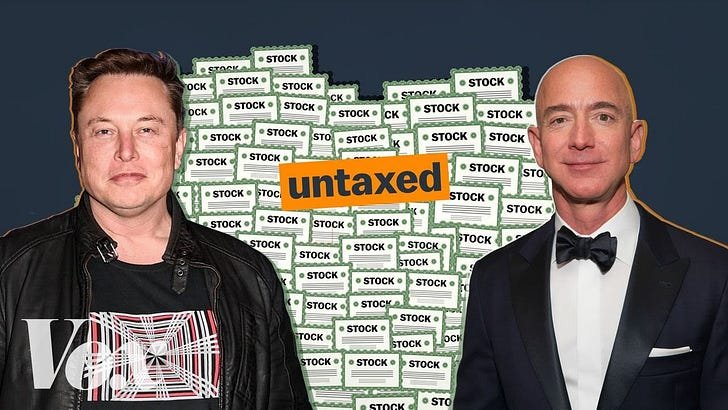
In an instant, the world’s wealthiest man increased his net worth to over $1.1 trillion of theoretical money by selling a small number of over-hyped shares in a company that has never made a profit, while keeping control of the voting shares. In the week since, it has further increased by runner-up Jeff Bezos’ entire net worth.
Elon Musk’s rise to the world’s wealthiest man is well-documented as an exercise in the ruthless application of public funds to private benefit. In 2025, he ran a government agency called the “Department of Government Efficiency” that systematically raided every major US government department and left with vast amounts of data. All federal investigations, and there were several, involving his businesses also magically disappeared through this exercise. Not surprising, then, that a year later his net worth exceeds Canada’s entire gross national debt.
For a man who claims to be the world’s biggest taxpayer, his net take from the government is still overwhelmingly in the positive.
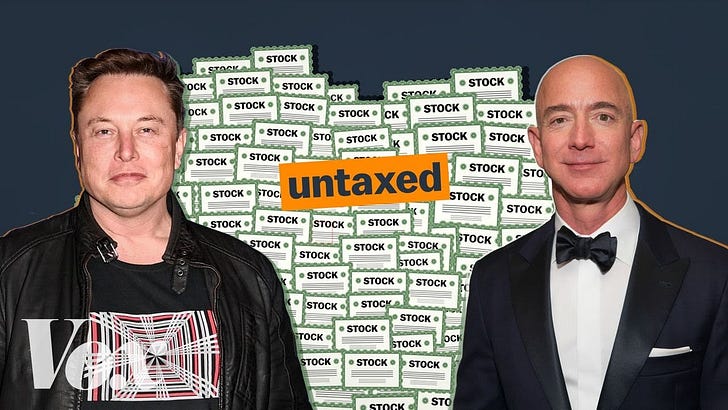
The ludicrously wealthy avoid paying taxes by borrowing against their investments, typically their shares. The gamble is that the value of those investments will rise faster than their principle and interest, and the fact that they have not sold those assets make them untaxable as they are considered to be ‘unrealised gains.’
The solution here is plainly obvious and requires only a modicum of political spine to implement. It is a problem common to both Canada and the United States. It is so simple it could probably be fixed through a Private Members Bill, and may not even require a Royal Recommendation.
Any asset that is exercised should be considered an asset that has been realised. If someone is using $40 billion worth of shares as collateral, for example, then those $40 billion of shares have been assessed and applied as a real-world value and have therefore been exercised — and should therefore be taxed, at the very least as a capital gain.
The wealthy will tell you that capital gains taxes are a tax on inflation, as if their portfolios only increase in value by the inflation over the same period. If their $100,000 investment becomes worth $400,000 over a 10-year holding period, but inflation has decreased the buying power of $400,000 by half over the same period, the capital gain is still measured at $300,000 and, in Canada, we tax only half of that amount as income. Thus, even if it is partially a tax on inflation, that is algorithmically considered within the tax structure.
But it isn’t, really. Capital gains is fundamentally a tax on unearned income, not inflation. If the value of your shares rise, your only action was to watch them do so — the increase in value comes from a combination of the work of the employees and the level of interest in other investors in buying those share from you. If your rental property is making money, the people renting from you are the ones doing the work to make you that money. In both cases, your value increased based on the contributions of others. There is real income — but it was not earned by you, and until you exercise it by selling the shares or the revenue property, that income is not even taxed.
Passive income, then, is simply the accumulated value of the work of other people.
Obscene wealth like that achieved by Elon Musk is made possible through this concept. The more wealth accumulated through the contributions of others, the more society tends to celebrate those people as a success, and the more we shield them from contributing to society through taxes.
Some contribute to charity, sometimes in large amounts. But for the most part, even that bit of wealthy chivalry has died. Andrew Carnegie left a legacy of public libraries, stating that he had gained his fortune through the education obtained through the use of libraries. Today’s equivalent tech moguls have no such sense of gratitude, obligation, or purpose.
Elon Musk wanted to be a trillionaire, and did not care who he hurt along the way or how he did it. He destroyed USAid on his way there, an action which has directly been credited with the death of hundreds of thousands of people in the year since. He cut a $15 million screwworm prevention program in the US which is now costing the government $1 billion to fix as, you guessed it, screwworm is back.
It was not long ago that Bill Gates was the wealthiest man in the world with a net worth of some $40 billion. Within a few years, we heard a new term — centibillionaire, and pretty quickly there were several of them.
Now, we can add the term trillionaire to our lexicon. That door has been flung open, and it won’t be long until someone else walks through it as well.
That we are not, as a society, overwhelmingly and revolutionarily disgusted with the rise of the centibillionaires and now the trillionaires is a great shame upon us all. For many people, a millionaire is a rich person. But a billion dollars is such an unfathomable amount of money that it is just a thing. It is no longer an amount of money, it has become an object in its own right.
For Musk to be a trillionaire is not widely understood to be an overwhelming concentration of wealth so much as an understanding that he is the first person to acquire this new thing. I have a train set — he has a trillion. That’s interesting, now back to work.
Billionaires should not exist, much less trillionaires. Individual people should not hoard more wealth than entire nations. We cannot rely on charity and philanthropy for them to contribute back to society — for the most part they don’t even pretend any more.
Our oligarchs must be brought to heel. If they are spending money they claim not to actually have, then the shell game must be called and they must pay the taxes associated with having it. If that forces them to sell their shares and investments rather than simply borrow against them, that is also okay — we will quickly learn the real value of their stated assets. And so will they.