dailynewsnblog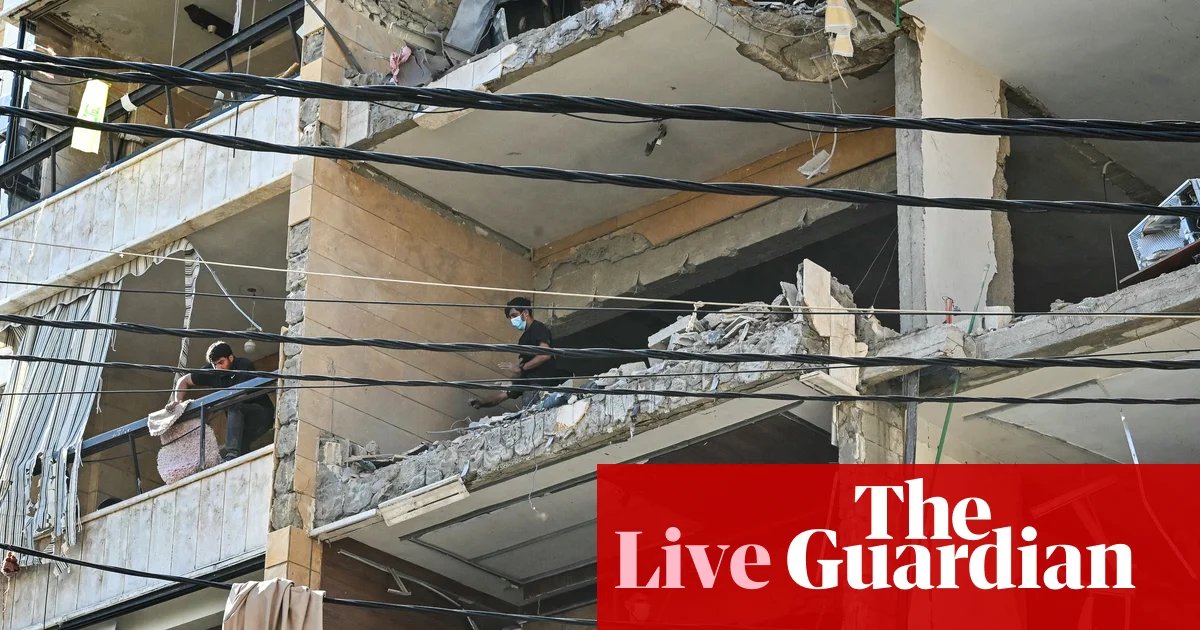
Key events
Yemen’s Houthis claim missile attack on Israel
Yemen’s Iran-aligned Houthi rebels have claimed an attack on Israel and say Israel-affiliated vessels would again be a target in the Red Sea.
The statement from Brig Gen Yahya Saree was broadcast on the Houthis’ al-Masirah satellite news channel on Monday. It’s another new escalation as the nominal ceasefire in the Iran war is being challenged by crossfire between Israel and Iran.
The EU’s top diplomat has urged calm after Iran and Israel traded strikes, testing the fragile truce and threatening to drag the Middle East region back into war.
“Overnight, we have seen escalation again,” Kaja Kallas said on Monday.
I think the region does not need an escalation, but actually that parties sit down to a negotiation table and agree.”
Opening summary
Hello and welcome to our live coverage of the crisis in the Middle East.
Israel launched airstrikes early on Monday targeting central and western Iran in response to missile fire from Tehran, attacks that threatened to drag the wider Middle East back into a regional war.
Iranian state TV reported the sound of explosions being heard in the cities of Isfahan, Karaj, Tabriz and Tehran. A witness in Tehran described hearing at least one large blast somewhere to the west of the capital.
Iran closed the airspace around Tehran’s Imam Khomeini international airport – the main airfield in the country – after the Israeli attack.
Multiple explosions were heard over Jerusalem later on Monday as Israel said a new wave of Iranian missiles was incoming. The Israeli military said it “identified missiles launched from Iran” and was working to intercept the threat.
Iran’s paramilitary Revolutionary Guard said Israel used air-launched ballistic missiles in its attack on Iran.
The Israeli military at dawn in Iran issued a short statement as its strikes started, saying: “A short while ago, the Israeli Air Force struck military targets belonging to the Iranian terror regime in western and central Iran.” It did not provide further details.
US officials said Donald Trump earlier spoke with Benjamin Netanyahu and urged the Israeli prime minister not to immediately retaliate over Iran’s missile launches against Israel, which upended the fragile ceasefire in place since April.
We will bring you all the latest developments here. Meanwhile:
-
Iran’s attacks appeared to be in retaliation for Israel strikes on Beirut’s Dahiyeh southern suburb area targeting Hezbollah infrastructure despite the truce agreement with Lebanon. Two people were killed and 20 wounded in Beirut, the Lebanon health ministry said.
-
A missile was launched from Yemen towards Israeli territory on Monday, the Israeli military said, adding its aerial defence systems were operating to intercept the threat. Israel’s rescue services say there were no reports of casualties or impacts.
-
Oil prices jumped more than 3% after Iran’s strikes, with the price of Brent crude – the international benchmark – rising 3.29% to $96.15 a barrel in early trading on Monday.
-
Iran’s barrage was the first since the ceasefire took effect in early April. Iran’s parliament speaker, Mohammad-Bagher Ghalibaf, said US bases and assets in the region were now “legitimate targets”.
-
The strait of Hormuz will be opened but under new conditions to be set by Iran and Oman, including a transit fee, Iran’s ambassador to Moscow, Kazem Jalali, told the Russian newspaper Izvestia – a position Trump strongly opposes.
-
Trump said Netanyahu would have no choice but to accept whatever deal the US negotiated with Iran because “I call the shots”, the Financial Times reported. “He won’t have any choice,” Trump said. “I call the shots. I call all the shots. He [Netanyahu] doesn’t call the shots.”