dailynewsnblog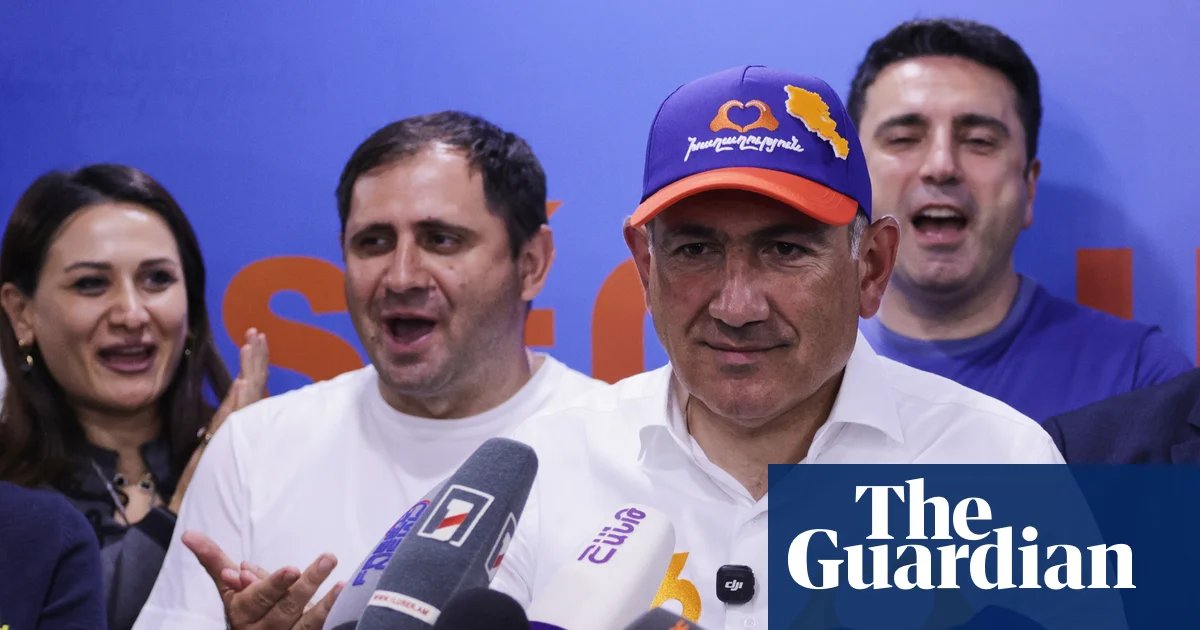
Armenia’s ruling pro-Europe party has won parliamentary elections, confirming the country’s pivot towards Europe and away from its traditional ally, Russia.
Final results in the small South Caucasus country showed the prime minister Nikol Pashinyan’s Civil Contract party securing a slim majority, while the Strong Armenia alliance, led by the Russian-Armenian billionaire Samvel Karapetyan, won 25% of the seats in parliament.
The result, which will be welcomed in Brussels but viewed with dismay in Moscow, strengthens Pashinyan’s hand as he pursues his signature and politically sensitive goal: a peace agreement with Armenia’s longtime adversary Azerbaijan and the normalisation of relations with Turkey.
“The people of Armenia voted for peace, regional prosperity and regional cooperation, and I hope this will be met with a positive response from Turkey and Azerbaijan,” Pashinyan said at his campaign headquarters as the results began to trickle in.
Pashinyan added that Armenia would continue to deepen ties with the west while maintaining its membership of the Russia-led Eurasian Economic Union.
A former journalist who swept to power during the 2018 Velvet Revolution promising to dismantle Armenia’s oligarchic system, Pashinyan has campaigned on a platform of peace, arguing that ending Armenia’s decades-long confrontation with its neighbours would unlock economic opportunities, improve security and reduce its dependence on Russia.
The prime minister, known for his populist and at times divisive rhetoric, has sought closer ties with Europe, signalling that Armenia’s future lies in deeper integration with the west and expressing hope that the country could one day join the EU.
The vice-president of the European Commission, Kaja Kallas, said on Monday that Armenians appeared to have voted for a “European future”.
She added: “The votes are being counted but it looks like now that Armenia’s people, although under heavy Russian pressure, still chose to have a European future, which is a good thing … We are trying to help them as much as possible on their future reforms.”
Pashinyan had also received an endorsement from Donald Trump, who described him as “a great friend and leader”. The US has taken an increasingly prominent role in efforts to broker a peace agreement between Armenia and Azerbaijan.
Sunday’s vote is the first national election since Armenia’s loss of Nagorno-Karabakh to Azerbaijan in 2023, a traumatic defeat that ended more than three decades of Armenian control over the disputed region.
The opposition has sought to portray the loss as evidence of Pashinyan’s failures, accusing him of surrendering historical Armenian lands to its enemies.
Pashinyan has tried to turn the issue into a political asset. Arguing that Armenia’s pursuit of Karabakh helped trap the country in perpetual conflict and dependence on Russia, he has presented the painful chapter as the necessary starting point for a more secure and prosperous future.
But difficulties remain for Pashinyan, who failed to secure the supermajority needed to call a referendum on amending the constitution, including removing references that Azerbaijan says imply territorial claims to Nagorno-Karabakh – a crucial condition for signing a final peace agreement.
Lilit Mkrtchyan, a shopkeeper from Yerevan, said Pashinyan’s victory would bring “peace and stability to Armenia”.
“Armenians are tired of war. We want to be an open, European country that develops and prospers, where I don’t have to worry that my son will be called up to fight,” she added.
Pashinyan’s course has put him in the crosshairs of Moscow, which has long projected influence over Armenian politics and the economy.
Many Armenians became disillusioned with Russia after Moscow failed to come to their aid when Azerbaijan seized Nagorno-Karabakh, despite the presence of Russian peacekeepers in the region.
The fallout prompted Pashinyan to suspend Armenia’s participation in the Collective Security Treaty Organization of six post-Soviet states, including Russia, marking the most dramatic rupture in relations with Moscow since the country’s independence.
In the run-up to the election, the Russian president, Vladimir Putin, said Armenia, which has not formally applied for EU membership, was heading down the same path as Ukraine.
Armenian officials and analysts have accused Russia of attempting to influence the election through disinformation campaigns in favour of pro-Russian candidates, and efforts to fly Armenians living in Russia back home to vote against Pashinyan.
In recent weeks, Moscow has adopted a more overt approach, imposing a series of trade restrictions affecting everything from flowers and fish to fruit and Armenian brandy.
Mindful of Armenia’s deep economic dependence on Russia and its reliance on cheap Russian gas, Pashinyan promised after the vote to pursue a balanced foreign policy, insisting that “there is no question of choosing” between Russia and the west.
Pashinyan has been buoyed up by strong economic growth after the influx of Russian businesses and capital after the invasion of Ukraine, leading him to invest heavily in Armenia’s regions, where his support remains strongest.
Yet observers have also pointed to his increasingly personalised style of politics, and what critics describe as growing authoritarian tendencies in Armenia, a country that remains a rare democratic outlier in a region largely governed by strongmen.
In the run-up to the elections, Armenian authorities arrested opposition figures, including members of Karapetyan’s party, with accusations ranging from vote-buying and financial crimes to calls to overthrow the government.
Karapetyan was detained in June and charged with calling for the seizure of power, leading him to campaign from house arrest.
After the election, Pashinyan said his party’s priority for the next term would be the complete dismantling of what he described as a “criminal-oligarchic system”. He also said leading opposition figures should face criminal prosecution.
On the campaign, Pashinyan has at times appeared erratic, engaging in angry public disputes with refugees from Nagorno-Karabakh, whom he accused of having “run away” from the region rather than staying to fight.
The EU, meanwhile, has largely brushed aside criticism of Pashinyan, making little secret of its support for Armenia’s shift away from Moscow. This week, Brussels announced an initial €50m support package to help Armenia withstand Russian economic pressure.
Karen Grigoryan, a doctor who voted for Karapetyan on Sunday, said: “Pashinyan is not the man he was when he came to power.”
Referring to the Ottoman-era mass killings of Armenians that Yerevan and many western countries recognise as genocide, he added: “We can’t just be friendly with Turkey and pretend the past is erased.”
Observers say many voters backed Pashinyan largely because the opposition remains widely discredited and closely linked to Russia. Tatul Hakobyan, a popular Armenian commentator, said: “People are choosing the lesser of two evils. The alternatives to Pashinyan are much worse.”