dailynewsnblog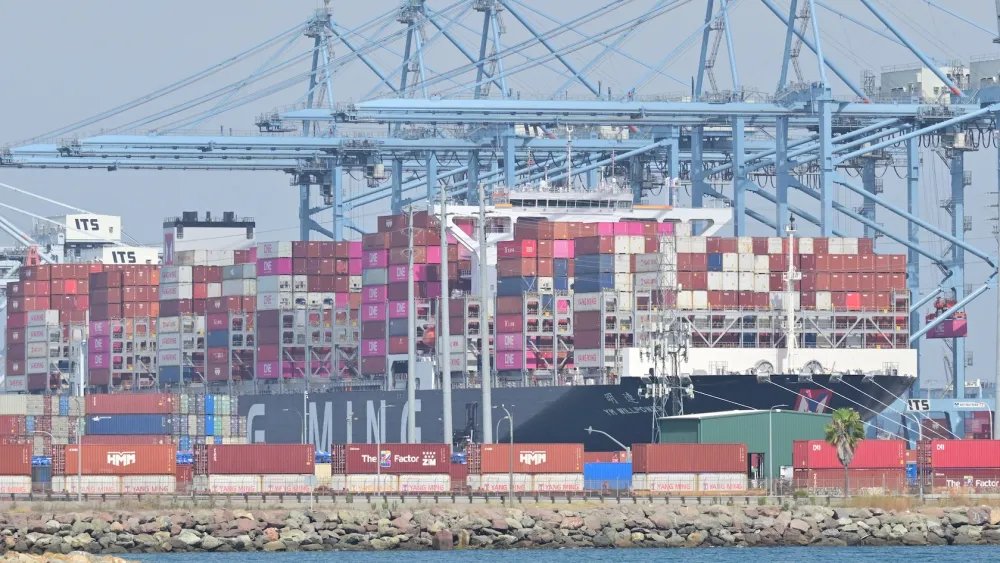
The Port of Long Beach could potentially move more than 900,000 20-foot equivalent units (TEUs) in September, which would represent a double-digit growth in cargo handling for the month.
After the port reported stronger-than-usual figures in May and June, Port of Long Beach CEO Noel Hacegaba suggested that the late summer peak shipping season that typically lasts from August to October was “outdated and obsolete.”
While the definition of the peak season going forward remains nebulous, the heavier buying earlier in the year has not resulted in a September slowdown at major U.S. ports.
According to data from the monthly Global Port Tracker from the National Retail Federation (NRF) and Hackett Associates, September is expected to be the busiest month for inbound cargo volumes at U.S. ports this year. The month is forecast to bring in 2.31 million TEUs, a projected 9.6 percent increase over import totals from a year ago.
The projection was notable as it reversed a forecast made just two months ago that called for a 5.7 percent decline in imported volumes.
The Long Beach port, which processes the second-most containers in the U.S., appears to be a main driver of this trend. While Hacegaba’s projections aren’t broken out by imports, the possible 900,000 total TEUs of anticipated throughput this month would represent a 12.8 percent annual jump at minimum.
“If you would have asked me [about planning for the rest of the year] two months ago, I would have told you that peak season would have extended possibly through September and October,” said Hacegaba during a Wednesday media briefing. “Now I’m hearing that that may be further extended.”
Hacegaba cited numerous factors including the recent transit restrictions at the Panama Canal, which are expected to shift more containers to West Coast ports, alongside weather conditions in Asia that delayed vessel departures.
To make cargo projections, the Port of Long Beach follows indicators like the Global Port Tracker, as well as consumer confidence and retail and wholesale inventory metrics. The gateway also communicates frequently with ocean carriers to gather insight on freight headed toward the U.S.
Throughout August, the San Pedro Bay gateway moved 919,992 TEUs, up 2 percent from the year-ago month. Imports rose 3.6 percent to 456,100 TEUs, exports were up 4 percent to 99,754 TEUs and empty containers dipped 0.4 percent to 364,138 TEUs.
Year-to-date, the Port of Long Beach has moved 6,678,078 TEUs through the first eight months of 2026, up 1.3 percent compared to the same period last year.
During the port’s briefing, Hacegaba highlighted the growing role of Vietnam in U.S. trade in recent years, noting that the southeast Asian country has become the gateway’s second-largest trading partner.
Furniture, apparel, and footwear are currently the top three Vietnam exports that move through the Port of Long Beach, he said, noting that more companies are diversifying their manufacturing bases in pursuit of the China-plus-one strategy.
“As recently as six years ago, China accounted for 70 percent of import and export cargo moving through our port. In 2025, that was down to 55 percent, replaced by ever-increasing cargo from Southeast Asia,” Hacegaba said. “As we head into the holidays and cold winter gateways, look for more of the things you buy coming from hot and humid Vietnam.”
Referencing data from the University of Pennsylvania, Hacegaba said China still faces the highest effective tariff rate among U.S. trade partners at 23.2 percent. As of June, the average effective tariff rate across all countries stood at 7.1 percent.
The Vietnam shift is a major reason for the port’s $1.8 billion on-dock rail support facility, which is anticipated for completion in 2032. According to Hacegaba, vessels coming from Southeast Asia take an additional two-to-three days to arrive at Long Beach compared to China.
The infrastructure project will reduce ocean transportation that takes four days on average down to 24 hours and connect the port to 30 rail hubs across the nation. With the facility in place, the Port of Long Beach expects to double its annual cargo volumes to 20 million TEUs by 2050.
The increased reliance on longer and more diversified supply chains comes as trucking capacity is tightening, potentially giving intermodal rail a larger role in moving imported merchandise inland.
Anne Reinke, president and CEO of the Intermodal Association of North America (IANA), said capacity in both drayage and over-the-road trucking has been “dramatically curtailed” amid elevated fuel prices and the Trump administration’s regulatory crackdown on the industry.
The challenge, she added, is making sure the current intermodal growth can be sustained rather than falling back into the “peaks and valleys” that have historically characterized the market.
The disruptions affecting ocean freight are also underscoring the value of flexibility once containers reach U.S. ports. Reinke said intermodal marketing companies and third-party logistics providers (3PLs) can help shippers find alternatives when a particular freight lane becomes constrained, describing them as the “freight quarterback” of the transaction.
“Ultimately, what that means is you have to have a really good partner who can exercise two great words: flexibility and optionality,” Reinke said.
She also identified drayage as a key area for greater coordination between ports, railroads and trucking companies. With available drivers, trucks and power units becoming more constrained, Reinke said technology and collaboration can help improve the handoff of containers between transportation modes.