dailynewsnblog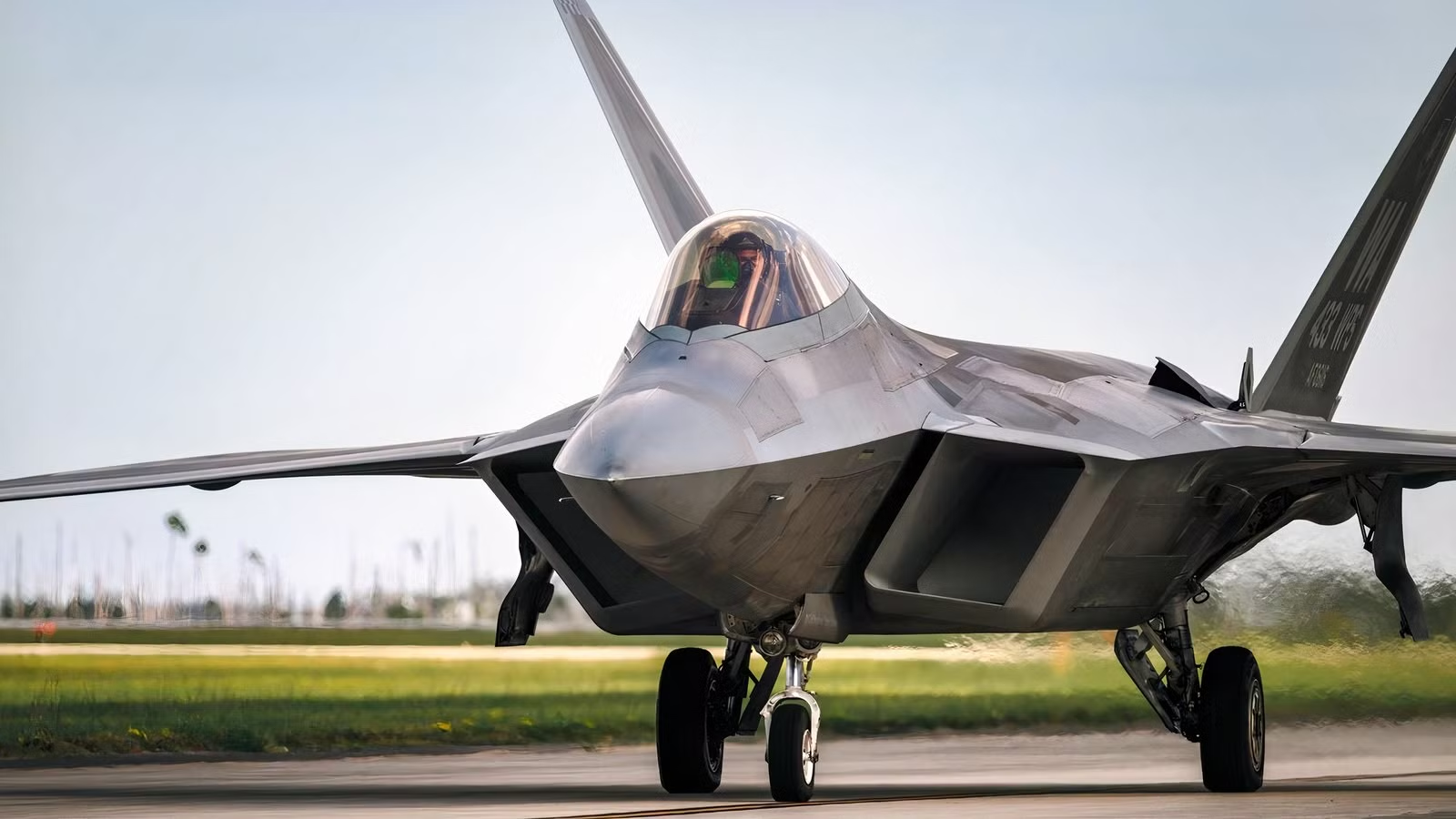
The 195th and final Lockheed Martin F-22 Raptor rolled off the Marietta, Georgia, production line in May 2012, and the line hasn’t reopened since. Of the 750 aircraft originally planned (then cut to 187 operational fighter jets), the fleet now stands at approximately 185 airframes following two decades of attrition. The F-22 is the most capable air superiority fighter ever built. It is also, per the Government Accountability Office, one of the most persistently difficult fleets the United States Air Force has ever tried to keep ready. The two facts are not unrelated: the same low-observable coating system that makes the Raptor functionally invisible to most radars makes it uniquely labor-intensive to maintain, and that labor intensity is the engine behind every spending figure in this article. The Advanced Raptor Enhancement and Sustainment (ARES) program is a sole-source sustainment and modernization program with a $10.9 billion ceiling through 2031 to keep nearly 185 out-of-production Raptors combat-relevant; the fleet’s operating cost runs about $80,000–85,000 per flight hour, structured to keep a fleet of aging, out-of-production aircraft combat-relevant as a bridge to the incoming Boeing F-47.
What the Air Force is doing with those 185 aircraft is the subject of this article. By the end of this article, you will know why that spending is driven primarily by one unavoidable engineering constraint: the stealth coating that consumes 50% of all F-22 maintenance hours and caused the fleet to miss its own readiness targets in every fiscal year from 2011 to 2021.
187 Procured, 185 Remaining: How The F-22 Fleet Got This Small

Understanding the F-22 Raptor‘s sustainment cost requires understanding how the fleet reached its current size, because small fleets are expensive in ways that large ones are not. The original program of record called for 381 combat-coded F-22s, a number derived from war-game analysis of the air-superiority threat environment the US expected to face in the 2010s and beyond. Secretary of Defense Robert Gates’s 2009 decision to cap production at 187 operational aircraft was driven entirely by cost — the F-22 program had already consumed $67.3 billion to produce 195 total airframes (187 operational plus eight test aircraft), a figure that works out to approximately $334 million per aircraft when development costs are amortized. The per-aircraft cost at that scale was unsustainable, and the program was terminated before it could achieve the economies of scale its architects intended.
The consequences of that truncation have compounded every year since. A fleet of 187 aircraft cannot generate the procurement volume needed to keep the supply chain for F-22-specific components viable at commercial production prices. Spare parts become scarce. Suppliers exit the market. Components that have been out of production for a decade require either custom manufacturing at premium prices or cannibalization from other airframes. The GAO’s 2024 review of the F-22 fleet confirmed that the Air Force had 185 F-22s as of September 2023, split between 32 Block 20 training-configured aircraft and 153 combat-coded Block 30/35 jets. Every spare part, every maintenance tool, every specialized cleaning compound for the radar-absorbing material coatings supports a fleet so small that none of it benefits from the pricing efficiencies that come with high-volume military logistics.
The fleet has shrunk further since production ended, with aircraft lost in accidents in 2020 and 2023. They cannot be replaced. The production line at Marietta has been dismantled, the workforce dispersed, and RAND Corporation estimates cited by TWZ suggest restarting F-22 production would cost around $50 billion and take at least a decade. In practical terms, every remaining Raptor is an irreplaceable strategic asset.
The ARES Contract: $10.9 Billion To Bridge A Fleet To The F-47

In 2021, the Air Force awarded Lockheed Martin an indefinite-delivery, indefinite-quantity contract for the ARES program. According to GlobalSecurity.org’s documentation of the contract, it was awarded as a sole-source acquisition, meaning no competitive bidding was conducted or considered. Lockheed Martin is the only entity on Earth with the knowledge, tooling, data rights, and cleared workforce to sustain the F-22, which makes the concept of competitive procurement somewhat theoretical. The contract runs to October 31, 2031, and covers maintenance operations, modernization hardware kits, capability upgrades, and performance-based logistics services, with a ceiling value of approximately $10.9 billion. The specific capability investment package, which covers new sensors, weapons, and avionics enhancements, is described separately by some sources as an $8 billion commitment.
The ARES program’s specific capability deliverables are substantial. As Simple Flying has detailed in its breakdown of the F-22’s midlife refresh, the modernization covers an Infrared Defensive System (IRDS) — a distributed set of embedded Tactical Infrared Search and Track sensors that give the aircraft passive detection capability against threats that do not emit radar signals, including stealthy adversary fighters. As reported by Aerotime, in January 2025, Lockheed Martin’s Vice President of Mission Systems, Hank Tucker, described the IRDS investment in specific terms:
“We understand the need for advanced and versatile infrared systems like IRDS that will make pilots’ missions more survivable and lethal against current and future adversaries.”
The program also includes Low Drag Tanks and Pylons (LDTP) — external fuel tanks with supersonic-compatible pylon geometry that allow the F-22 to carry additional fuel without the drag penalty that makes current external tanks impractical at combat speeds.
The engine element of ARES was separately announced in February 2025, when  RTX Corporation— the parent company of Pratt & Whitney — disclosed a three-year contract worth up to $1.5 billion to sustain the F-22’s F119-PW-100 engines. As Simple Flying has reported on the F119 software update, Pratt & Whitney is deploying a Full-Authority Digital Engine Control (FADEC) software update that is expected to increase the engine’s kinematic performance by adjusting automatic throttle limits. This is a meaningful capability improvement delivered entirely through code, not hardware replacement. The approach is notable because it illustrates the modernization strategy applied throughout the ARES program: use software to extract additional performance from fixed hardware, since the hardware itself cannot be replaced in a fleet this size at any reasonable cost.
The Coating That Consumes Half The Maintenance Hours

The F‑22’s radar‑absorbing coating is a precision electromagnetic surface that requires constant restoration due to weather, bird strikes, and supersonic stress; Lockheed Martin estimates coating work consumes roughly 50% of maintenance hours, making stealth upkeep the dominant driver of the aircraft’s ~$80–85k flight‑hour cost. As documented on Simple Flying in its analysis of the F-22’s operating costs, this stealth maintenance burden is the primary driver of the aircraft’s approximately $80,000 to $85,000 per flight-hour operating cost: not the fuel, not the engines, not the sophisticated avionics. The coatings.
The operational consequences extend well beyond expense. A 2014 GAO report noted that routine repairs requiring access beneath the aircraft’s skin can take days rather than hours because panels must be stripped, re-coated, and tested before returning to service. Even relatively simple maintenance tasks can therefore keep an F-22 grounded far longer than a conventional fighter. According to the GAO’s 2024 fleet review, this burden contributed to the Air Force missing its F-22 mission-capable and aircraft availability goals every fiscal year from 2011 through 2021.
The ARES program aims to reduce that burden through improved stealth materials, more durable application methods, and a performance-based logistics contract that rewards Lockheed Martin for reducing aircraft downtime rather than simply performing maintenance. The program’s success will ultimately depend on whether these changes can meaningfully reduce a maintenance challenge rooted in the physics of low-observable technology.
Catch what other flight trackers miss
Emergency squawks, holds, NOTAMs — live signals, no signup.
Open tracker
Catch what other flight trackers miss
Emergency squawks, holds, NOTAMs — live signals, no signup.
Open tracker
The Block 20 Problem: 32 Trainers Congress Will Not Let The Air Force Retire

Of the approximately 185 F-22s currently in the fleet, 32 are Block 20 aircraft — an earlier configuration used almost entirely for pilot training at Tyndall Air Force Base, Florida. Block 20s lack the combat software, sensor integrations, and weapons capabilities of the Block 30/35 jets that make up the combat-coded fleet. The Air Force has attempted to divest the Block 20s in multiple successive budget cycles, arguing that the approximately $50 million per airframe cost of upgrading them to Block 30/35 standard is not justified, and that the training mission they perform could be absorbed by other platforms. Congress has blocked every divestment attempt through legislative prohibition.
The arguments on both sides are genuinely strong. The Air Force’s position is that maintaining 32 non-combat-capable aircraft consumes maintenance resources, parts, and cleared technician hours that would generate more operational value if concentrated on the 153 Block 30/35 jets. According to the National Security Journal’s analysis of the upgrade program, the GAO warned in its 2024 report that retiring Block 20s would force combat F-22s to absorb training duties, degrading the readiness of aircraft that are already struggling to meet availability goals. In 2024, defense expert Heather Penney of the Mitchell Institute made a strong case for retaining the F-22 fleet. The former F-22 pilot insisted that the Air Force needs to maximize the modernization and preservation of every available aircraft, including the Block 20s. Her argument emphasized that in a fleet with such limited numbers, every lost airframe represents an irreplaceable capability.
The outcome has significant implications for the $10.9 billion ARES sustainment program. Retiring the Block 20 fleet would allow maintenance resources to be concentrated on the remaining 153 combat-coded aircraft. Retaining them, however, requires sustaining three separate F-22 configurations: Block 20, Block 30, and Block 35, each with distinct software, parts, and maintenance requirements.
What The Fleet Has Actually Done In Combat

The sustainment spending has a direct combat return that would be difficult to argue against in 2025 and 2026. F-22s participated actively in Middle East operations, shooting down Iranian-launched UAVs and ballistic missiles in 2024 and 2025. As documented by RTX, an F-22 achieved the longest known air-to-air kill with an AIM-120 AMRAAM in late 2025 during a test, surpassing a record set just three years earlier by a McDonnell DouglasF-15C. The F-22’s stealth allowed it to operate in environments where conventional fighters would have faced significant exposure to threats, while its supercruise and extreme maneuverability provided engagement options that no adversary aircraft in the region could match.
Those operational results provide the political and strategic rationale that sustains the ARES program’s budget through Congressional appropriations cycles. An aircraft that fails its own readiness metrics but still holds the world air-to-air engagement record is difficult to argue against in a defense authorization hearing. The fleet’s maintenance struggles are real; its operational performance when operational is equally real. According to the National Security Journal’s February 2026 analysis, the aircraft’s 2026 readiness rate sits at approximately 40% — meaning roughly 74 of the 185 aircraft are genuinely mission-ready on any given day. That is the number the ARES program is structured to improve.
The FY2026 budget also includes approximately $15 million specifically for Crewed-Platform Integration — adding tablet-based interfaces to the F-22 cockpit that allow pilots to control Collaborative Combat Aircraft (CCA) autonomous wingmen via the aircraft’s existing Intra-Flight Data Link (IFDL). All 143 combat-coded F-22s are eventually planned to receive this capability, meaning the Raptor’s final operational years will include directing uncrewed teammates rather than simply flying air superiority alone. That capability shifts the aircraft’s operational profile from a solitary stealth fighter to a node in a distributed combat network — a role its designers in the 1980s did not envision, but which makes it meaningfully more relevant in the 2030s force structure the Air Force is building toward.
$10.9 Billion To Keep 185 Jets Relevant Until The F-47 Arrives

The ARES program’s $10.9 billion ceiling, the $80,000-per-flight-hour operating cost, and the decade of missed readiness targets all point to the same underlying reality: maintaining a small fleet of highly specialized aircraft out of production is one of the most expensive things a military can do. The F-22 was designed for a fleet of 381. The economics of everything from spare parts pricing to training pipeline throughput were predicated on that number. At 185, the fleet operates at less than half the scale that would make it sustainable at a reasonable per-aircraft cost, and that arithmetic cannot be corrected by any modernization contract. What the ARES program can do is slow the effects: improving availability, streamlining maintenance, and extending the fleet’s useful life. But it cannot solve the underlying problem of a fleet that is simply too small.
The time being bought runs through the mid-2030s, when the Boeing F-47 NGAD is expected to begin fielding in sufficient numbers to start the Raptor replacement cycle. The F-47 program is sized for at least 185 aircraft, which is a one-for-one replacement targeting the current F-22 fleet — and is being designed from the outset with operating cost as a discipline rather than an afterthought. The lessons from the F-22’s maintenance burden and the specific cost drivers the ARES program has had to address are embedded in every F-47 requirement. The new aircraft will not repeat the stealth coating maintenance trap if the Air Force can help it.
The single takeaway from the $10.9 billion program is this: 50% of all F-22 maintenance hours are consumed by stealth coating restoration, a constraint no contract can engineer away, which caused the fleet to miss its readiness goals every year for a decade and which drives the majority of the aircraft’s $80,000-per-hour operating cost. The last F-22 left Lockheed Martin’s production line in 2012. Every dollar in the ARES program exists because replacing those aircraft is no longer an option.

![American Airlines Launches 10 Nonstop Routes From New York-JFK To Europe [List & Map]](https://dailynewsnblog.com/wp-content/uploads/2026/09/aa.png)