dailynewsnblog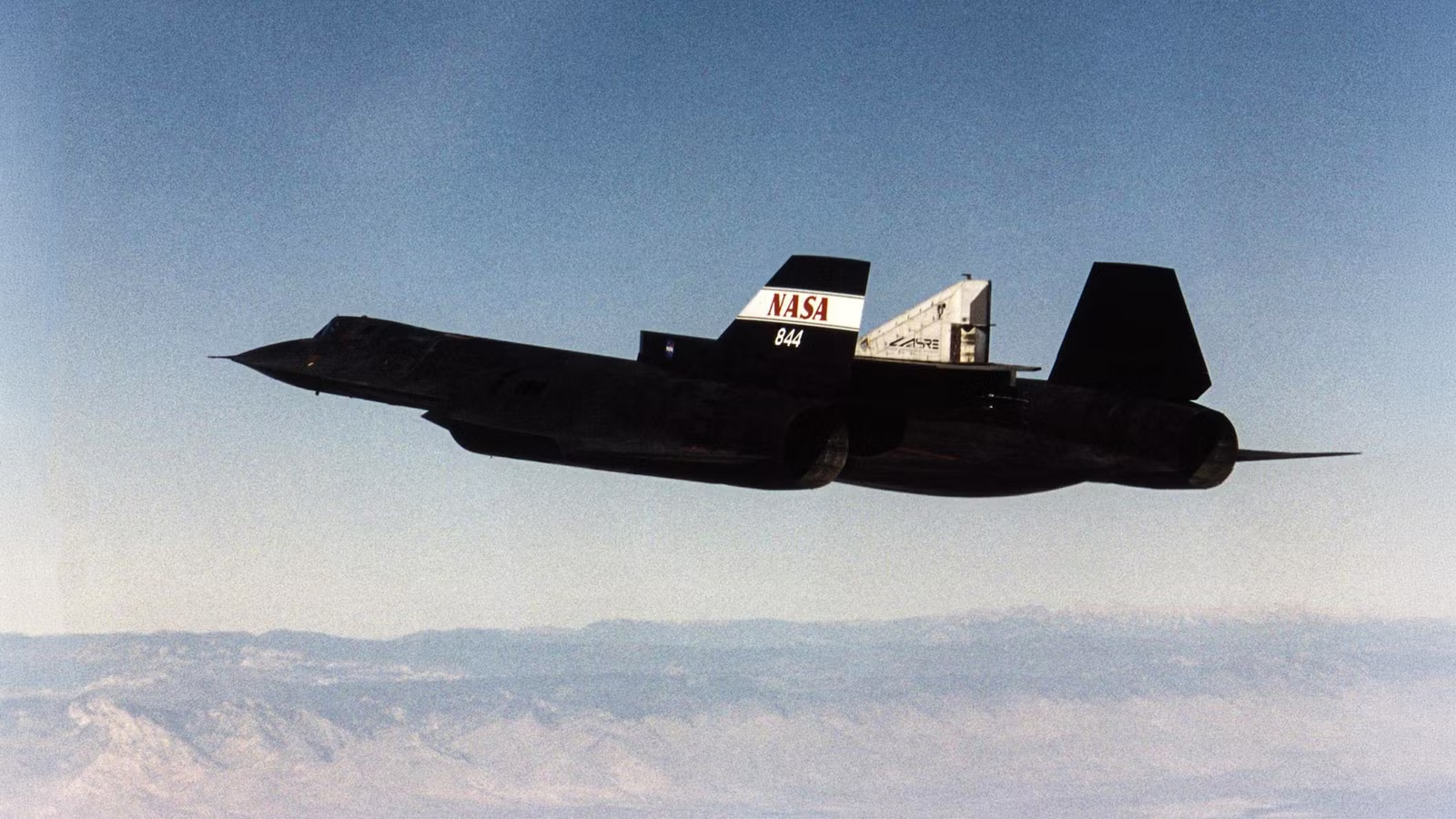
In 1997, NASA needed an aircraft that could perform an incredibly unique experiment in order to test a revolutionary type of rocket engine. The only plane in the world capable of being the test bed for its linear aerospike experiment, or LASRE, was the Lockheed SR-71 Blackbird. It was the only jet that could carry the seven-ton LASRE pod with its rocket thrust engines to the upper stratosphere and fly at the speed of a single-stage-to-orbit spaceship, or SSTO.
NASA brought two Blackbirds out of retirement and reconfigured them to carry the enormous sensor suite on their back. The groundbreaking experiments were the first in-flight validation of computational fluid dynamics of how a rocket’s exhaust interacts with the lifting body of a spaceship. While the Lockheed Martin X-33 spacecraft it was meant to support was ultimately canceled in 2001, the foundational telemetry gathered on the back of the Blackbird laid the groundwork for today’s commercial space sector.
The LASRE mission would also have the honor of overseeing ONE OF the last flights ever conducted by a Blackbird. For over three decades, the Blackbird’s sole purpose was Cold War espionage, flying at Mach 3+ to photograph hostile territory. When NASA SR-71 Tail Number 844 touched down at the Dryden Flight Research Center after its final LASRE validation run in 1998, it closed the final chapter on the fastest air-breathing aircraft ever built before its permanent sunset.
VentureStar’s X-33: Almost America’s First SSTO

NASA’s Dryden Flight Research Center and Lockheed Martin Skunk Works collaborated to perform the LASRE flights in support of VentureStar, which aimed to build the world’s first SSTO. The LASRE apparatus was a scale replica of the X-33 mounted on top of the fuselage of SR-71 Tail Number 844 as a testbed. Built into the tail of the 41-foot-long (12.5 meters), 14,300-lb (6,486 kg) half-scale model was a small-scale linear aerospike engine containing eight thrust cells.
Instead of putting a model inside a static wind tunnel, the SR-71 acted as a ‘flying wind tunnel,’ pushing the engine through the real upper atmosphere at supersonic speeds. The pod carried its own live propellants: gaseous hydrogen and liquid oxygen. It also carried water to regeneratively cool the engine fences and a high-pressure helium system to purge the lines. The flight test campaign was meticulously broken down into stages to ensure the SR-71 could handle the massive aerodynamic drag of the pod without mishap.
The first tests began simply with payload experiments to determine if the SR-71 could indeed fly at transonic and supersonic speed with a seven-ton wedge of metal mounted on top of it. The initial flight gradually increased speed to prove that the uniquely modified Blackbird was stable with its passenger aboard. After that, the LASRE pod tested cryogenic fuel systems under high-G and high-vibration environments, and how the unignited gas plume interacted with the Aircraft.
After the ‘cold flights’ came the low-power stage of the testing battery. These flights finally introduced ignition, but not at full power. They proved the engine could light up reliably at high altitudes and ensured the flames wouldn’t melt the tail of the SR-71. After the preliminary trials were successful, the high-power flight testing was flown from 1997 to 1998 at Edwards Air Force Base.
Lighting The Fire: LASRE Goes Supersonic

The SR-71 flew a total of seven research flights carrying the LASRE pod. The most difficult phase of flight for any spaceplane is the transonic regime, where the aircraft transitions from subsonic to supersonic speed. At Mach 1, shockwaves physically attach themselves to the body of the aircraft. Even modern supercomputers struggle to calculate this boundary-layer transition smoothly. The experiment successfully collected aerodynamic data up to a speed of Mach 1.8 and altitudes up to 33,000 feet (10,058 meters).
Catch what other flight trackers miss
Emergency squawks, holds, NOTAMs — live signals, no signup.
Open tracker
Catch what other flight trackers miss
Emergency squawks, holds, NOTAMs — live signals, no signup.
Open tracker
LASRE gave engineers hard, unarguable telemetry on how shockwaves distorted the efficiency of the aerospike engine during the most violent phase of flight. While the engine was successfully ignited in flight, a true, full-power, sustained test run was never achieved. The team suffered from persistent, minor liquid oxygen leaks and electrical anomalies in the pod’s complex plumbing.
Since the SR-71 was an incredibly expensive and irreplaceable asset, NASA and Lockheed chose not to risk a catastrophic explosion in midair. Despite never doing a full-power burn in flight, LASRE was considered a major scientific success. It provided the world’s first real-world dataset proving that a linear aerospike engine could be structurally integrated into the back of a lifting-body aircraft and survive supersonic aerodynamic pressure.
The Last Lift-Off For The Blackbird

While computer simulations, specifically Computational Fluid Dynamics, are incredibly powerful tools now, they are inherently based on mathematical approximations. A ‘flying wind tunnel’ flight test offers unique, irreplaceable value compared to a purely digital environment. The fact that NASA had to bring the SR-71 out of partial retirement for LASRE proved that even thirty years after its first flight, the Blackbird possessed capabilities that no other aircraft on Earth could match.
In a simulation, engineers must predict how a supersonic stream of burning rocket exhaust interacts with the fast-moving outside air and the physical body of the spaceship at the exact same time. LASRE allowed NASA to see the real, unsimulated interaction of this aerodynamic boundary layer. The flying test revealed unexpected pockets of massive aerodynamic drag behind the vehicle where the air and rocket exhaust collided. Computers had predicted smooth airflow, but the real atmosphere proved that the shape of the spacecraft’s tail was choked by turbulent wake vortices.
It was a poetic final act for one of the most legendary warbirds of all time. The premier supersonic jet of the Cold War spent its final operational hours birthing the propulsion technology of the 21st century. Instead of using its speed to outrun surface-to-air missiles in a contest between great powers, the SR-71 used its speed to advance the technology of space flight for all of humanity.
Following the final LASRE flight, the aircraft were kept in flyable storage until 2002, but eventually sent to museums. The ultimate value of the final SR-71 flights wasn’t to replace computer simulations, but to fix them. The telemetry gathered by the LASRE flights provided the global aerospace community with a ‘golden dataset’ to find exactly where the computer code was failing. That NASA Blackbird data served as the foundational anchor, allowing modern engineers to trust their CFD models when designing today’s aerospike engines.
Failure To Launch

The X-33 was originally intended as a subscale technology demonstrator for a massive commercial fleet of spaceships called VentureStar. The Lockheed Martin X-33 program was officially canceled by NASA in March 2001 after four years of development and $1.25 billion in investment, according to Wired. The X-33 was found to have critical design issues that made it unsalvageable as an SSTO design after the LASRE test flight campaign.
Plagued by fuel leaks, the X-33 testbed’s outer skin ruptured and peeled apart during a pressure test of the composite liquid-hydrogen tank. Following the tank rupture, Lockheed Martin engineers proposed a backup plan: scrap the carbon composite tanks and replace them with proven, reliable aluminum-lithium alloy tanks. NASA and Congress argued that the entire point of the billion-dollar X-33 project was to force a breakthrough in composite tank technology.
Building a heavy aluminum spaceplane was viewed as a regression that did not justify spending further taxpayer money. NASA refused to grant the additional funding required to re-engineer the tanks. Simultaneously, Lockheed Martin intended to fund VentureStar privately by launching thousands of commercial satellites, but at the time, commercial satellite mega-constellations of the era were experiencing financial distress.
Seeing the commercial satellite launch market collapse, Lockheed Martin concluded that even if they fixed the X-33, building the final VentureStar fleet would never turn a profit without total government funding. NASA pulled the plug to redirect its money into the broader Space Launch Initiative.
The LASRE Legacy

Since the demise of the X-33, no space agency in the world has yet to successfully fly a true SSTO like the LASRE program sought to achieve. However, there are ongoing efforts around the world to change that fact. The Pangea Aerospace ARCOS liquid-fuel engine is a directly scaled-up powerplant based on the LASRE foundation. The Oryx Spacecraft is a fully reusable launch vehicle with an aerospike engine made by Aspire Space.
While there is no operational, crewed spaceship currently flying in orbit with an aerospike engine, these modern vehicles incorporate linear or toroidal propulsion systems pioneered by LASRE research. The MIRA and AURORA Spaceplanes are being tested by Polaris Raumflugzeuge to build on the SSTO research that began with LASRE to build a heavy SSTO.
The scaled prototypes of German aerospace firm Polaris use the exact same flat, wedged rear end where a linear aerospike engine sits flush against the tail fuselage. Meanwhile, the Oryx uses the XRA-2E5 cryogenic engines, which scale up the Rocketdyne linear aerospikes tested on the SR-71 into a 20-ton thrust engine. Stoke Space, in the US, is also nearing the completion of its Nova Launcher, a second-stage spaceship capable of reentering the atmosphere and landing.
The Stoke Nova rockets have taken a new approach based on the historic lessons learned by the SR-71 LASRE flights and applied aerospike technology to a ring-shaped engine. The toroidal Zenith powerplant encircles the bottom of the Nova to propel it into space as well as return to Earth, where it can be refueled and flown again. All of these successor programs are making strides in the advancement of economical space flight, all thanks to the pioneering mission of the NASA Blackbirds.

![8-Hour Route: Air Arabia Launches 3rd Daily Nonstop Flight To London [Map]](https://dailynewsnblog.com/wp-content/uploads/2026/07/shutterstock_2445797177_cropped.jpg)