dailynewsnblog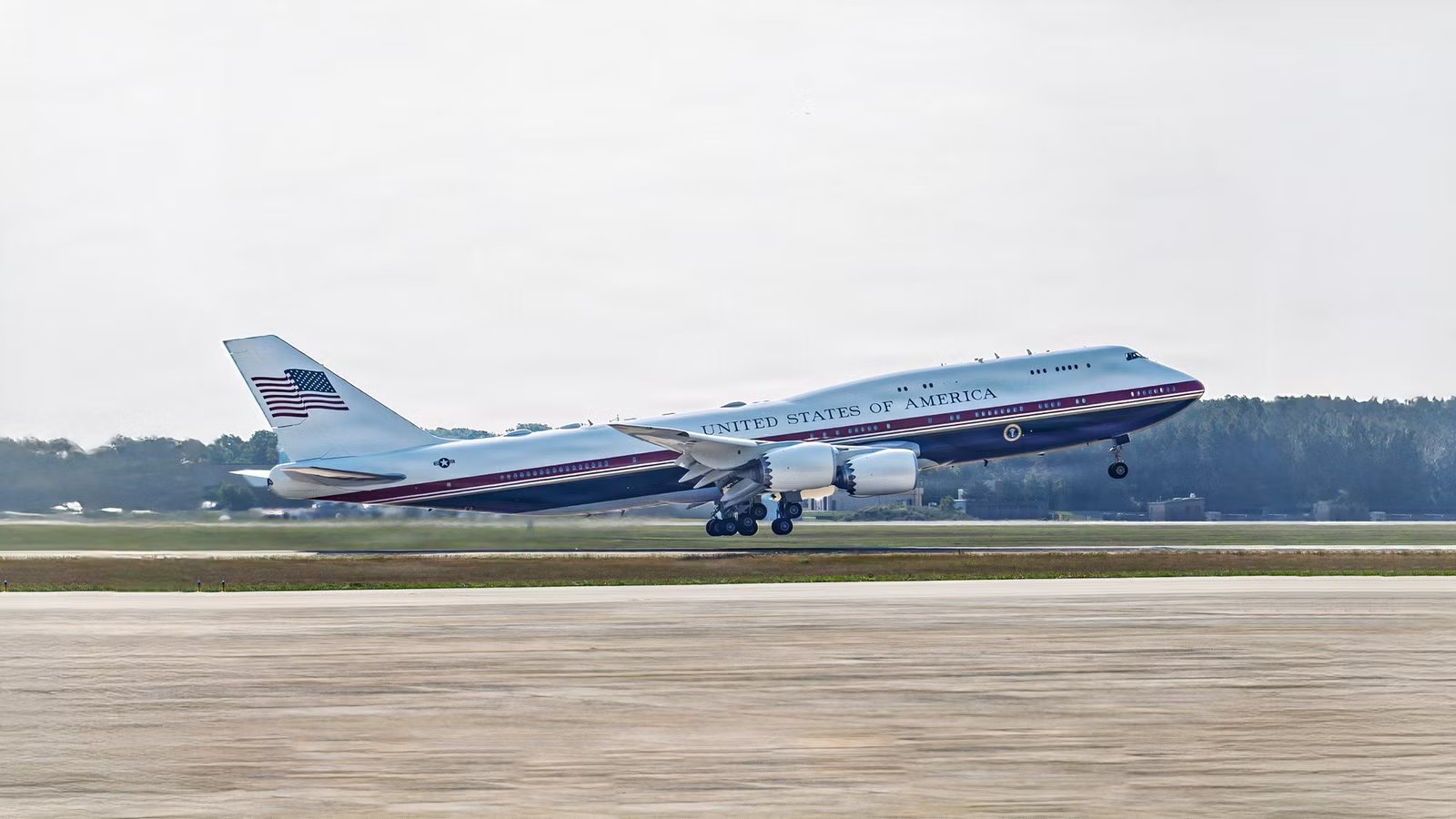
President Donald Trump recently flew aboard a newly designated Air Force One: a VIP-configured Boeing 747-8 Intercontinental gifted by the Qatari government for the first time. But its long-term fate remains far from settled. According to a recent report from The Wall Street Journal, Trump wants the $400 million aircraft to eventually become the centerpiece of his planned presidential library in Miami.
However, the idea of permanently parking a former Air Force One inside a private presidential library is already facing political, legal, and logistical headwinds. While the aircraft has just started serving as a “bridge” Air Force One due to Boeing’s delayed VC-25B program, its final destination is not guaranteed. The question now is whether this symbolic aircraft will ever legally and practically become part of Trump’s post-presidency legacy project.
Legal Groundwork: Why The Donation Is Allowed—For Now

At the heart of the controversy is the aircraft’s origin: a luxury 747-8 originally owned by the Qatari royal family. The aircraft was transferred to the United States Air Force (USAF) after discussions between the Qatari emir and Trump, who had reportedly asked to use the jet temporarily before a broader arrangement was reached.
Simple Flying previously reported that lawyers from the White House Counsel’s Office and the Department of Justice concluded the arrangement is legally permissible under current interpretations of federal law. Officials determined that accepting the aircraft does not violate bribery statutes or the Constitution’s emoluments clause, which restricts gifts from foreign states to US officials.
Attorney General Pam Bondi and White House counsel David Warrington have also reportedly concluded that transferring the aircraft to a presidential library foundation before the end of Trump’s term would be legally acceptable. The timeline under discussion would see ownership formally moved no later than January 1, 2029, with all associated costs, including military outfitting and operational modifications, covered by the USAF.
Political & Operational Obstacles To A Permanent Transfer

Despite legal clearance from executive branch lawyers, the aircraft’s final destination remains politically vulnerable. The aircraft is currently classified as a VC-25B “bridge” asset, meaning it fills the gap until Boeing delivers the new Air Force One aircraft, expected no earlier than 2028. That timing alone complicates any assumption that the jet will be surplus at the end of Trump’s term. Air Force leadership has emphasized that presidential mobility and security come first. That means the aircraft could remain in service well beyond the end of Trump’s term if new VC-25Bs are further delayed or operational needs persist.
A key unknown is also the role of future administrations. The Air Force ultimately decides where retired military aircraft are allocated. That means a future administration could simply refuse to release the aircraft to Trump’s library, even if earlier agreements exist.
“The mission is going to dictate how long the bridge is going to be around,” Gen. Dale White, who is overseeing the Air Force One program, told The Wall Street Journal. “We have mission requirements that we have to move the president of the United States and make sure he’s safe, secure and has mission communications.”
Additionally, even if the aircraft is eventually retired, Congress could intervene. Lawmakers have already signaled intent to block its transfer into private hands, and future shifts in congressional control could further complicate Trump’s plan to replicate the Ronald Reagan Presidential Library model, which displays a retired Air Force One.
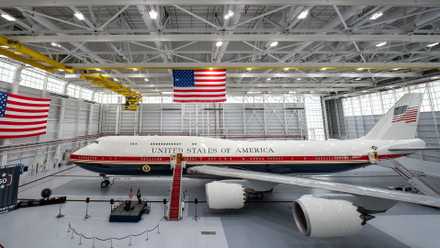
In Photos: Trump Unveils VC-25B ‘Bridge’ Air Force One After Rapid 10-Month Conversion
The president’s interim jumbo jet arrives.
A Symbolic Aircraft With An Uncertain And Problematic Legacy

Historically, retired presidential aircraft fall under the authority of the National Museum of the US Air Force in Dayton, Ohio, which oversees the allocation of former military aircraft to museums and institutions nationwide. The Ronald Reagan Presidential Library and Museum already houses a former Air Force One, but that aircraft had been fully retired and decommissioned before being transferred in 2005, long after it had left operational service. That distinction matters because it sets a clear precedent: aircraft entering museum life are typically no longer part of the active presidential fleet.
In this case, however, the Qatari-gifted 747-8 is not a conventional retired asset. It is a heavily modified, taxpayer-upgraded aircraft still considered part of the presidential transport system under its “bridge” Air Force One role. That ongoing operational status complicates the question of whether it can legally or procedurally qualify for museum loan programs at all, regardless of future plans for a presidential library display.
Even if legal and political barriers are eventually cleared, physical reality introduces another layer of difficulty. The 747-8 stretches roughly 250 feet (76 meters) in length, making integration into a Miami skyscraper-style presidential library a significant architectural challenge. Trump himself has acknowledged that fitting the aircraft into a building lobby would be “a trick,” underscoring how ambitious the concept is in practice, according to The Independent.
Past museum projects show just how complex such installations can be. The Smithsonian Air and Space Museum required extensive disassembly and reassembly of aircraft components to fit large aircraft into indoor spaces, whereas the Ronald Reagan Library project involved removing the wings and tail sections before transporting the aircraft and reconstructing them around a purpose-built pavilion. Replicating that level of engineering in a dense urban environment like downtown Miami would be significantly more complex, costly, and time-consuming.
Beyond engineering and regulatory constraints, the aircraft has also taken on a symbolic role in political discourse. Its acceptance and continued use have drawn criticism from both Republicans and Democrats, who question the optics of a foreign government gifting a luxury presidential aircraft—even if it has been formally transferred to the USAF and modified for government use. Supporters, meanwhile, argue it represents a practical solution during a period in which Boeing’s long-delayed Air Force One replacement program continues to struggle.
This aircraft now sits at the intersection of diplomacy, aviation logistics, and presidential legacy-building. Whether it ultimately becomes a permanent exhibit or remains in operational service under future administrations remains unresolved and could still be subject to congressional action or executive reversal.