dailynewsnblog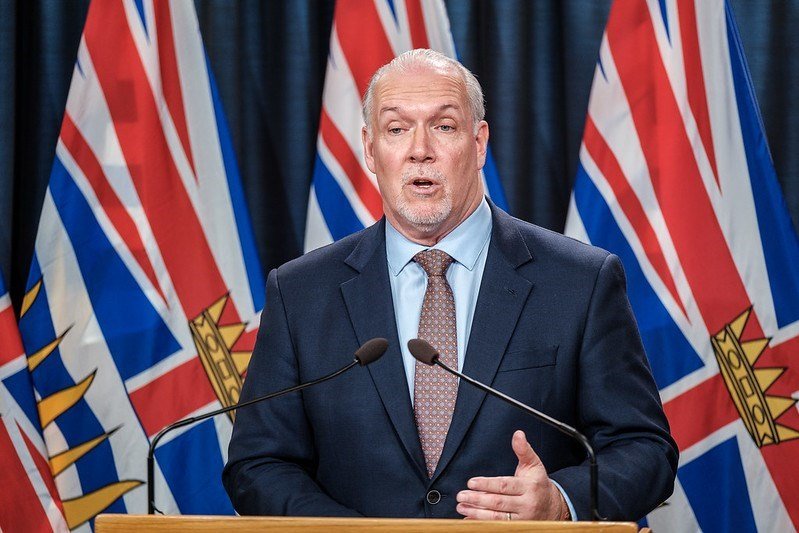

John Horgan would probably find it amusing to hear that his old government colleagues named the Site C dam after him. After all, at various points in his career, he thought the dam was a ridiculous, over-priced, ill-conceived, archaic, boondoggle of a political vanity project. Now the gigantic structure near Fort St. John bears his name.
Horgan would chuckle at that irony. Were he still with us, he’d probably try to sneak up to the site and tape onto the new plaque a copy of the infamous photo of him holding a sign that read, “Site C Sucks.”
“I think all of us know that if John were here today, he would not have allowed us to name the dam or anything after him,” Premier David Eby said Thursday, announcing the move at the legislature.
“And he would have used much rougher language than dam.”
Horgan’s history with Site C was as long and complex as the project itself.
A member of the BC NDP’s labour “brown” side that supported natural resource projects, Horgan was mostly in favour of Site C before he became party leader in 2014.
But after, he soured on the idea as he watched then-B.C. Liberal premier Christy Clark push and promote the idea.
Horgan blasted the dam at the 2015 BC NDP convention, saying the then $8 billion project could be better spent on a variety of other projects instead of “flooding a valley where we can grow food when we don’t need the energy.”
“It has massive consequences to the land, to our hydro utility,” Horgan said in 2016. “We don’t have a market for the power. And it strikes me that that’s bad policy, it’s bad government, and it’s also bad politics.”
Some days, Horgan would rail on the project. Other days, he’d retreat behind his technical promise that an NDP government would send the project for a review by the independent BC Utilities Commission before determining if it should be scrapped.
“If the review comes back saying it is not in the public interest, it won’t proceed,” he said in 2017.
That might have worked, had Clark and her then-Energy Minster Bill Bennett been so insistent on getting the dam beyond the point of cancellation.
“I will get it past the point of no return,” Clark declared at former Social Credit premier Bill Bennett’s funeral in 2016, crediting him for the vision of the large-scale hydroelectric dam.
The BC Greens thought Horgan’s promise of a “review” of Site C was a pretense for him to cancel it. And so they signed on to a power-sharing agreement following the 2017 election that toppled the Clark government and put Horgan’s NDP in power.
Much to the chagrin of the Greens, the review came back to say cancelling the in-progress dam construction—by then with almost $2 billion spent—would cost a fortune, and jack up BC Hydro rates into the double digits for two decades.
“At the end of the day, we’ve come to a conclusion that, although Site C is not the project we would have favoured or would have started, it must be completed,” Horgan said in 2017, six months after taking office.
At that point early in the Horgan mandate, he and Finance Minister Carole James were being careful with spending in order to keep the budget balanced and didn’t want to waste money cancelling Site C when it would eat into other plans.
It’s an almost quaint notion now, given the current NDP’s record $13 billion deficit. And in retrospect it was partly a moot point, given that Site C would double in cost during construction over the next seven years to end at $16 billion last year.
But Horgan was not the only one skeptical of Site C over many years. His Opposition energy critic (now energy minister) Adrian Dix made no bones about how foolish a project he thought it was.
“We won’t need Site C’s power for a long time after it comes into service (in 2024),” Dix said in 2016.
“It’ll have to be sold outside of B.C. for what we can get for it, and that means billions of dollars in losses. Secondly, since they announced Site C, the price of renewables as competitive choices that BC Hydro could have made has dropped precipitously.”
Both Dix and Horgan thought a large-scale hydro dam was a waste, compared to emerging solar, wind and geothermal projects. Dix accused Clark of locking B.C. into “a 70-year contract for a flip phone” with her dam plan, while other more modern options were possible.
Plus, Dix and Horgan were insistent that B.C. didn’t need the extra power.
The Liberals argued that a dam would provide reliable fixed power, to backstop intermittent wind and solar. They also forecasted that electricity demand was rising.
The Liberals were right. Almost a decade later, Dix is now exploring whether more hydroelectric dams are possible, to provide the fixed power B.C. needs to keep up with rising demand.
All of which leaves a complicated legacy for Horgan on Site C.
And Eby acknowledged that fully when describing the decision to name the dam after Horgan.
“It is a desire to reflect the complexity and the challenge of governing that John engaged in, in a style that was recognized and appreciated by British Columbians across the province,” said Eby.
“The naming reflects the nuance and the challenge of decisions that confronted John in his time and is emblematic of his integrity and his willingness to move forward in the best interests of British Columbians and to reconsider and ensure that the decisions he was making were in the best interests of British Columbians.”
Put that way, it’s actually very fitting. Horgan had strong feelings in opposition about the dam. But he re-evaluated in government, with new information, and made a different call. It was difficult for him to do. But history shows, ultimately, eventually, he got it right.
Perhaps viewed that way, as Eby suggests, the decision to name the dam after Horgan is the right call too.
Rob Shaw has spent more than 18 years covering B.C. politics, now reporting for CHEK News and writing for BIV. He hosts the weekly show Political Capital and has a NEW daily podcast, Political Capital Daily.
[email protected]
New newsletter alert! Stay ahead of the curve in B.C. politics. Get expert political analysis delivered straight to your inbox, plus inside scoops and other stories from across the province. Sign up here for the Capital & Coast newsletter.