dailynewsnblog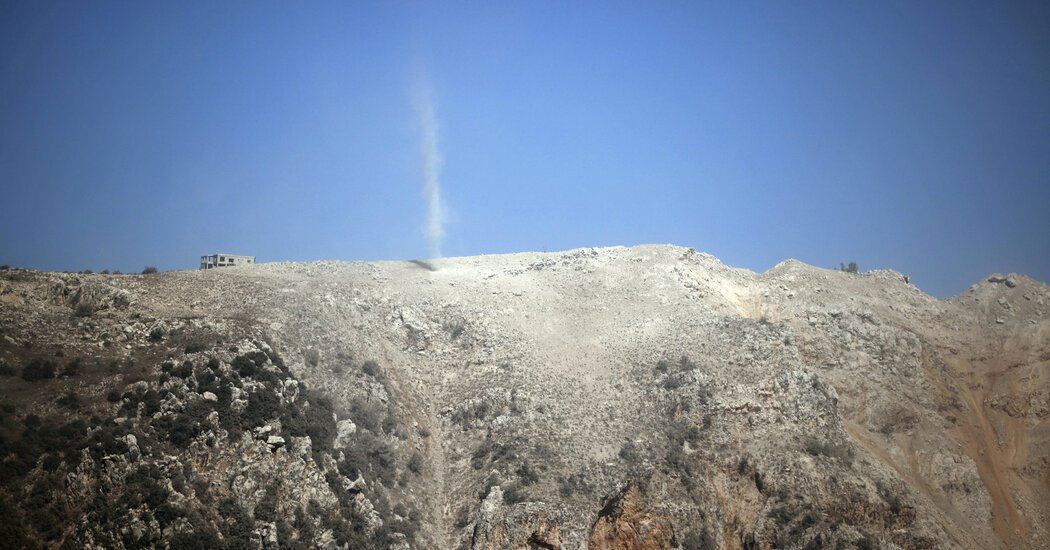
The Israeli military said on Saturday that it had killed several Hezbollah members overnight on a strategic ridge in southern Lebanon, challenging a fragile cease-fire between Israel and the Iran-backed militant group.
The encounter happened in the area of the Ali al-Taher ridge, a hilltop about six miles from the Israeli border where violence has flared in recent days. The Israeli military said it had “struck” Hezbollah fighters in an Israeli-occupied area where its soldiers were operating, and that an Israeli soldier was wounded.
Hezbollah did not immediately address Israel’s claim.
A cease-fire between Israel and Hezbollah has barely held in recent weeks, just as Israel and Lebanon have worked to implement a separate, U.S.-brokered agreement to end months of fighting. That deal calls for Israel to gradually withdraw from territory in southern Lebanon.
Hezbollah has rejected the deal, saying it effectively allowed Israel’s continued presence in southern Lebanon and that the group would not give up its weapons without an Israeli withdrawal.
Clashes have persisted in southern Lebanon, with daily reports of airstrikes, artillery shelling, demolitions and sonic grenades, according to the United Nations. But Saturday was the first time Israel announced deaths from the fighting since July 15, raising fears of a renewed escalation.
The latest conflict between Hezbollah and Israel erupted on March 2, after the group attacked Israel in solidarity with Iran following the U.S.-Israeli strikes that began the war with Iran. The fighting has killed more than 4,300 people in Lebanon, and Israel now occupies large swaths of the country’s south. Israeli officials say at least four Israeli civilians and more than 30 soldiers have been killed.
In recent months, the Ali al-Taher ridge has become one of the most strategically significant areas in the conflict. Lebanese and Israeli officials say they believe Hezbollah has established one of its largest underground installations beneath the ridge. Israel says the complex has for years served as a crucial command center for planning and launching attacks against its territory.
This week, the Israeli military said, Hezbollah launched an explosive drone at one of its vehicles on the ridge. A Hezbollah spokesman said the group did not claim responsibility for an operation in the area, and accused Israel of using “false pretexts” to continue attacks in Lebanon.
The area is about three miles north of Beaufort, a Crusader castle that Israel said it captured on May 31. On Friday, Benjamin Netanyahu, the Israeli prime minister, and Israel Katz, the defense minister, said in a joint statement that the military had destroyed what it called Hezbollah’s “terrorist tunnels” in the area, which they claimed formed a key part of the group’s plan to infiltrate communities in northern Israel.
As recently as May, the ridge was beyond the area that Israel had occupied several miles inside southern Lebanon. Israel marks the boundary of this zone with a yellow line on its maps and views anyone within it as a legitimate military target. In June, however, Israel redrew those boundaries, extending the yellow line to include the ridge.
The U.S.-brokered agreement between Israel and Lebanon calls for the Lebanese Armed Forces to move in and secure the areas as Israel slowly withdraws, and to facilitate the return of displaced residents. Officials are expected to discuss more details in Rome this week.
The first areas slated for implementation, described as “pilot zones,” are intended to test the broader agreement reached last month. Three villages have been designated in the first phase of the withdrawal plan.
But the framework has been criticized in Lebanon because it sets no fixed timetable for Israel’s withdrawal, and is tied to the Lebanese government’s tentative efforts to disarm Hezbollah, a goal it has so far pursued in vain.
Abdi Latif Dahir and Hwaida Saad contributed reporting.