dailynewsnblog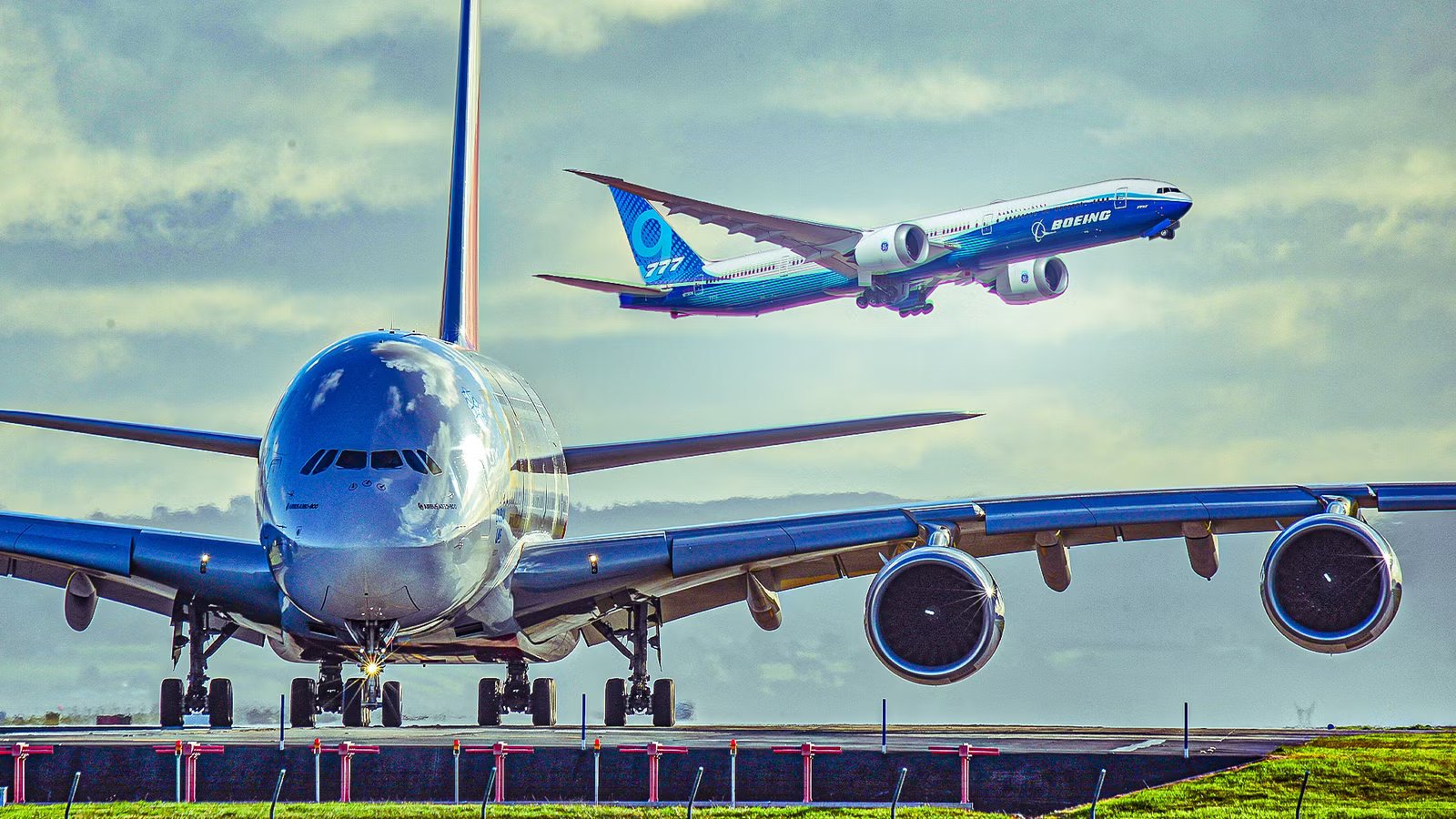
The question of whether the upcoming Boeing 777X truly represents a 20% reduction in operating costs compared to the Airbus A380 is something that many carriers want a solid answer to. Operating costs are somewhat of a financial survival metric that determines the feasibility of ultra-long-haul routes and the future of hub-and-spoke networks. This guide will dismantle the marketing claims to see how much of that percentage is grounded in real-world physics and how much is clever statistical positioning.
The A380 was designed to solve airport congestion by carrying over 500 passengers in a single flight, and the 777X aims to deliver similar capacity with the cost performance of only two engines. We will explore the role of the GE9X powerplant, the impact of composite wing technology, and why carriers like  Emirates are transitioning their fleets away from the four-engine giant in favor of Boeing’s latest flagship.
Marketing Doesn’t Apply To All Comparisons

The 20% figure is technically accurate in a marketing context, but it is often misapplied to direct head-to-head comparisons with the Airbus A380. Boeing’s primary claim of a 20% reduction in fuel burn and emissions specifically targets the aircraft the 777X is designed to replace, the Boeing 777-300ER. When the lens is shifted to compare the 777X directly against the A380, the efficiency advantage remains significant but drops to approximately 13% on a per-seat basis, depending on cabin configuration and passenger load.
If an A380 is flying with a light load, its per-seat costs skyrocket because the airline is still paying to keep four massive engines running and a massive airframe in the sky. In contrast, the 777X is designed to be profitable across a much wider range of load factors. Industry analysts noted as early as 2014 that even a 13% fuel-per-seat advantage would be enough to fundamentally challenge the A380’s business case, which is exactly what has played out in the market over the last decade.
The 20% figure became a rallying cry for Boeing because it represented a generational leap in twin-engine technology. The 777-300ER has been a staple of the long-haul industry for years, and a 20% improvement over such a successful aircraft is a massive achievement. However, for a passenger-heavy airline like Emirates or  Singapore Airlines, the decision to retire an A380 is more nuanced. They are looking far more at landing fees, maintenance cycles, and the reality that two engines are simply cheaper to maintain than four.
Powering Lower Costs

The cornerstone of the Boeing 777X’s cost-saving narrative is the General Electric GE9X, a powerplant that effectively renders the four-engine configuration of the Airbus A380 obsolete. Each GE9X engine delivers approximately 110,000 lbs (489 kN) of thrust, allowing just two of these massive units to propel an aircraft of nearly the same capacity as the quad-engine A380. The primary advantage here is the lack of the inherent financial penalty of maintaining four separate sets of turbines, fuel pumps, and cooling systems. By halving the number of engines, airlines immediately reduce their engine-related maintenance labor and spare-parts inventory by nearly 50%.
The GE9X also introduces a generational leap in thermal and propulsive efficiency. It features a 134-inch (340 cm) front fan, which is physically wider than the fuselage of a Boeing 737, enabling a bypass ratio of 10:1. This massive fan architecture allows the engine to move a larger volume of air at lower speeds, which General Electric claims provides a 5% lower specific fuel consumption compared to any other engine in its class. A claim like this makes a massive difference for airlines, as a 5% improvement in fuel burn across a fleet of 20 aircraft can translate into tens of millions of dollars in annual savings. However, until the 777X enters commercial service in 2027, these figures remain based on flight test data rather than thousands of cycles in varying environmental conditions.
|
Feature |
GE9X (Boeing 777X) |
Trent 900 (Airbus A380) |
|
Engine Count |
Two |
Four |
|
Fan Diameter |
134 in (340 cm) |
116 in (295 cm) |
|
Bypass Ratio |
10:1 |
8.7:1 |
|
Total Thrust |
~220,000 lbs (978 kN) |
~280,000 lbs (1,245 kN) |
The sheer scale of the GE9X core also plays a vital role in reducing the environmental tax that modern airlines must pay in the form of carbon credits and noise penalties. The engine’s overall pressure ratio of 60:1, the highest in commercial aviation history, ensures that every drop of jet fuel is squeezed for maximum energy. This technical precision allows the 777X to stay roughly around Operating Stage 5 noise limits, which is critical for operators flying into noise-sensitive airports like  London Heathrow or
  Frankfurt.

What Makes GE9X The World’s Monster Jet Engine?
Unravel the secrets of the massive GE9X, a jet engine that redefines scale and efficiency in the skies.
The Long Road To Future Efficiency

The global aviation industry has largely voted with its checkbook, yet the endorsement of the Boeing 777X is tempered by a growing sense of frustration among major carriers. Emirates reaffirmed its commitment in 2025 by ordering an additional 65 airframes, bringing their total backlog to a staggering 270 aircraft. President Sir Tim Clark has remarked that the airline will not accept the 777X until it has undergone a rigorous period of “hell on earth” testing to ensure it meets the promised performance metrics. This highlights the industry’s cautious stance as the 20% cost reduction is highly desirable, but only if the aircraft can maintain the high utilization rates required of a long-haul workhorse.
The delay in the delivery schedule is where the theoretical cost savings of the 777X meet the harsh reality of airline balance sheets. Originally slated for a 2020 entry into service, the program has faced a series of setbacks that have pushed the first deliveries to the beginning of 2027. For launch customers like  Lufthansa, this seven-year delay represents a massive opportunity cost. Instead of retiring older, less efficient aircraft, these airlines are forced to invest millions in heavy maintenance for their existing fleets of Boeing 777-300ERs and Airbus A340s. Boeing has recorded a $4.9 billion charge in connection with the program’s shifting timeline, but the airlines are the ones bearing the operational burden of flying yesterday’s technology while waiting for the efficiency of tomorrow.
On paper, the Boeing 777X will indeed be the A380 killer in terms of operating economics, but it arrives at a time when the certification landscape has fundamentally changed. Following the heightened controls by aviation authorities worldwide, the 777X is being scrutinized more than any widebody in history. This means the initial burn-in period for the aircraft might see higher-than-expected maintenance costs as crews and technicians adapt to the complexity of the folding wingtips and the GE9X core.
A More Suitable Comparison

The comparison to the Airbus A380 is often used to justify the Boeing 777X’s existence. However, the real-world rival that provides a more balanced perspective is the Airbus A350-1000. Unlike the A380, which is no longer in production, the A350-1000 is a modern, clean-sheet design that is already flying for major carriers like  Qatar Airways and Cathay Pacific. When looking at the 20% cost claim, it is important to note that the A350-1000 actually beats the 777-9 in several key trip cost metrics due to its significantly lighter airframe. The A350 is constructed from over 70% advanced materials, including 53% composites and 14% titanium, whereas the 777X remains a primarily metallic aircraft with only about 30% composite material, mostly in its wings.
This difference in material philosophy has a direct impact on the scales. The Boeing 777-9 has an empty weight of approximately 400,000 lbs (181,400 kg), which is nearly 116,000 lbs (52,600 kg) heavier than the A350-1000’s empty weight of 284,000 lbs (128,800 kg). This weight penalty means that the 777-9 must work significantly harder to get off the ground, consuming more fuel per nautical mile just to move its own structure. While the 777-9 offers a lower cost per seat because it can carry roughly 426 passengers compared to the A350’s typical 369, it is the A350-1000 that often wins on trip cost, regardless of how many people are on it.
For many airlines, the choice between the 777X and the A350-1000 comes down to the specific purpose. The 777X is the clear winner for slot-constrained airports, where an airline wants to cram as many passengers as possible into a single departure window to maximize revenue. However, the A350-1000 provides more flexibility for thinner routes where filling over 400 seats might be a struggle. Crucially, the A350-1000 has already proven its reliability over millions of flight hours, whereas the 777X is still a question mark in many financial models. This lack of operational history is a significant risk that some airlines are not willing to take, especially after the high-profile delays that have plagued the 777X program.

Why Might The World’s Long Range Leader Have Boeing Worried?
A game-changing aircraft has Boeing on high alert. What’s behind the growing concern?
Delays Keep On Coming

The road to a 20% reduction in operating costs is paved with significant risks that cannot be ignored. Recent reports from early 2026 indicate that even as the aircraft nears final certification, new durability issues have been identified with the GE9X engines during routine inspections. This follows a high-profile grounding of the test fleet in 2024 after structural cracks were found in the titanium thrust links that connect the engines to the wings. For an airline, these technical hiccups translate directly into higher-than-expected maintenance costs and the risk of grounding a brand-new fleet, a scenario no CEO wants to explain to shareholders.
Another unique risk factor is the 777X’s signature folding wingtips. They allow the aircraft to fit into standard Code E airport gates, avoiding the expensive terminal modifications that hampered the A380, but they also introduce a new mechanical failure point that older aircraft don’t have. To satisfy strict FAA and EASA certification standards, Boeing has had to implement complex multi-layered alerting systems and mechanical locking bolts designed to make in-flight unfolding physically impossible. However, these systems require precise maintenance; any wear or corrosion on the hinges could lead to operational delays. If a wingtip fails to extend properly before takeoff, the aircraft could miss its departure slot, costing the airline thousands of dollars in fuel and passenger compensation.
Case studies of early engine programs, like the GE90 or the Trent XWB, show that durability fixes are a normal part of a jet engine’s maturation. However, the GE9X is operating at such extreme temperatures and pressures that the margin for error is razor-thin. Industry analysts warn that if these durability concerns are not fully resolved by the 2027 entry into service, the promised 20% fuel savings could be partially offset by the high cost of frequent engine overhauls. At least for now, no 777X has yet flown in the harsh, sandy environments of the Middle East or the humid climates of East Asia for thousands of cycles, so the true maintenance cost remains a theoretical projection rather than a proven fact.
Only Time Will Tell

The Boeing 777X’s 20% cost reduction is a valid engineering achievement, but it is not a magic promise that guarantees profitability. This figure represents the peak potential of the aircraft when compared to the outgoing 777-300ER, but when measured against the Airbus A380, the efficiency gain is closer to 13% per seat. This gap is the difference between a route being a financial liability or a consistent profit-generator.
The true cost of the 777X over the next decade will be determined by Boeing’s ability to navigate the final stages of its certification and the real-world durability of the GE9X engine. While the folding wingtips and massive composite wings offer unprecedented aerodynamic advantages, they also represent a shift toward higher mechanical complexity. For travelers and enthusiasts, the 777X represents the final evolution of the widebody jet, a machine that mimics the capacity of an A380 while maintaining the point-to-point flexibility that modern passengers demand.
The 777X stands as a testament to the fact that in aviation, bigger is no longer better; smarter is. By focusing on squeezing every possible ounce of energy out of a two-engine layout, Boeing has created an aircraft that will likely dominate the high-capacity market for the next 20 years. The A380 will always be remembered for its grandeur and unrivaled passenger experience, but the 777X is the aircraft built for the reality of the future global economy, where efficiency is the only metric that truly matters.