dailynewsnblog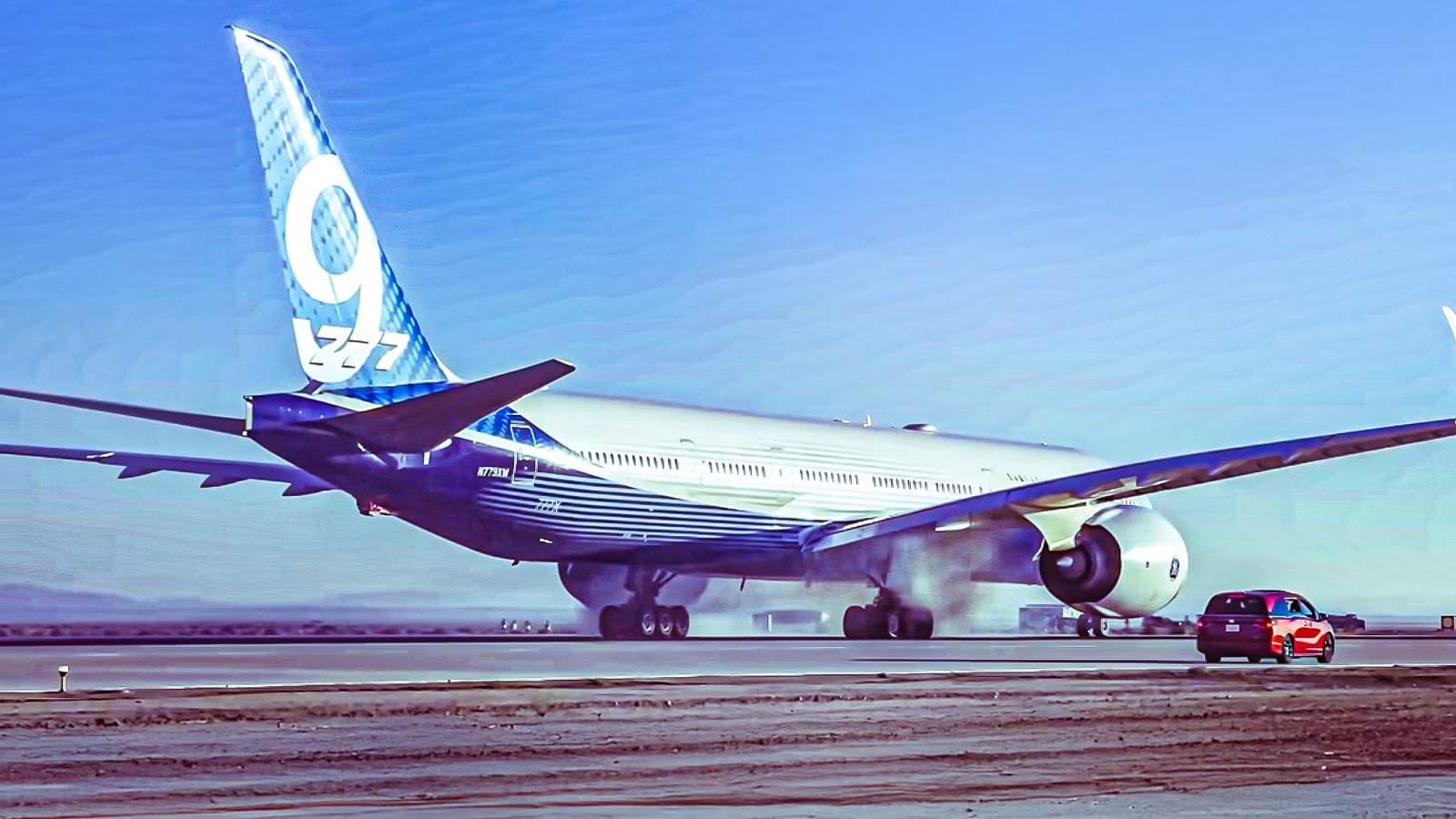
Widebody landing rolls always look and sound dramatic. Passengers feel the firm touchdown, hear the engines spool up in reverse, and sense the deceleration as spoilers deploy and brakes begin biting into the runway. On a large aircraft, reverse thrust is one of the most visible and audible parts of the arrival, so it is easy to assume that it is essential to stopping the aircraft. Which is what makes the Boeing 777X question so compelling: is it really true that this giant new twinjet does not need reverse thrust to come to a full stop?
The short answer is yes. But not because the 777X has some unusual exemption. Under Federal Aviation Administration (FAA) and European Union Aviation Safety Agency (EASA) certification rules, any modern transport-category airliner is certified to be able to land and come to a full stop without relying on reverse thrust. What makes the 777X interesting is not the yes-or-no answer, but how  Boeing is proving it. The manufacturer is currently working through a layered brake-certification process for the 777X that started last year, and which has recently produced some dramatic highlights ahead of the aircraft’s anticipated certification later this year. So let’s take a closer look at what it takes to certify the braking system of what will be the world’s largest production jetliner.
Certifying A New Braking Installation

The 777X’s braking systems are produced by Safran, the world’s largest manufacturer of aircraft landing gear and a long-term supplier for previous Boeing 777 generations. The company says the braking system for Boeing’s latest widebody still has some common features with its predecessors.
“A new generation of carbon brakes designed around increased capability, enhanced reliability, lower operating costs and minimal weight, while keeping strong commonality with the in-service 777-300ER and 777-200LR.”
So it’s important to note that Boeing is not inventing a brand-new braking philosophy here, it is refining a proven architecture for a new variant. However, Safran has optimized the package in very specific ways: a titanium torque tube, clipless stators, a new wheel design with easily replaceable parts, and an oxidation-protection system aimed at improving durability and corrosion resistance.
Because this is a new brake installation on a new aircraft derivative, Boeing has to prove to regulators that the braking assemblies can absorb the required landing and rejected-takeoff energy loads and manage heat efficiently, including at worn-brake limits and under extreme conditions. That need for proof leads directly to the three very important certification test areas.
The Three Most Important Brake Tests

At the center of the 777X brake-certification process are three FAA-defined tests, as outlined in 14 CFR § 25.735, which sets the certification requirements for transport-aircraft brake systems. The first test is the standard Design Landing Stop, which is a normal operational landing stop at maximum landing weight. The Most Severe Landing Stop levels this up with the most critical combination of landing weight and speed.
Beyond landing scenarios, the Maximum Kinetic-Energy Accelerate-Stop is a test for rejected takeoffs at the most critical combination of takeoff weight and speed, all with fully worn brakes. The FAA requires all three to be substantiated by dynamometer testing of the wheel, brake and tire assembly, which is why the brake certification story starts long before the airplane rolls onto a runway.
|
Test |
What it represents |
Why it matters |
|---|---|---|
|
Design Landing Stop |
Normal landing stop tested at different brake wear levels |
Proves the brakes can handle a routine landing |
|
Most Severe Landing Stop |
Worst case weight-and-speed landing combination |
Tests the ugliest landing case, not just the routine one |
|
Maximum Kinetic-Energy Accelerate-Stop |
Worst rejected takeoff case |
Validates the high-speed abort scenario that drives brake energy hardest |
The order of the work matters. First comes analysis, where Boeing determines how much kinetic energy the brakes must be able to absorb in the critical landing and aborted-takeoff cases. Then comes dynamometer testing, where the brake assembly is run on a rig rather than under a flying airplane. Only after that does the work move into testing with actual aircraft, where Boeing validates actual braking performance, system behavior, and runway handling on the 777-9 itself.
The certification logic is what sits behind the headline claim. The 777X must be able to complete these tests without reverse thrust being utilized at all. To achieve that, Boeing has been very busy at facilities in Oklahoma and California, with both testing campaigns garnering a lot of public attention.

How Exactly Does Reverse Thrust On A Plane Work?
It plays a vital role in keeping air travel safe and efficient.
The Dry Runway Testing In Oklahoma

Last year, the 777X certification team spent more than two months at Clinton-Sherman Airport (CSM) in Oklahoma, completing a series of braking certification tests for the new widebody. The testing required very specific weather conditions, including calm winds (below ten knots) and dry runways. Madison Strauss, test director, explains why:
“Our analysis team gave us really tight wind limitations, so the data we collect focuses on the brakes’ performance, not other influencing factors. If the winds exceed those on a particular day, we can’t do that test.”
The weather proved to be far more unpredictable than expected, causing the team to readjust the plan constantly. For example, when high winds meant brake testing couldn’t happen, the team flew to Lubbock, Texas, for the day to pick up crosswind testing. Twice, the weather was so severe that the team had to fly elsewhere to avoid potential hail damage to WH001, one of the five 777X test aircraft that was being used for that portion of the certification.
The team returned home after a trip that took more than twice as long as originally planned, but it had accomplished the foundational brake certification tests. Specifically, the team focused on dry runway testing for the design and severe landing stops, using hard braking to test performance and wheel behavior at the aircraft level. Terry Beezhold, 777X vice president and general manager, would go on to praise the team for the “successful completion of dry runway testing”, saying:
“This team never gave up. They demonstrated impressive resolve and tenacity as they fought for every test point. I am so proud of this team and what they accomplished.”
The Headline Moment At Edwards AFB

If Oklahoma was the long, weather-sensitive workhorse campaign, Edwards Air Force Base was where Boeing carried out the single most dramatic brake-certification event it has made public so far. On April 1, Boeing said the 777X completed maximum brake energy testing in California, describing it as a simulation of one of the most challenging situations the airplane could face. The work was carried out by the 777X certification team with support from the 412th Test Wing at Edwards.
The test scenario was the classic worst-case aborted takeoff. The aircraft was loaded to its highest takeoff weight, accelerated to around 190 knots — just below rotation speed — and then the takeoff was rejected with full braking applied. Matt England, 777X flight test engineer, was especially clear on two points: no reverse thrust was used, and the brakes had been intentionally machined to a fully worn condition to simulate the toughest certification case:
“We don’t use thrust reversers, so the brakes provide 100% of the stopping power of the airplane. And we do the condition on brakes that are intentionally machined down to 100% worn, so it’s a worst-case simulation. It’s just conditions that you’ll never see in service, but regulations require it, and we test it.”
The results of the testing produced some astonishing numbers: Boeing says that the test required dissipating kinetic energy equivalent to several hundred megajoules entirely through the braking system. It also generated more than a billion foot-pounds of torque, while brake temperatures climbed beyond 2,500°F (1,370°C).
|
Edwards maximum brake-energy test |
Details |
|---|---|
|
Test aircraft |
Boeing 777-9 |
|
Location |
Edwards Air Force Base, California |
|
Completion date |
April 1, 2026 |
|
Test type |
Maximum brake energy / aborted takeoff certification test |
|
Aircraft condition |
Loaded to maximum takeoff weight |
|
Speed reached |
Approximately 190 knots |
|
Thrust reversers |
Not used |
|
Brake condition |
Intentionally machined to fully worn |
|
Peak brake output |
More than 1 billion foot-pounds of torque |
|
Peak brake temperature |
More than 2,500°F (1,370°C) |
|
Post-stop event |
Fuse plugs melted as designed, tires deflated safely |
Despite the extreme circumstances and forces, the 777X performed without issue. While engineers closely monitored brake energy absorption, stopping distance, and system redundancy throughout the process, emergency crews waited five minutes before approaching the aircraft, mirroring real-world scenarios. Ultimately, Boeing said the testing was completed successfully, marking a key milestone on the road to certification for the 777X.

Stopping Power: Boeing 777-9 Brakes Reach 2,500 Degrees In Critical Aborted Takeoff Test
The aircraft pushed the limits of its advanced braking system during a simulated maximum-weight, high-speed aborted takeoff.
Further Wet Runway Testing

If the dry-runway work answers the headline question, wet-runway work explains the caveat. Boeing has said that after the dry-runway campaign, the 777X program would continue with wet-runway braking evaluations. This is not simply a repeat of dry-runway stopping with a little water added. The wet runway testing looks to specifically examine the performance of the anti-skid system (Condition E of the FAA requirements) and how tire friction changes, with regulators needing to know how much performance margin the airplane loses.
FAA guidance defines a runway as wet when more than 25% of the surface is covered by visible dampness or water up to 1/8 inch, while EASA guidance for wet-runway anti-skid testing says the runway should be well soaked but not flooded. EASA also says at least three complete stops, or equivalent segmented stops, should be performed on a wet runway at appropriate speeds and energies to cover the critical operating modes of the anti-skid system.
These are not maximum-energy brake tests in the Edwards sense. They are about braking efficiency, directional control, and system behavior when the runway is slippery but not contaminated:
|
Wet-runway certification focus |
What regulators want to understand |
|---|---|
|
Runway condition |
Wet enough for anti-skid activity, but not flooded |
|
Braking efficiency |
How much stopping performance is lost versus dry pavement |
|
Anti-skid behavior |
Whether the system cycles effectively across the speed range |
|
Controllability |
Whether the aircraft remains directionally manageable under braking |
|
Reverse thrust role |
Whether and how reverser credit can be used in wet accelerate-stop calculations |
|
Test depth |
At least three complete or equivalent segmented wet-runway stops |
Wet-runway testing also changes the reverse-thrust picture. The FAA excludes reverse thrust in all dry runway testing, but it is included and measured on a wet runway under certain required conditions. That is why the wet-runway campaign will be so important for the 777X. It is the final hurdle for the brake testing, and where Boeing has to show not just that the aircraft stops, but how braking, anti-skid and, where permitted, reverse thrust interact once the runway is no longer dry.
Now Comes The Push To Delivery

The next big symbolic step for the 777X is the first flight of a production-standard aircraft. Reuters has reported that Boeing plans the first flight of a production 777X this month, using a  Lufthansa-bound 777-9 at Paine Field (PAE) in Seattle. That aircraft has already been going through fuel tests ahead of engine tests, and the production-flight milestone is an important one for Boeing as the FAA wants a production example to take part in delivery-style certification work.
The wider certification of the 777X is ongoing, with Boeing saying at an investor conference last month that it had completed the third of five certification stages. The FAA confirmed this days later, saying that the 777X was cleared into the fourth phase of certification testing. That was an important sign of momentum after years of delay, but it also underscored that Boeing is still in the middle of the process rather than at the finish line.
The target for first delivery of the long-delayed 777X program remains early 2027. Which means that the 777X testing team is going to be very busy in the months ahead. More testing, more system-by-system validation, the production-flight milestone, and a continued effort to move the 777X through the final certification stages. That is why the reverse-thrust question is interesting, but ultimately a little too simple. Yes, the 777X has to be able to stop without it. The real story is that Boeing is still proving, one brake test at a time, that the biggest new jet in its lineup can do exactly that under the conditions regulators care about most.