dailynewsnblog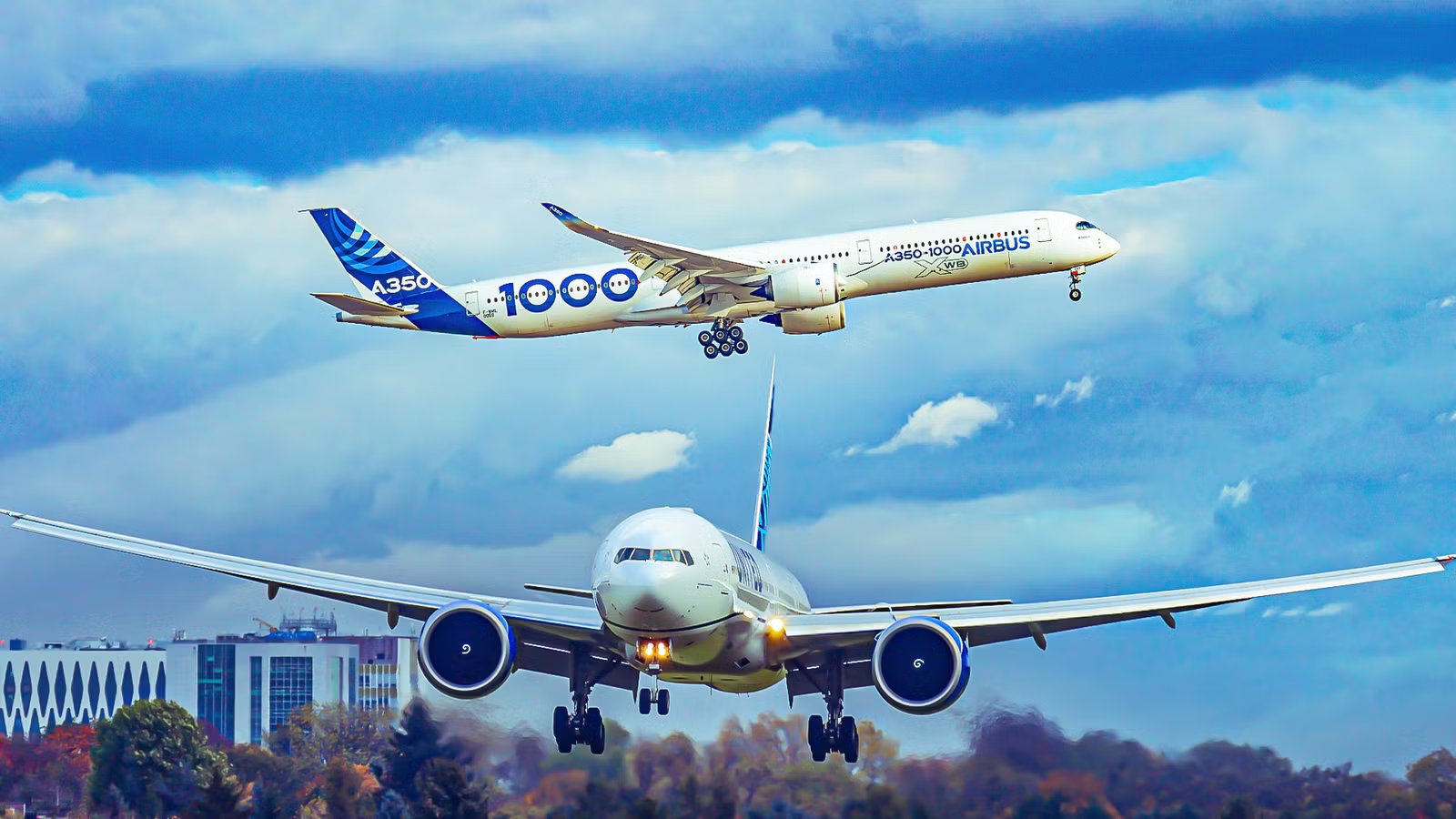
While the primary competitors to the Airbus A350-900 are the Boeing 787-9 and 787-10, the top competitor to the stretched Airbus A350-1000 is the Boeing 777-300ER. Following the termination of the Airbus A380 and the Boeing 747-8, these are now the flagship products of Airbus and Boeing. Boeing is currently working on replacing the Boeing 777-300ER with the delayed 777-9 in an effort to keep it competitive with the A350-1000.
The Boeing 777 family is wider than the A350 family, but is it heavier? Note that size and weight do not neatly correlate to passenger capacity. Due to changes in the exit doors, the 777-9 will have a markedly decreased maximum certifiable passenger count than the 777-300ER, placing it just behind the A350-1000. When reading this article, it is useful to keep in mind that the 777-300ER is generally a bigger, but older and shorter-ranged aircraft, relative to the cleansheet and longer-ranged A350-1000.
Boeing 777-300ER Vs A350-1000 Dimensions

In terms of physical dimensions, the Boeing 777-300ER is almost the same as the A350-1000 in some aspects. The -300ER’s length is 242.4 feet (73.9 meters), making it just slightly longer than the -1000’s 242.1 feet (73.8 meters). The wingspans are also almost the same, as they are built to maximize airport Code E regulations. The -300ER’s wingspan is around two inches longer at 212.7 feet (64.8 meters) compared with 212.5 feet (64.75 meters).
For comparison, the A350-900 is 212.2 feet (66.8 meters) long, and the Boeing 777-200LR is 209.1 feet (63.7 meters) long. They have the same wingspans as their stretched relatives. In terms of height, the A350-1000 stands 56 feet (17.08 meters) tall, making it around four feet shorter than the -300ER’s 60-foot (18.5-meter) stature. The -200LR is the tallest at 61 feet, and the -900 is the shortest at 55 feet. Where the 777 really shines through as a bigger aircraft is in the interior cabin width.
The old production stand for the A350-1000 came with an internal cabin width of 18 feet and five inches (5.6 meters). This was increased by four inches to 18 feet and nine inches (5.7 meters) with the new production standard. The -300ER’s cabin width is 19 feet and three inches (5.86 meters). The A350 is typically configured 9-abreast, except on some 10-abreast low-cost carriers. The -300ER is typically configured 10-abreast, except on some higher-end Asian carriers where it is configured 9-abreast.
Boeing 777-300ER Vs A350-1000 Dry Weight

The Operating Empty Weight (OEW) is crucial for determining payload capacity and fuel requirements. It is the total weight of an aircraft that includes the structure, engines, all permanent equipment, as well as baggage, crew, and necessary fluids like oil, but not passengers, cargo, or usable fuel. The OEW is necessarily higher than the Manufacturer Empty Weight (MEW) but below the Max Take-Off Weight (MTOW).
The typical OEW for the A350-1000 is 342,000 lbs (155 tonnes), while the MEW is 284,000 lbs (129 tonnes). The Boeing 777-300ER’s MEW is 350,000–355,000 lb (159–161 tonnes), and this rises to around 370,000 lbs (168 tonnes) for the OEW. For reference, the OEW for the A350-900 is typically 279,000-289,000 lbs (127 to 121 tonnes) and around 340,000–355,000 lbs (154 to 161 tonnes) for the -200LR.
|
A350-1000 vs 777-300ER (per Airbus, Boeing) |
Airbus A350-1000 |
Boeing 777-300ER |
|---|---|---|
|
Length |
242.1 feet (73.8 meters) |
242.4 feet (73.9 meters) |
|
Manufacturer Empty Weight |
284,000 lbs (129 tonnes) |
350,000–355,000 lb (159–161 tonnes) |
|
Operating Empty Weight |
342,000 lbs (155 tonnes) |
370,000 lbs (168 tonnes) |
|
Maximum Take Off Weight |
703,000 lbs (319 tonnes) |
775,000 lbs (351 tonnes) |
|
Max Certified Passengers |
480 |
550 |
|
Advertized Range |
8,700-9,000 nautical miles |
7,350 nautical miles |
The operating empty weight is about the same for the A350-900ULR (Ultra Long Range). When it comes to OEW, the -300ER is around 20% heavier than the -1000. Airbus is currently investigating stretching the A350 to the A350-2000. If this happens, it’s unclear what the empty weights, operating empty weight, and maximum take-off weights will be.

Here’s How Much More The Airbus A350-1000 Costs Compared To The A350-900
The price difference between the two variants.
Boeing 777-300ER Vs A350-1000 MTOW

Not only did the new production standard for the A350 family increase the internal cabin width, but it also increased its MTOW. The new production standard removed up to 1.2 tonnes of weight while increasing the MTOW by three tonnes. This means the A350-900 now has an MTOW of up to 624,000 (283 tonnes), and the A350-1000 has a maximum take-off weight of up to 703,000 lbs (319 tonnes). Some sites may list the slightly higher 710,000 lbs (322 tonne) figure, but that is for Maximum Taxi Weight.
The Boeing 777-300ER has an MTOW of 775,000 lbs (351 tonnes), while the -200LR is down slightly at 766,000 lbs (348 tonnes). This means the -300ER has an MTOW around 10% greater than that of the A350-1000, making it the heavier aircraft in this scenario. The -200LR is also significantly heavier than the -900.
The same maximum take-off weight as the upcoming 777-9 that replaces the -300ER. Boeing lists the 777-9 as having an MTOW of 775,000 lbs (351 tonnes), while the 777-8 will have an MTOW of 805,000 lbs (365 tonnes). This suggests the 777-8 will have an MTOW increased by around 40,000 lbs compared with the -200LR. Note that the maximum landing weights of all these aircraft are significantly lighter than the maximum take-off weights.
Boeing 777-300ER Vs A350-1000: Fuel Loads

One of the most important questions for any aircraft is how much fuel it can carry. The -300ER and -200LR have an approximate usable fuel load of 321,000 lbs, with this increasing to 350,410 lbs for the Boeing 777X due to its larger wings. This means that the standard A350 aircraft has a lower published usable fuel capacity and fuel weight than the 777-300ER, according to official manufacturing data. Separately, the 777-200LR is also able to carry auxiliary fuel tanks that boost its max fuel load to around 358,000–362,000 lbs.
The usable fuel of the A350-1000 is 275,000–290,000 lbs, giving it a higher fuel volume than the standard A350-900’s 238,000–240,000 lbs. However, Airbus is currently building the special A350-1000ULR subvariant specifically for Qantas’ Project Sunrise to connect Sydney with London and New York. This comes with additional tanks that will add another 5,280 US gallons (20,000 liters). The A350-900ULR increases the usable fuel load to 275,000–290,000 lbs. The -900ULR uses the same tank structure, but optimizes/utilizes more of the center tank capacity, adding around 6,340 US gallons (24,000 liters) of usable fuel without adding new tanks.
Boeing advertises the -300ER with a range of up to 7,370 nautical miles, while Airbus advertises the A350-1000 with a range of 8,700 to 9,000 nautical miles (the higher 9,000 nautical mile range is sometimes cited by Airbus). This means the A350 is able to fly further with less fuel than the older 777 family. This is partly because it is a smaller, newer, lighter aircraft, with more modern engines.
Here’s How Much More The Airbus A350-1000 Costs Compared To The A350-900
The price difference between the two variants.
Boeing 777-300ER Vs A350-1000: Passengers

The Airbus A350-900 is certified to carry up to 440 passengers, while the A350-1000 can carry up to 480, assuming it is the new production standard with updated Type A+ exits. Older A350-1000s were certified to carry up to 440 passengers. The 777-200LR is similar to or the same as the A350-900 in terms of the number of people it can carry.
The Boeing 777-300ER is the leader, being able to carry up to 550 passengers due to its higher exit limit, thanks to additional doors. That said, these aircraft are normally configured with far fewer seats. The official Boeing Type Certificates for the upcoming 777-8 and 777-9 are not yet fully public as they have not yet been finalized. The aircraft is not expected to get its type certificate until sometime in 2027.
However, it seems that Boeing is downsizing its maximum certified limits by the types of exit doors it is using. The 777-8 will likely be able to carry up to 400–440 passengers, and the 777-9 will carry around 475 passengers. The main customers of the 777X are mainline carriers like Emirates and Qatar that will not use squishy configurations for the long-haul routes these aircraft are intended to serve.
Airbus A350 Benefits From More Lightweight Materials

Overall, the Boeing 777-300ER is the heavier aircraft compared with the Airbus A350-1000. It is also certified to carry around 80 more passengers than the new production standard A350-1000 and can much more comfortably seat 10 passengers abreast. That said, an airline willing to squish passengers in can configure the A350-1000 to carry around the same number of people as the -300ER.
The A350-1000 benefits from being a more modern cleansheet aircraft made up primarily of advanced lightweight materials; it is largely built from carbon-fiber-reinforced polymers (CFRP), making it significantly lighter. The aircraft’s engines are also next-generation Rolls-Royce Trent XWBs and are more fuel-efficient than the GE90-115B engines found on the 777-300ER.
The Boeing 777X is attempting to rectify this, but as it is an update to an older aircraft, it will only increase the share of lightweight materials to around 30%. The legacy 777-300ER has around 9–11% CFRPs and other materials, as well as 7-10% titanium alloys. Around 70% of the A350’s weight is from advanced aluminum alloys. CFRPs account for around 53% of the A350’s weight, while titanium alloys contribute another 14%.