dailynewsnblog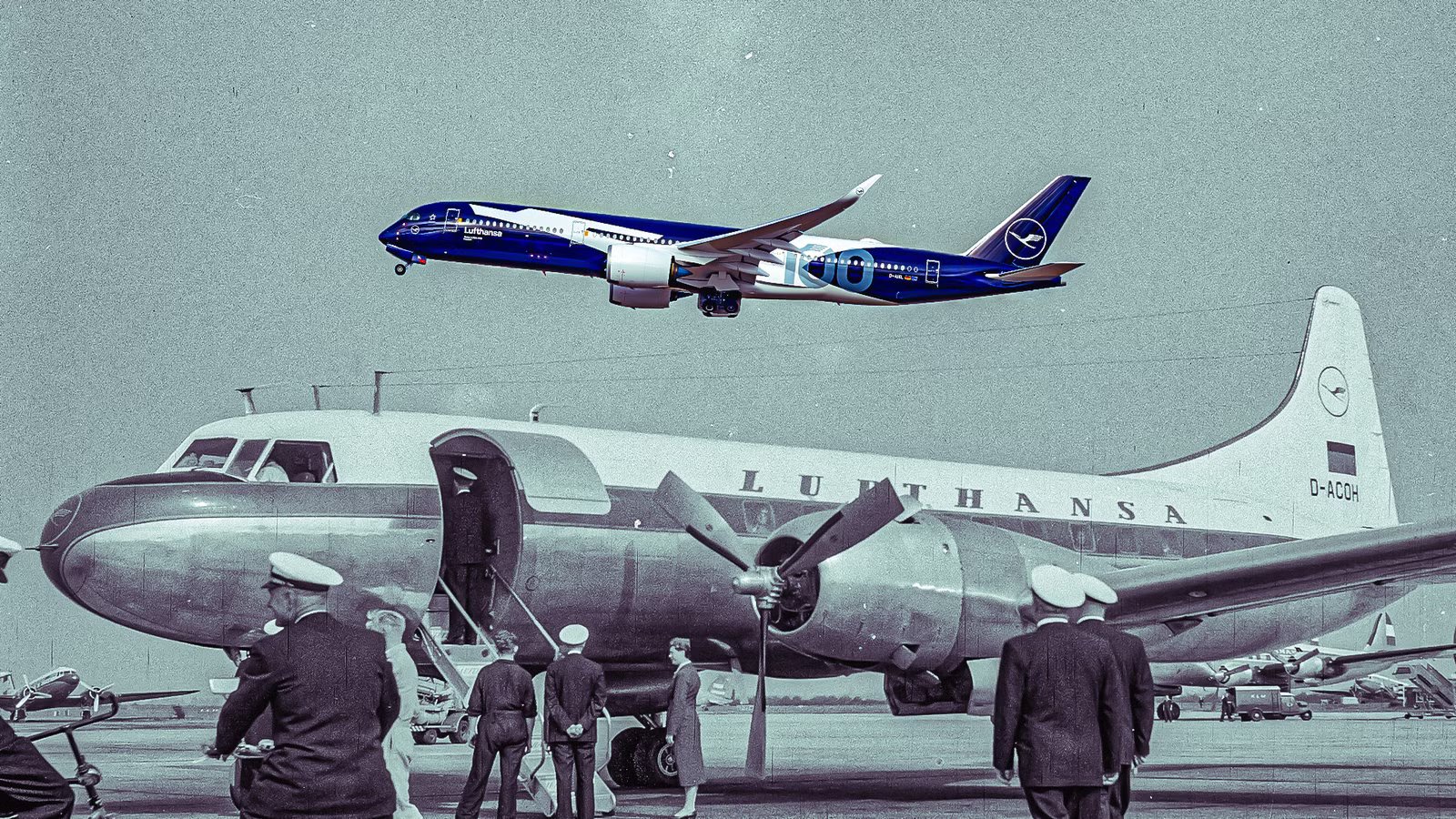
On April 6, a deep-blue Airbus A350-900 taxied across the tarmac at Berlin Brandenburg Airport (BER), with its fuselage adorned with a striking super crane design and the years 1926 | 2026 emblazoned in silver. This flight was far from an ordinary scheduled service to Zurich; it was a high-tech tribute to a century of German aviation. Exactly 100 years prior, a primitive Fokker-Grulich F II had lumbered into the sky from Berlin-Tempelhof, marking the birth of Deutsche Luft Hansa AG. This guide traces that remarkable trajectory, exploring how an airline that began with open-cockpit sensibilities evolved into a global titan defined by the carbon-fiber wings of the A350 and the upcoming folding wingtips of the Boeing 777X.
The story of  Lufthansa is a long one, filled with many highs and many lows. Over the past 10 decades, the carrier has navigated industrial revolutions, economic collapses, and the total reimagining of how humans move across the planet. As we look back at the original flights from Berlin to Zurich and Cologne, here is the evolution of one of the most important airlines in aviation history.
The Humble Beginnings

The dawn of German commercial aviation was characterized by a raw, mechanical ambition that took flight on April 6, 1926. Operating from the grassy expanses of Berlin-Tempelhof, the newly formed Deutsche Luft Hansa AG launched its inaugural services to Zurich and Cologne, utilizing the Fokker-Grulich F II and the Dornier Komet III. These early operations were a far cry from the pressurized, high-altitude transits of today, as pilots navigated by sight and passengers sat in wicker chairs within wood-and-fabric fuselages.
At a cruising speed of just 140 km/h (87 mph), the journey from Berlin to Zurich was an all-day affair that required immense fortitude from both the crew and the travelers. These unpressurized cabins meant that the aircraft rarely flew above 3,000 meters (9,842 feet), keeping the six passengers onboard intimately connected to the weather patterns and terrain below. Despite the lack of modern amenities, this era established the operational blueprint for European connectivity, setting a very high bar early on.
By the late 1920s, the fleet began transitioning to all-metal designs that would eventually define the brand’s reputation for engineering excellence. The introduction of the Junkers G 24 and the legendary Ju 52 marked a shift toward greater durability and passenger capacity, allowing Lufthansa to expand its reach toward the Far East and South America. These three-engine workhorses were the first to provide a sense of industrial scale to the airline, laying the groundwork for a network that would eventually span the globe, long before the first jet engine ever whistled on a runway.
Restart & Rapid Growth
_at_DUS_1982_(14553458553).jpg?q=49&fit=crop&w=500&dpr=2)
After the hiatus of World War II, Lufthansa took flight again in 1955, but the real metamorphosis occurred five years later with the arrival of the Boeing 707. This was the moment Lufthansa truly stepped onto the global stage, shrinking the Atlantic from a multi-day ordeal into a manageable ten-hour flight. The transition from piston-driven propellers to the piercing whistle of turbojets marked the beginning of a modern era where speed and altitude became the primary metrics of success.
The introduction of the Boeing 747-100 in 1970 was perhaps the most pivotal fleet decision in the history of the company. Affectionately known as the Queen of the Skies, the 747 enabled Lufthansa to democratize long-haul travel, carrying hundreds of passengers at a time across vast distances previously unreachable for the average traveler. For a carrier focused on the premium European experience, the upper deck of the 747 became an iconic feature, offering a level of onboard luxury that mirrored the grand hotels of Frankfurt and Munich.
This widebody dominance was especially crucial for the airline’s expansion into global markets, where the 747 became a staple on high-demand intercontinental routes. By the 1980s, the airline was utilizing the 747-200 and later the 747-400 to connect its German hubs with major financial centers across the globe, catering to a growing demographic of business travelers who demanded both reliability and prestige. The sheer scale of the 747 allowed Lufthansa to maintain a dominant presence on the world stage, establishing a legacy of service that still influences the carrier’s premium cabin philosophy 56 years after that first jumbo jet delivery.

I Flew Lufthansa’s 100-Year “Time Travel” Flight From Berlin To Zurich: Here Is What Happened
From parallel takeoffs to a “nose-to-nose” photoshoot: Inside the historic 100-year flight Lufthansa just operated from Berlin to Zurich.
Moving Into The Modern Era

As the calendar turned toward the 21st century, the aviation industry faced new economic and environmental pressures that brought the end of the four-engine era. The iconic A340 and the A380initially served as the choices of the long-haul fleet, but the rising cost of fuel and the push for lower carbon emissions led the airline toward a more streamlined philosophy. This transition marked a departure from sheer size toward precision engineering, prioritizing aircraft that could fly farther and more efficiently with two engines rather than four.
The modern cornerstone of this strategy is the A350-900, a carbon-fiber marvel that represents the most significant technological leap since the introduction of the jet engine. In 2026, the A350-900 (registered as D-AIXL) stands as the flagship of the centenary celebrations, showcasing the super crane livery to the world. Alongside the 787-9 Dreamliner, these aircraft utilize advanced aerodynamics and lighter materials to reduce fuel consumption by 25% compared to previous generations. It is a world away from the first aircraft in the fleet, demonstrating just how far the airline has come in the last 100 years.
The shift to these twin-engine widebodies has allowed the airline to maintain high-frequency schedules on routes that were previously only viable with larger, more expensive aircraft. By integrating the 787-9’s distinctive scalloped engine nacelles and the A350’s elegant winglets, the carrier has achieved a 900+ km/h (559+ mph) cruising speed with a fraction of the noise footprint of the 20th-century fleet. This technical refinement is particularly noticeable in the cabin, where noise levels have been reduced by 50%.
The Next Generation Of Lufthansa

The next chapter of this century-long story is defined by the arrival of the 777X, a jet that represents the culmination of 100 years of aerodynamic research and a landmark moment for the airline as the launch customer . This aircraft features the longest composite wing ever produced by  Boeing, stretching 71.75 meters (235 feet) inflight. The most striking technical feature of the 777-9 variant is its folding wingtips, a mechanical solution that allows the wingspan to retract to 64.82 meters (212 feet) on the ground, ensuring the massive jet can still fit into existing airport gates designed for the previous generation of aircraft.
The 777X is set to become the heavy-lift flagship of the fleet, complementing the existing A350-900 and the upcoming A350-1000. The real appeal of the 777-9 lies in its GE9X engines, which are the largest and most powerful commercial jet engines ever built, yet they contribute to a 10% reduction in fuel consumption compared to their predecessors. This efficiency is critical as the airline navigates the stringent environmental regulations of the late 2020s, aiming to balance the need for high-capacity long-haul travel with a significantly reduced carbon footprint.
As these new twin-engine titans enter service, the airline is progressively retiring the last of its quad-engine workhorses. The transition marks the end of an era for the Airbus A340 and the older Boeing 747-400 models, aircraft that served as the backbone of the fleet for three decades. Downsizing from four engines to two that produce more thrust with less waste, the carrier is future-proofing its operations for the next century of flight, ensuring that the legacy of the crane survives in an increasingly green-conscious global industry.

Lufthansa Lockheed L-1649A Super Star Restored To Former Glory For Airline’s 100th Anniversary
In its flying days, the aircraft was primarily deployed on transatlantic routes.
Celebrating The Centenary

On April 6, 2026, the aviation world watched as two symbolic flights bridged a century of progress. Flight LH1926 departed Berlin for Zurich, while flight LH2026 turned its nose toward Cologne. These specific designations were chosen to honor the very first scheduled services of Deutsche Luft Hansa AG, but the passenger experience onboard could not have been more different from the 1926 original.
The centerpiece of this is the livery design, and what a remarkable design it is. This livery is a sophisticated evolution of the traditional blue-and-white, featuring a deep-blue tail and a stylized crane that serves as a visual bridge between the past and the future. The markings 1926 | 2026 are prominently displayed on the fuselage, serving as a reminder of the ten decades of engineering that led to this moment. The airline chose the A350 and 787 for this honor because these aircraft are the absolute pinnacle of current fleet technology, embodying the move toward lightweight composites and ultra-efficient engines that provide a significant reduction in fuel burn compared to older models.
This design is not limited solely to the A350 and 787, as plenty of other aircraft, such as the 747-8 and A380, will also receive a livery overhaul. Additionally, its first Airbus A350-1000 expected for delivery later this year will also wear the 100-year markings, a fitting tribute to days gone by and to the next century of flight, led by high-capacity, twin-engine efficiency. By painting these giants of the sky, the airline is effectively turning the global tarmac into a moving museum, celebrating its heritage in every major international hub it serves.
Only Just The Beginning

As the centenary celebrations of 2026 draw to a close, the aviation world shifts from nostalgia for the past to the immense challenges of the next hundred years. Lufthansa’s iconic legacy is defined by a commitment to technical precision that began in a Tempelhof hangar and now resides in the sophisticated fly-by-wire computers of the Airbus A350. The lessons of the last ten decades have been applied to the digital and sustainable needs of the future.
It is truly incredible to see just how far the airline has come since its inception, and as it has grown, the aviation industry has grown with it. Even in its early days, Lufthansa has been at the forefront of global aviation, pushing boundaries further and getting passengers to their destinations faster and in greater comfort. The introduction of the 777X and A350-1000 will mark the beginning of the next 100 years, but that is only the beginning.
The trajectory of the fleet points toward even more radical innovations, including the potential for hydrogen-powered short-haul flight and the total automation of the cargo sector. While the hardware will continue to change, moving from carbon fiber to perhaps even lighter smart materials, the airline’s core philosophy remains anchored in that original January afternoon in 1926. Whether the future brings supersonic transit or silent, electric regional jets, the foundation of global connectivity was laid when those first four passengers stepped into the rattling cabin of a Fokker-Grulich F II, trusting that the horizon was worth the journey.