dailynewsnblog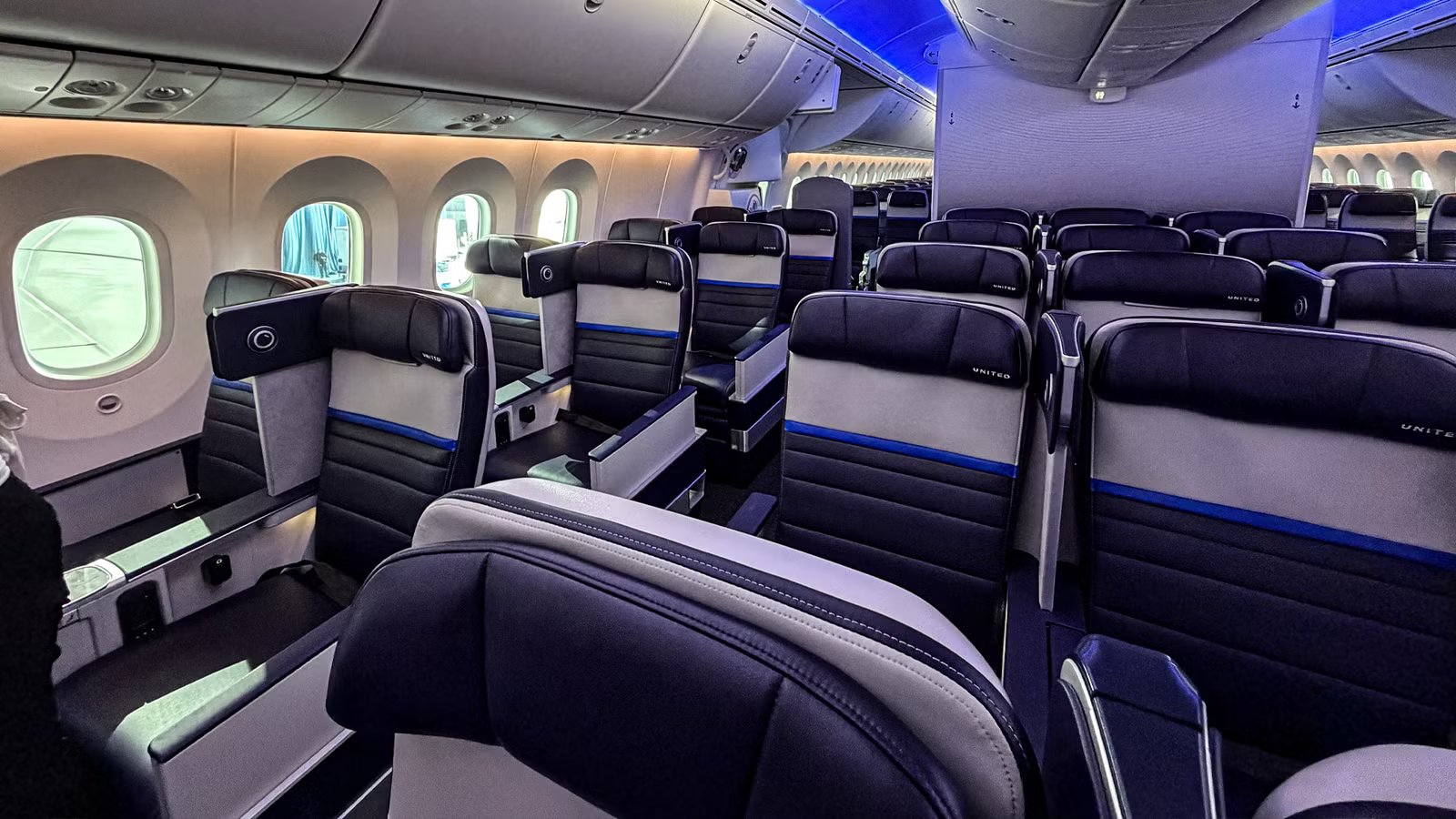
When United Airlines first took delivery of its Boeing 777-300ERs in 2016, these aircraft were equipped with 60 Polaris seats, 102 Economy Plus seats, and 204 regular economy seats, for a total of 366 seats. Later on, when the Chicago-based carrier began installing its Premium Plus cabin throughout its widebody fleet, it cut out the first four rows of Economy Plus and replaced them with three rows of Premium Plus.
This brought the aircraft’s overall capacity up to 350 seats, including 60 Polaris seats, 24 Premium Plus seats, 62 Economy Plus seats, and 204 economy seats. Generally, long-haul economy seats are configured with 30 to 32 inches (76.2 to 81.3 cm) of pitch, while premium economy seats are configured with 38 to 42 inches (96.5 to 106.7 cm) of pitch.
A premium economy cabin might result in the loss of one extra economy row, but each additional premium economy row doesn’t necessarily cost an extra row of economy in addition to the row that it’s replacing. When you consider the overall equation of adding premium economy versus economy or business class, the new cabin starts looking very appealing.
The Real Tradeoff With Premium Economy

On the 777-300ER, United installed three rows of Premium Plus, which replaced four rows of Economy Plus. This is United’s extra-legroom economy seat product, which offers a seat pitch of 34 inches (86.4 cm), although even four rows of the airline’s standard economy seats would actually take up slightly more space than three rows of Premium Plus.
This doesn’t seem like a bad deal at all, but the bigger issue is that premium economy seats are wider than those in economy, further cutting capacity. On some aircraft types, you only lose one seat per row in premium economy compared to economy. On the Boeing 767, premium economy is configured six-abreast, while economy is usually configured seven-abreast.
The Airbus A330 is usually configured with seven and eight seats per row, respectively, while the Airbus A350 usually features eight premium economy seats per row and nine in economy. On others, however, you lose two seats per row. The Boeing 787 is typically configured with a seven-abreast layout in premium economy, but features nine economy seats per row.
Meanwhile, the Boeing 777 usually features an eight-abreast premium economy layout and a ten-abreast economy layout. On the Airbus A380, airlines lose one seat per row if premium economy is installed on the upper deck, while they lose two if the cabin is placed on the main deck.
In the case of United’s 777-300ERs, the airline installed 24 Premium Plus seats in the same space where it previously had 40 Economy Plus seats. This 16-seat drop in capacity, or about 40%, isn’t ideal, and the cabin therefore needs to generate significantly more revenue than the Economy Plus seats that it replaced. This, however, has proven to be a strength of the product.
The Revenue Strength Of Premium Economy

Premium economy tickets are often significantly more expensive than economy tickets. United Airlines and other US carriers are fairly unique in that they explicitly offer an extra-legroom economy seating option sold at a sizable premium, but in other parts of the world, premium economy usually replaces either standard economy or business class seats.
In either case, premium economy is a very attractive product financially. On many routes, premium economy may be sold for double what economy seats go for, while they don’t typically come with a 50% drop in capacity. This significantly improves the economics of an airline’s layout and leads to an overall rise in revenue, especially when you consider that the drop in economy/extra legroom economy capacity can sometimes lead to stronger yields due to the lack of supply.
Premium economy has been in extremely high demand, but airlines have generally been conservative with their premium economy cabins. The travel class is still relatively new, and airlines lack data to fully understand demand for the cabin.
This has led to higher fares than you might expect for the class, as demand is outstripping supply, which has further improved the economics of the travel class. Meanwhile, airlines that have committed to larger premium economy cabins are earning even more revenue, and far more than a similarly-sized section of economy.
Premium Economy Or Business Class

United’s 2016 Polaris seat (based on the Safran Optima) is the most space-efficient widebody business class seat in service today that offers direct aisle access. Two rows of the Optima can be installed with a combined pitch of just 76 inches (193 cm), or 38 inches (96.5 cm) per row on average.
In the space where United formerly installed four rows of Economy Plus, it could have feasibly installed three more rows of Polaris, or the same number as Premium Plus. The challenge, however, is that because Polaris is a direct-aisle access product, you only get four seats per row.
United Widebody Cabins | Seat Models | Standard Seat Pitch |
|---|---|---|
Polaris | Safran Optima (2016) | 38 inches (96.5 cm) |
Elevate Ascent (2026) | 42 inches (106.7 cm) | |
Premium Plus | Collins Aerospace MiQ | 38 inches (96.5 cm) |
Economy Plus | Collins Aerospace Pinnacle/Aspire | 34 inches (86.4 cm) |
Economy | Collins Aerospace Pinnacle/Aspire | 31 inches (78.7 cm) |
Therefore, in this space where United formerly had 40 Economy Plus seats and now offers 24 Premium Plus seats, the carrier could have only fit 12 Polaris seats, or about 70% fewer seats. Meanwhile, this is also using the most space-efficient direct-aisle-access widebody seat. Most other models require between 42 and 48 inches (106.7 and 121.9 cm) of row pitch. Business class is usually multiple times more expensive than economy, but it’s not always twice as much as premium economy.
Airlines now report that premium economy has better profit margins than business class on a square footage basis for precisely this reason, as the prices are closer to business class while the seats themselves take up significantly less space. Given that demand continues to prove robust for the cabin, more airlines have been joining the premium economy club, and premium seating in general has become more lucrative than ever.
Where Is Demand For Premium Economy Coming From?

Until recently, premium economy was a foreign concept to airlines, and integrating the cabin into aircraft layouts was slightly tricky because the carrier had to decide whether to cut business class or economy capacity.  American Airlines, the first US airline to introduce premium economy, was already densifying its widebody layouts, and so it chose to shrink business class while also installing small premium economy cabins.
 Delta Air Lines chose to cut Delta One capacity while going big with Premium Select on the initial fleets that received the cabins. Later fleets got smaller premium economy cabins while the Delta One cabins were untouched. Meanwhile,
  United Airlines largely left the Polaris cabins alone while installing consistently small Premium Plus cabins and took capacity from Economy Plus.
All three took slightly different approaches to the cabin because these were first efforts in the segment. More recently, however, it’s become clear that most passengers aren’t switching from business class to premium economy.
Customers booking the latter are generally coming from economy, and there has been a noticeable increase in the number of passengers that fit this profile. A growing number of long-haul passengers are now booking premium cabins while traveling for leisure, and premium economy is well-suited for this demographic as it’s priced below business class while still offering added comfort over economy.
How Widebody Aircraft Layouts Are Evolving

Because premium economy has proven extremely popular and demand for premium cabins as a whole is rising, airlines are responding by adding premium capacity. In the US, American Airlines has been taking new Boeing 787-9s with 51 Flagship Suites and 32 premium economy seats, whereas its prior 787-9 layout has 30 Flagship Business seats and 21 premium economy seats.
Meanwhile, it’s also retrofitting Boeing 777-300ERs with 70 Flagship Suites and 44 premium economy seats, up from 28 premium economy seats and 52 Flagship Business seats. In 2026, United Airlines began taking delivery of new 787-9s with 64 Polaris suites and 35 Premium Plus seats, whereas its older 787-9s feature 48 Polaris seats and 21 Premium Plus seats.
The carrier has yet to begin retrofitting planes with its updated cabins, but future layouts are sure to feature an increase in premium capacity. Delta Air Lines, meanwhile, is actively retrofitting its Airbus A350-900s with 40 Delta One suites and 40 Premium Select seats, which actually represents a loss of one Premium Select row but a gain of two Delta One rows.
It’s also set to begin taking delivery of Airbus A350-1000s in 2027 that will feature 53 Delta One suites and 48 Premium Select seats. This trend of increasing premium seat capacity isn’t only occurring in the US either. Indeed, Qantas finished retrofitting its Airbus A380s shortly after COVID, and as part of the project (which also included new seats), the airline added six business class seats while bumping premium economy capacity to 60 seats.
Air France, with its latest four-class 777-300ER layout, added two business class seats and 16 premium economy seats compared to its older four-class configuration. With this, what we’re seeing is that globally, airlines are generally increasing premium capacity, and premium economy is quickly becoming a core product offering.