dailynewsnblog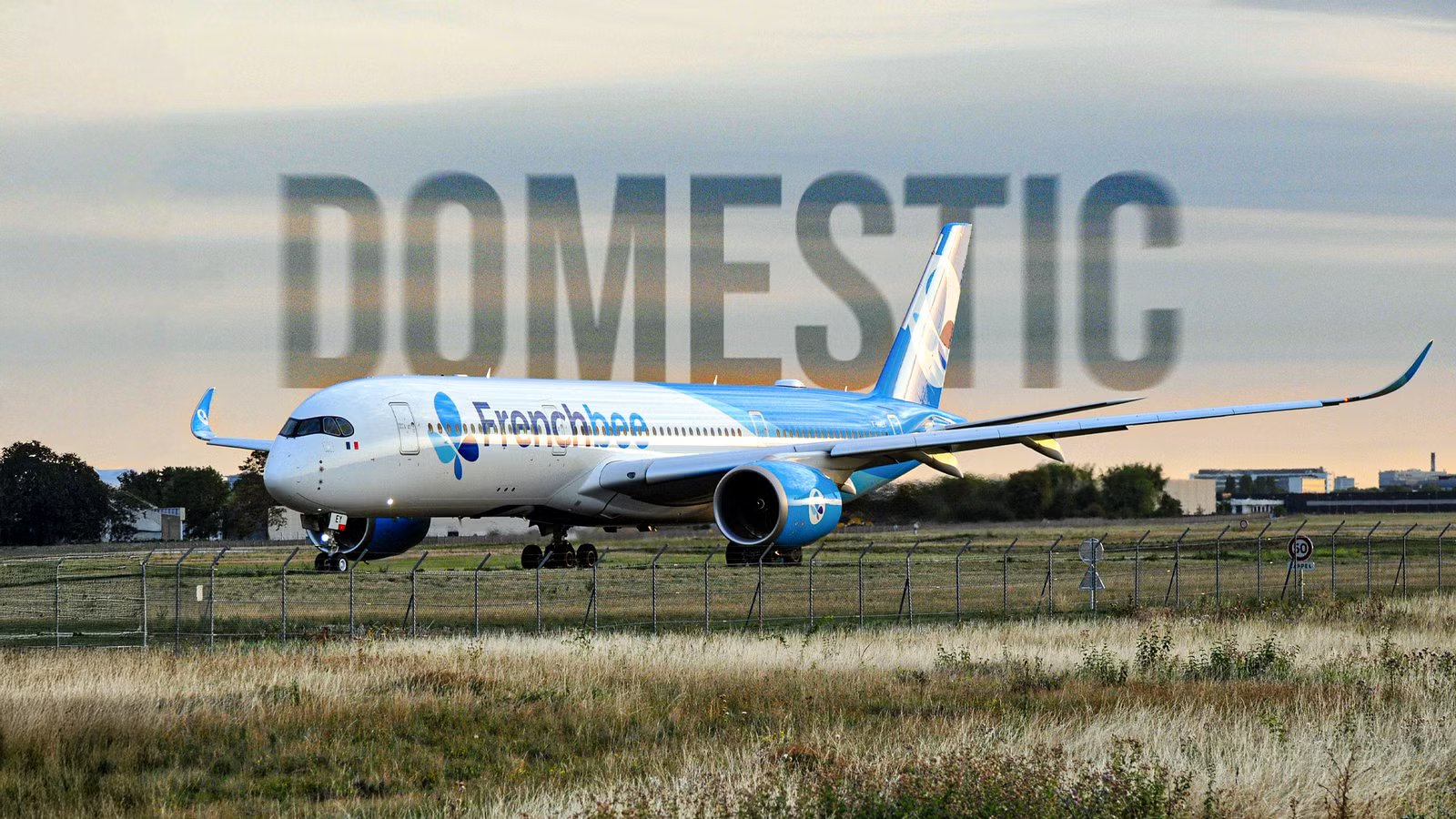
Going on any flight lasting nearly 12 hours is almost always a long international journey. The key word is almost, because there is actually a flight that is just as long but does not land in a different nation. Upon touching down at Roland Garros Airport (RUN) in Saint-Denis de la Réunion, passengers disembark without passing through border control, presenting a passport, or exchanging currency. Covering 5,048 nautical miles (5,810 statute miles / 9,349 km), the nonstop route between Paris and Saint-Denis outpaces traditional intercontinental sectors like London to New York by a wide margin, taking roughly 11 hours 40 minutes southbound.
This Indian Ocean service holds the record as the longest regularly scheduled domestic flight in the world. So how can this be possible? Réunion operates as an overseas territory legally identical to mainland regions, meaning thousands of passengers cross two hemispheres on a standard domestic ticket, relying on a vital air bridge built on decades of technical evolution and sovereign European integration.
No Passport Needed?

The classification of an air route as domestic depends on sovereign political geography, and has little to do with proximity. Réunion, an island situated in the Indian Ocean east of Madagascar, has held the status of an overseas department of France (département d’outre-mer) since 1946. Under Article 73 of the French Constitution, this administrative framework accords the island an identical legal standing to departments located on the European mainland. Consequently, a service departing from  Paris Charles De Gaulle Airport (CDG) or Paris Orly Airport (ORY) and bound for Roland Garros Airport (RUN) in Saint-Denis operates entirely within French national jurisdiction.
The origin and destination share identical sovereign authority, so border management mirrors that of a short-haul mainland route. European Union passengers can board the journey using a standard national identity card, bypassing the passport requirements typical of intercontinental transit. The territory utilizes the euro, enforces French civil law, and integrates directly into the national healthcare and public administration infrastructure, as per Country Reports. Standard domestic aviation frameworks, cabotage protections, and taxation rules apply to operators on the route, setting it apart from standard international long-haul services.
The result is a unique operational environment across such a long distance. Although the aircraft overflies multiple international flight information regions (FIRs) and foreign airspaces across Europe and Africa during its 11-hour transit, the flight begins and ends within a single country. As highlighted in Simple Flying analysis, this jurisdictional framework classifies the non-stop link between Paris and Saint-Denis as the longest scheduled domestic flight in the world.
A Journey Spanning Continents

Before nonstop connections transformed the air corridor, reaching Réunion Island from Paris was only possible with multi-leg journeys across the African continent. Long-haul airliners operating in the mid-to-late 20th century could not reliably complete the trip without intermediate technical stops. Throughout the 1960s, 1970s, and 1980s, carriers like  Air France routed flights using aircraft such as the Boeing 707 and Boeing 747 through intermediary hubs including Cairo, Djibouti, or Nairobi. These mandatory stops added several hours to total block times, pushing journey lengths well past 15 hours.
The biggest issue preventing direct operations was airfield infrastructure at RUN in Saint-Denis. Operating off the earlier 8,760 feet (2,670 meters) runway, fully loaded widebody jets like the 747-200 could not depart at maximum takeoff weight (MTOW) with sufficient fuel to reach metropolitan France nonstop, as highlighted by Airports of the World. High ambient temperatures and tropical humidity further restricted takeoff weight performance, meaning airlines had to sacrifice revenue payload or use mid-route refueling stops in East Africa.
The critical operational shift occurred on November 26, 1994, with the opening of a second runway at Roland Garros Airport. Spanning 10,499 feet (3,200 meters) in length, runway 12/30 provided the necessary pavement distance for heavy widebodies to depart fully loaded with fuel and payload. This infrastructure upgrade allowed Air France to end the technical stops and establish a direct nonstop schedule, reducing travel times down to under 12 hours. Today, modern twin-engine widebodies like the Boeing 777-300ER and Airbus A350-900 build upon this runway foundation, maintaining the world’s longest active domestic route.
Highly Contested Corridor

Four main carriers compete directly along the corridor connecting Paris with Saint-Denis, turning what might otherwise be an isolated island route into one of the highest-density widebody domestic markets in global aviation. Air France holds its presence on the route using 777-300ER aircraft configured in specialized high-density layouts featuring 472 seats, alongside modern A350-900 airframes designed to maximize aerodynamic efficiency over long sector lengths, as noted in Simple Flying analysis.
Regional and low-cost operators play an equally decisive role in optimizing payload-range performance across the Indian Ocean. Home carrier Air Austral deploys 777-300ER aircraft and Boeing 787 aircraft to maintain primary long-haul links to mainland France. Meanwhile, low-cost long-haul airline French bee relies exclusively on an all-Airbus A350 fleet, operating high-capacity A350-1000 aircraft fitted with up to 480 seats, as per Airbus.
Loading map…
Drag to explore
Corsair has similarly modernized its long-haul network by transitioning to an all-Airbus A330-900neo fleet. Equipped with high-bypass Rolls-Royce Trent 7000 engines and refined wing aerodynamics, these modern jets cut operating costs while improving passenger cabin altitude over 11-hour block times. Routine operations along this extended oceanic corridor demand strict Extended-range Twin-engine Operational Performance Standards (ETOPS) compliance and precise fuel management to keep twin-engine flagships safely connecting mainland Europe with the Southern Hemisphere.
An Essential Link To Europe

Operating a long-haul route of this length is an immense financial investment, but multiple daily flights depart between Paris and Saint-Denis year-round. This high frequency persists because the flight path functions less like an optional holiday connection and more like a necessary connecting bridge, just like any other domestic flight. As a full department of France, Réunion depends entirely on air transport to remain integrated with the European mainland. Without land highways or passenger railway networks across the Indian Ocean, scheduled airline services represent the sole practical connection for civil administration, healthcare, and trade.
Underneath the passenger cabins, cargo capacity serves a vital role in sustaining the island supply chain. High-yield belly cargo on widebody aircraft delivers essential pharmaceuticals, fresh agricultural items, high-tech components, and express mail to Roland Garros Airport every single day. As detailed by Simple Flying, commercial operators on this corridor carry massive payloads over long distances to fulfill essential regional demand.
Catch what other trackers miss
Emergency squawks, holds, NOTAMs — live signals, no signup.
Open tracker
Catch what other trackers miss
Emergency squawks, holds, NOTAMs — live signals, no signup.
Open tracker
The air corridor also maintains deep social and civic ties between the island and continental Europe. Thousands of university students rely on these flights each autumn to begin their studies at mainland institutions, while medical patients often require specialized transport to Parisian hospitals. Furthermore, subsidized ticket programs and public service support lower the barrier for family travel, allowing residents to maintain personal connections despite living across continents.
A Temporary Change Of The Crown

Global travel disruptions in early 2020 briefly created an unexpected record holder change. When transit bans prevented French carriers from using traditional stopovers in the United States, Air Tahiti Nui dispatched a 787-9 from Papeeteto CDG on March 15, 2020, as noted in Simple Flying coverage. Flying eastbound across 8,485 nautical miles (9,765 statute miles / 15,715 km) nonstop in 15 hours and 45 minutes, the flight set an absolute record for the longest ticketed domestic sector ever operated under French sovereignty.
Two months later, low-cost carrier French bee extended that record using an A350-900 carrying 44,000 lb (20,000 kg) of medical supplies. Flying nonstop from Papeete to ORY, the jet covered 8,709 nautical miles (10,022 statute miles / 16,129 km) in 16 hours and 49 minutes. Both of these ultra-long sectors relied on light payloads and favorable tailwinds that made reverse westbound flights unfeasible without technical refueling stops.
Once international transit corridors reopened, both airlines reinstated their scheduled stops in  Los Angeles International Airport(LAX) and
  San Francisco International Airport(SFO). While these pandemic nonstops got to show off a glimpse of the limit for domestic widebody range, daily flights between Paris and Réunion retain the crown as the world’s longest regularly scheduled, year-round domestic route.
Setting Off Across The Oceans

Spanning across two hemispheres, the connection between Paris and Saint-Denis really is a remarkable convergence of sovereign constitutional law and long-haul airline economics. What began decades ago as an arduous multi-stop journey through East Africa has evolved into a vital, high-density trunk route served by four major airlines using the most advanced widebody flagships.
While temporary pandemic diversions across the Pacific Ocean briefly pushed the theoretical limits of nonstop domestic distance, the daily connection between metropolitan France and Réunion remains unchallenged in its year-round operational consistency. Driven by essential air cargo demands, public service obligations, and social integration, this transoceanic link is a lifeline for a tropical territory in the Southern Hemisphere, keeping it united with mainland Europe, one 11-hour flight at a time.