dailynewsnblog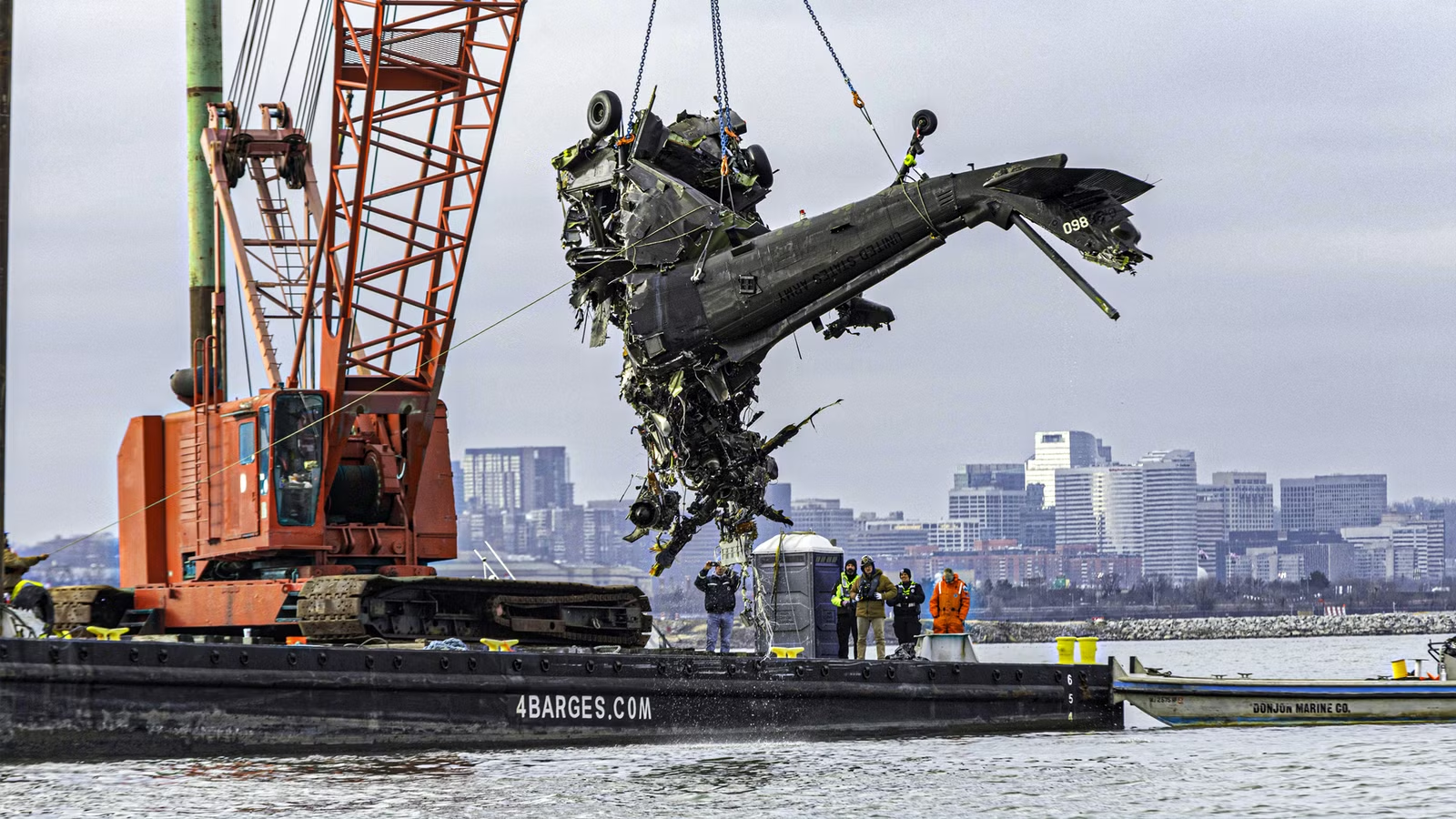
A widely shared claim suggests that a roughly $400 ADS-B receiver, a portable GPS-based traffic display, could have prevented the January 29, 2025, midair collision between American Airlines Flight 5342 and a US Army Black Hawk helicopter near Washington DC. Based on findings from the National Transportation Safety Board, there is some truth to this. Investigators estimate that active ADS-B systems could have alerted the airline crew some 59 seconds before impact.
However, while the absence of ADS-B receivers was one part of the equation, a cascade of system failures all culminated in the tragic loss of 67 lives. A poorly designed helicopter route through some of the United States’ busiest airspace, overworked air traffic controllers, and missing equipment from the Black Hawk all played contributing roles. Here’s a look at what ADS-B is, the role it could have played in the crash of flight 5342, and what has changed since last January.
What Is ADS-B, And How Does It Work?

Automatic Dependent Surveillance–Broadcast, universally known as ADS-B, is a GPS-based surveillance system designed to replace traditional radar-based tracking technology. Unlike radar, which relies on ground stations sending signals that bounce off aircraft, ADS-B depends on the aircraft itself to determine and broadcast its position. Using onboard GPS, an ADS-B-equipped aircraft continuously transmits its precise location, altitude, speed, and heading, typically at a frequency of once per second.
This information is then received by ground stations, such as air traffic control (ATC) facilities, as well as by other aircraft equipped with ADS-B “In” receivers. The ADS-B system has two primary components: ADS-B Out, which broadcasts the aircraft’s data, and ADS-B In, which allows the aircraft to receive data from others. While ADS-B Out has been mandated in most controlled U.S. airspace since 2020, ADS-B In remains optional for many operators, particularly in military aviation.
With GPS systems on the rise, the advantages ADS-B provides over traditional radar are substantial. Radar systems typically update every 5 to 12 seconds, whereas ADS-B updates every second, providing almost real-time situational awareness to pilots, allowing controllers and pilots to better understand traffic patterns and potential conflicts. Additionally, ADS-B enables cockpit-based traffic displays, allowing pilots to “see” other aircraft around them even without direct visual contact. However, the system’s effectiveness depends heavily on universal participation, as even if one aircraft is not broadcasting, it effectively becomes invisible to others relying solely on ADS-B data.
The Tragic Events Of American Airlines Flight 5342

On January 29th, 2025 at approximately 8:48 pm, an American Airlines Bombardier CRJ-700 regional jet registered as N709PS and operated by PSA Airlines, collided midair with a US Army Sikorsky UH-60L Black Hawk helicopter. The collision occurred just off the final approach end of Runway 33 at Ronald Reagan Washington National Airport (DCA), right across the river from Washington DC. Tragically, all 67 individuals aboard both aircraft were killed, including 64 passengers and crew on Flight 5342 and three servicemen on the helicopter.
Since that night, which became the deadliest aviation accident in the United States in over two decades and ended a remarkable safety streak of more than 15 years without a fatal commercial airline crash in the country, the National Transportation Safety Board (NTSB) revealed several critical findings through its investigation. Notably, NTSB investigators found that the Black Hawk helicopter involved in the collision was equipped with ADS-B Out hardware. However, despite having the technology onboard, investigators confirmed that the system was not transmitting at the time of the crash. This meant that the helicopter’s position was not being broadcast to nearby aircraft or fully integrated into the broader ADS-B surveillance network.

Additionally, the Traffic Collision Avoidance System (TCAS), designed to provide pilots with warnings to climb or descend in the event of an upcoming collision, is disabled below 400 feet above the ground. With the collision occurring about 300 feet above the Potomac River, the pilots onboard the American Airlines flight never received a TCAS alert as they were descending towards the airport.
Additionally, those pilots were not expecting to be close to the path of the helicopter. The air traffic controller at the time, who was later determined to have been managing a load “not normal” for that time of day at DCA, had instructed the helicopter to pass behind the aircraft at an altitude of 200 feet or lower, the maximum permissible altitude for helicopters in the area. In the end, all the holes lined up that night, and investigators concluded that the probable cause of the accident was the placement of a helicopter route in close proximity to the runway approach path.

Helicopter Route Placement Deemed As Probable Cause In American Airlines Crash By Final NTSB Report
The accident happened just over a year ago.
A $400 GPS Device Could Have Alerted The Crew 59 Seconds Earlier

One of the most widely discussed findings from the NTSB’s post-crash analysis was the potential impact of ADS-B technology. According to NTSB Chair Jennifer Homendy, if both aircraft had been equipped with and actively using ADS-B, the system could have provided significantly earlier warnings of the impending collision. In fact, investigators estimated that the American Airlines flight crew would have received an alert approximately 59 seconds before impact. The helicopter crew, meanwhile, could have been warned 48 seconds prior to the collision, a substation window of time that would have allowed the pilots to communicate with air traffic control and execute an evasive maneuver.
Since 2006, the NTSB has recommended to the FAA that ADS-B be required on aircraft 17 times. However, at the time of the crash, the FAA had not yet approved the system for installation in the CRJ-700, the model type of the American Airlines aircraft involved.
This is where the claim of a $400 GPS device comes in. Portable ADS-B In receivers, often used in general aviation aircraft that are not equipped with digital cockpit displays, can cost just a few hundred dollars and connect to digital tablets or displays. These devices allow pilots to see nearby traffic through ADS-B in real time. In theory, if both aircraft had been broadcasting and, crucially, receiving ADS-B data, a device similar to this could have displayed the conflicting traffic and provided an earlier warning than existing systems.
Systemic Failures Beyond Simply ADS-B

While ADS-B technology has been central to discussions about the crash, the NTSB emphasized that the accident was not caused by a single missing system. Instead, it resulted from what Homendy called “deep, underlying systemic flaws.” A cascading failure of safety systems “aligned to create the conditions that led to this devastating tragedy.
One of the most significant concerns raised by investigators was the design of helicopter routes around Reagan National Airport. These routes placed military helicopters operating at altitudes as low as 75 feet below commercial aircraft on final approach. Despite years of reported near-miss incidents, averaging at least one per month, and repeated warnings from air traffic controllers, the FAA had not addressed the risks of operating near DCA.
Additionally, air traffic control staffing and workload played a critical role. On the night of the crash, a single controller was responsible for managing both helicopter and commercial aircraft traffic in the area. On a typical day, these responsibilities are split between two controllers to provide greater supervision over each aircraft. However, since the sole controller was working both sectors, this increased workload may have reduced their ability to detect and respond to the developing conflict in a timely manner.
Human factors further compounded the situation. Given that the event happened at night, visibility and situational awareness were significantly reduced. The helicopter crew had requested to maintain visual separation from the American Airlines jet, a common practice. However, given the conditions, the helicopter pilots likely mistook another aircraft farther from the airport as their traffic to avoid rather than the American Airlines flight they crashed into.

The ALERT Act: How Congress Plans To Stop Midair Collisions
The Airspace Location and Enhanced Risk Transparency Act, or ALERT Act, aims to address every safety recommendation issued by the NTSB.
What Has Changed Since January 2025?

With 15 months passing since January 2025, several changes designed to prevent this type of accident from ever happening again have been implemented. In the immediate aftermath of the crash, the FAA restricted helicopter flights near DCA and closed many of the routes that had brought the two aircraft into conflict. The Army also moved to install ADS-B systems on its Black Hawk helicopters. American Airlines also retired flight number 5342, with the Wichita to Washington DC flight transitioning to Flight 5677.
Legislatively, the path to change has been much slower than many had hoped for. In early April 2026, the House passed the ALERT Act, a version of an aviation safety bill coming months after it voted against the CARE Act, which cleared the Senate with unanimous support. The ALERT Act would require that all civilian and military aircraft flying near busy airports install ADS-B in equipment so they can receive location data from other aircraft in their area. Additionally, the bill aims to improve helicopter routes and separation requirements while also providing funding to improve air traffic control staffing, training, and processes.