dailynewsnblog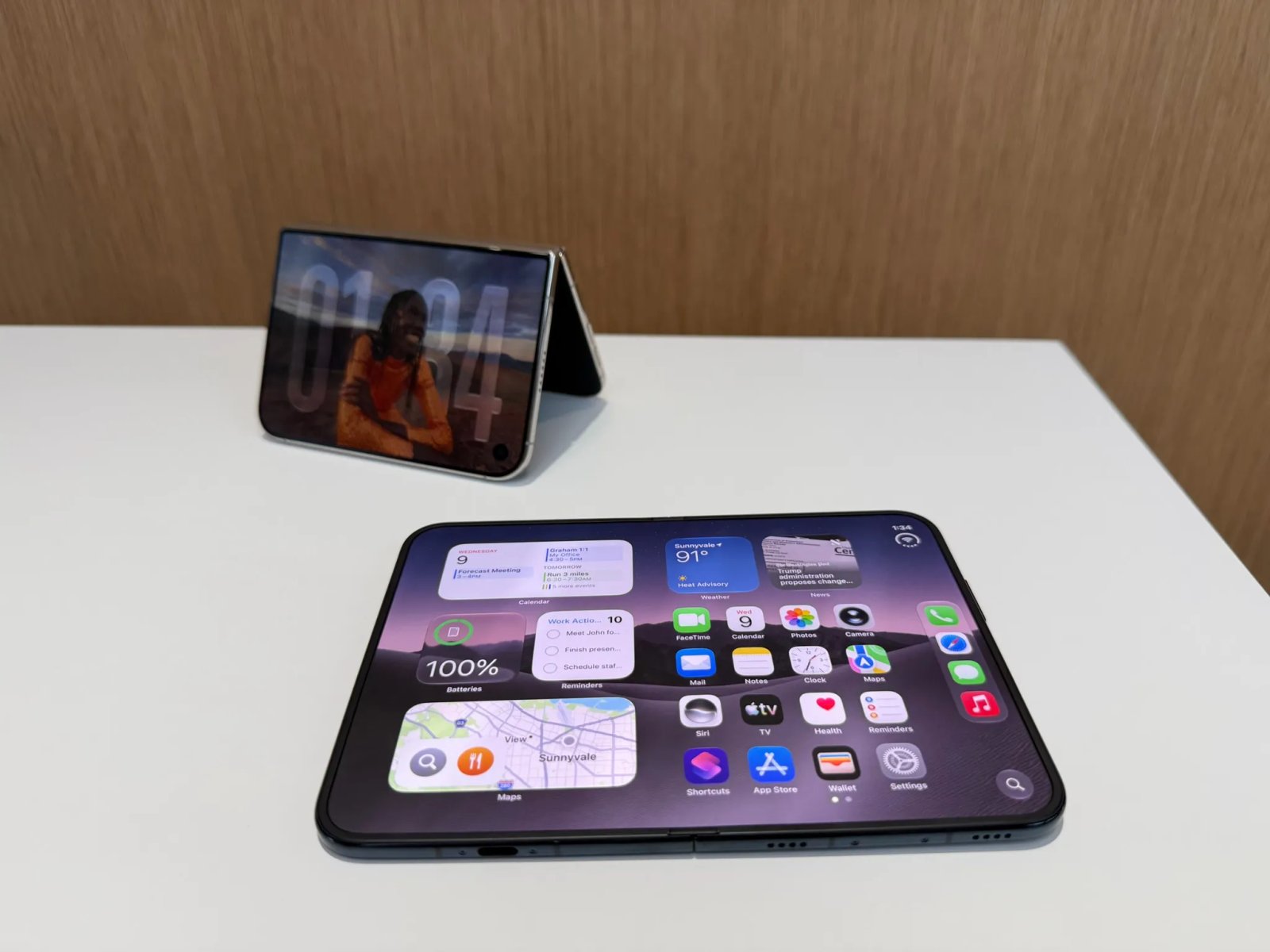
For months, rumors suggested Apple would name its first foldable the iPhone Ultra. But on Wednesday, the company unveiled its highly anticipated device with a different name: the iPhone Duo.
Skipping the Ultra name feels fitting for a foldable that doesn’t quite offer Apple’s highest-end features. The Duo is still a premium device, but it lacks a telephoto camera and has a slightly more modest battery than the iPhone 18 Pro Max.
In that respect, the iPhone Duo is more comparable to Samsung’s similarly palm-size Galaxy Z Fold 8. The Galaxy Z Fold 8 Ultra, meanwhile, takes things a step further with Samsung’s top-tier camera and battery specs.

The Duo is designed to be compact and versatile, allowing you to easily watch horizontal videos in landscape mode and vertical content in portrait. On the other hand, the Z Fold 8 Ultra feels similar to a slab phone when closed, thanks to its slim design and more standard dimensions. (Meanwhile, the smaller Galaxy Z Fold 8 shares design elements with the iPhone Duo. You can read more about how those phones compare here.)

The Duo and Z Fold 8 Ultra share the commonality of a high price tag. The iPhone Duo starts at $1,999 for 256GB, while the Galaxy Z Fold 8 Ultra starts at $2,100 for the same storage level.
Preorders for the iPhone Duo kick off Oct. 16 for an Oct. 23 release. The Galaxy Z Fold 8 Ultra is available now.
Here’s how the two foldable phones compare.
iPhone Duo vs. Galaxy Z Fold 8 Ultra design and displays

The key difference between the iPhone Duo and the Galaxy Z Fold 8 Ultra is in their designs.
The iPhone Duo is palm-size with a squat, 5.4-inch cover screen and a 7.6-inch inner display. The Z Fold 8 Ultra has a more conventional book-style foldable design, with a taller, 6.5-inch cover screen and a larger 8-inch inner display.
A unique feature of the iPhone Duo is its matte, nano-texture inner display that helps to reduce reflections and minimize the crease. The Galaxy Z Fold 8 Ultra has an anti-reflective coating that also helps to reduce those distractions, but the Duo’s matte finish does a better job at that.

The Z Fold 8 Ultra stands out for its exceptionally thin build, measuring 4.1mm when open and 8.9mm when closed. The iPhone Duo is also fairly thin, measuring 5.2mm when open and 11.3mm when closed.
The Z Fold 8 Ultra is a little lighter, weighing 215 grams, while the Duo weighs 254 grams. It’s a small difference that’s barely perceptible.
When multitasking, the Duo can only run up to two apps simultaneously, while the Z Fold 8 Ultra supports multitasking with up to three apps. This is aided by the Ultra’s larger main display that prevents apps from feeling cramped.

Perhaps one of the most impressive features of the Duo is its IP68 rating: it can withstand submersion in up to 6 meters of water for 30 minutes and is dust-resistant. The Z Fold 8 Ultra has a more limiting IP48 rating, meaning it can be submerged in up to 1.5 meters of water for 30 minutes and is protected against solid objects larger than 1mm, but not dust or sand. The Duo’s dust resistance is a rarity in the world of foldables and is shared with Google’s Pixel 11 Pro Fold.
If you value durability and compactness, the iPhone Duo can be a good fit. If you want a foldable phone that feels more similar to a slab phone when closed and a tablet when open, the Galaxy Z Fold 8 Ultra is a good pick.
iPhone Duo vs. Galaxy Z Fold 8 Ultra cameras

Because the iPhone Duo is compact, it makes some compromises with the cameras. There’s a 48-megapixel main camera and a 48-megapixel ultrawide camera, but no telephoto lens. The cover display has a 12-megapixel selfie camera, while an “under-display FaceTime camera” sits on the inside screen.
The Galaxy Z Fold 8 Ultra has a triple rear-camera system, which includes a 200-megapixel wide-angle, 50-megapixel ultrawide and 10-megapixel telephoto camera. There’s a 10-megapixel selfie camera on each display.

We’ll have to see how the iPhone Duo performs in our camera tests, but the Galaxy Z Fold 8 Ultra shares rear camera optics with the top-of-the-line Galaxy S26 Ultra (hence the shared moniker), and has performed well in our camera tests.
iPhone Duo vs. Galaxy Z Fold 8 Ultra processor and battery life
The iPhone Duo is powered by the same in-house A20 Pro chip as the iPhone 18 Pro models. The Galaxy Z Fold 8 Ultra has Qualcomm’s Snapdragon 8 Elite Gen 5 chip for Galaxy.
Apple doesn’t share specific battery specs, but says the iPhone Duo will give you up to 31 hours of video playback on the inner display, and 44 hours when using the outer screen. When using both screens equally, the company says you’ll be able to go 24 hours before needing to charge.
Samsung boosted battery capacity on its book-style foldable this year, going from 4,400 mAh on the Z Fold 7 to 5,000 mAh on the Z Fold 8 Ultra. That should easily get you through a day without worrying about where the nearest charger is.

Apple says the iPhone Duo can charge up to 50% in around 20 minutes with a 60-watt adapter or higher. The Z Fold 8 Ultra supports up to 45-watt wired charging, going from empty to 63% in around 30 minutes in CNET’s testing.
The Duo has a key advantage when it comes to wireless charging: it supports MagSafe, with Qi2 wireless charging up to 25 watts. Meanwhile, the Z Fold 8 Ultra doesn’t have built-in magnets, but if you use a Qi2-compatible case, you can tap into 20-watt wireless charging.
If you prefer being able to easily attach magnetic accessories without a case, the iPhone Duo has the advantage here. The Galaxy Z Fold 8 Ultra has a long-lasting battery that pulled its weight in our testing.
Which phone should you pick?

Whether you go with the iPhone Duo or the Galaxy Z Fold 8 Ultra ultimately depends on how you plan to use your foldable phone.
The iPhone Duo is designed to better accommodate both horizontal and vertical content on the inner display, while the compact cover is good for quickly sending texts or checking notifications. If you find yourself viewing swaths of content and want a phone that feels a little different — or are deep in Apple’s ecosystem — the Duo could be the right fit for you.
Meanwhile, the Z Fold 8 Ultra operates as more of a standard-feeling phone when closed, opening to a wide, traditional tablet-like display. If you don’t want to stray too far from the design of slab phones but also want a more expansive screen sometimes, the Z Fold 8 Ultra might be a better pick.
Stay tuned for CNET’s review of the iPhone Duo for more details on the experience. For now, you can read our hands-on with Apple’s new foldable, and check out the spec chart below for more on how the phones compare.
| iPhone Duo | Samsung Galaxy Z Fold 8 Ultra | |
| Cover display size, tech, resolution, refresh rate | 5.4-inch OLED, 2,342×1,080 pixels, 120Hz refresh rate | 6.5-inch AMOLED; 2,520×1,080 pixels; up to 120Hz variable refresh rate |
| Internal display size, tech, resolution, refresh rate | 7.6-inch OLED, 2,670×1,878 pixels, 120Hz refresh rate | 8.0-inch AMOLED; 2,256×2,504 pixels; up to 120Hz variable refresh rate |
| Pixel density | Cover: 460 ppi; internal: 430 ppi | Cover: 422 ppi; Internal: 422 ppi |
| Dimensions (inches) | Open: 4.6 x 6.5 x 0.2 in; Closed: 4.6 x 3.3 x 0.4 in | Open: 6.23 x 5.6 x 0.16 in; Closed: 6.23 x 2.87 x 0.35 in |
| Dimensions (millimeters) | Open: 117.8 x 164.6 x 5.2mm Closed: 117.8 x 84.1 x 11.3mm | Open: 158.4 x 143.2 x 4.1mm; Closed: 158.4 x 72.8 x 8.9mm |
| Weight (grams, ounces) | 254 g (9 oz) | 215g (7.58 oz) |
| Mobile software | iOS 27 | Android 17 with One UI 9 |
| Cameras | 48-megapixel (wide), 48-megapixel (ultrawide) | 200-megapixel (wide), 50-megapixel (ultrawide), 10-megapixel (telephoto), 10-megapixel (cover screen selfie) |
| Internal screen camera | 12-megapixel | 10-megapixel |
| Video capture | 4K at 60fps | 8K at 30 fps |
| Processor | A20 Pro | Qualcomm Snapdragon 8 Elite Gen 5 for Galaxy |
| RAM/storage | RAM N/A + 256GB, 512GB, 1TB, 2TB | 12GB + 256GB; 12GB + 512GB; 16GB + 1TB |
| Expandable storage | None | None |
| Battery | Up to 24 hours | 5,000 mAh |
| Fingerprint sensor | Side | Side |
| Connector | USB-C | USB-C |
| Headphone jack | None | None |
| Special features | Apple N1 wireless networking chip (Wi-Fi 7 (802.11be) with 2×2 MIMO), Bluetooth 6, Thread. Camera Control button. Dynamic Island. Apple Intelligence. Visual Intelligence. Siri AI. Dual eSIM. 1 to 3,000 nits brightness display range. IP68 resistance. Colors: black, white. Fast charge up to 50% in 20 minutes using 60W adapter or higher via charging cable. Fast charge up to 50% in 30 minutes using 35W adapter or higher via MagSafe Charger. | IP48 rating, Corning Gorilla Glass Ceramic 3 (cover scnree), Corning Gorilla Glass Victus 2 (Rear), Advanced Armor Aluminum, 5G (sub6, mmW), Wi-Fi 7, 3,000-nit peak brightness, anti-reflective display, 45-watt wired charging, 20-watt wireless charging |
| US price starts at | $1,999 (256GB); $2,199 (512GB); $2,599 (1TB); $3,199 (2TB) | $2,100 (256GB); $2,300 (512GB); $2,700 (1TB) |

See full bio