dailynewsnblog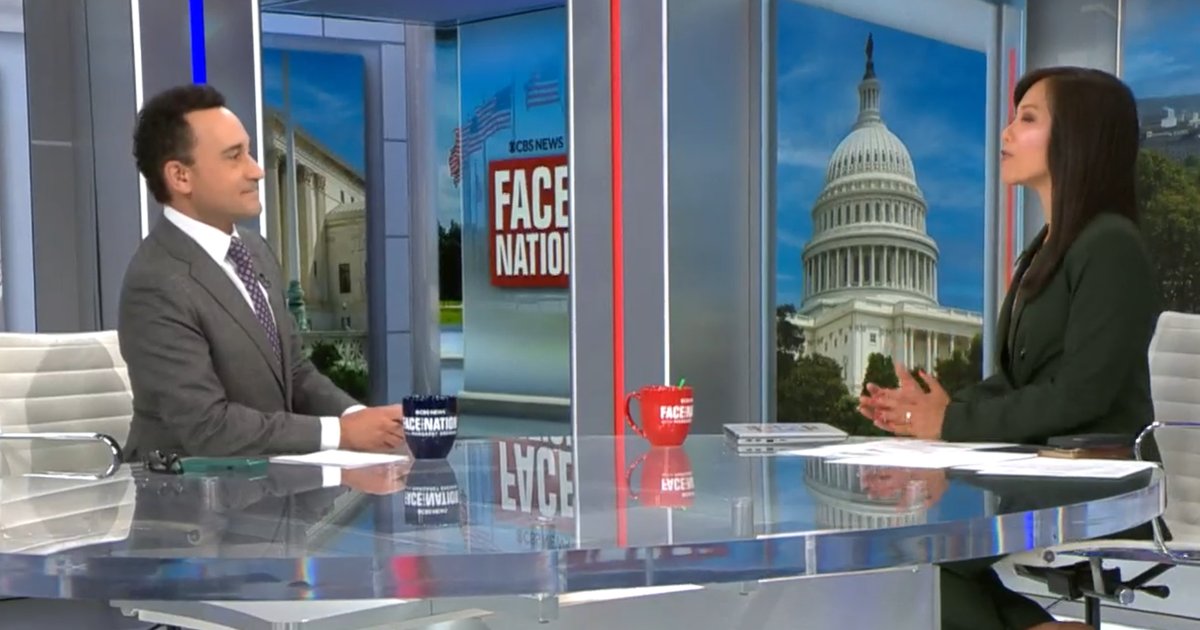
On this “Face the Nation with Margaret Brennan” broadcast, moderated by Weijia Jiang:
- Michigan Senate candidate Abdul El-Sayed, a Democrat
- Utah Gov. Spencer Cox, a Republican
- CBS News executive director of news and surveys Anthony Salvanto
- CBS News executive director of news and surveys Anthony Salvanto, CBS News senior White House and political correspondent Ed O’Keefe and Amy Walter, the editor-in-chief and publisher of the Cook Political Report.
Click here to browse full transcripts from 2026 of “Face the Nation with Margaret Brennan.”
WEIJIA JIANG: I’m Weijia Jiang in Washington.
And this week on Face the Nation: a major development in the artificial intelligence arms race. And our election-year Battleground Tracker reveals where the race for control of Congress stands less than two months from Election Day.
As the midterm election campaign pace picked up dramatically last week, so did America’s anxiety over A.I.
(Begin VT)
QUESTION: Do you have any concerns about A.I. leading to human extinction?
DONALD TRUMP (President of the United States): No, I don’t have any. I have concerns that, if we don’t win A.I., we’re going to be put in a very bad position. We are leading China right now by a pretty good period.
(End VT)
WEIJIA JIANG: This coming after an Anthropic researcher’s very public revelation.
(Begin VT)
JACOB COXON (Former Anthropic Researcher): Super advanced intelligence, it could – it will be smart enough to kill us.
(End VT)
WEIJIA JIANG: And now a big development within the industry.
(Begin VT)
DARIO AMODEI (CEO and Co-Founder, Anthropic): What we need to do is not stop. We need to slow down.
(End VT)
WEIJIA JIANG: Dario Amodei is the head of Anthropic. We will have more of his first-on-CBS conversation with our Jo Ling.
Then, on to politics. We will talk with Utah Republican Governor Spencer Cox, as well as Michigan Democratic Senate candidate Abdul El-Sayed. Plus, our CBS News poll shows where the battle for Congress stands.
It’s all just ahead on Face the Nation.
Good morning, and welcome to Face the Nation. Margaret is off today. I’m Weijia Jiang.
We begin with the stunning news from Anthropic CEO Dario Amodei Saturday that he is urging a slowdown when it comes to the development of artificial intelligence. It was a pronouncement that his chief competitor, OpenAI CEO Sam Altman, and Elon Musk quickly agreed with.
Our Jo Ling Kent sat down with Dario Amodei yesterday. He explained the thinking behind his decision.
(Begin VT)
DARIO AMODEI (CEO and Co-Founder, Anthropic): What we’re building is essentially intelligence. When something’s very powerful, then, of course, it can be used well and it can also be used for ill.
And so I am worried about what we have seen with the OpenAI Hugging Face incident, with models taking actions they weren’t authorized to take, and I’m worried about that escalating. I’m worried about misuse of A.I. models.
Just two days ago, we put out a report about misuse of models to build biological weapons. And our view, the whole way we have built Anthropic is so that these bad outcomes don’t happen. Instead of talking about the probabilities, let’s talk about what we can do. It’s not like we’re just rolling the dice, right?
If we build in the right way, I think the probability of something bad happening is very low. If we build in the wrong way, the probability of something bad happening is very high.
JO LING KENT: But the conversation…
DARIO AMODEI: And so we have got to build in the right way.
JO LING KENT: We are in this race with China. Do you actually think slowing down is a good idea, when China will not?
DARIO AMODEI: So, this is – this is the toughest dilemma. This is the toughest aspect of our situation. If we weren’t in that situation, we could take much more time.
So, this is – this is the thing that most puts us in a bind. It’s not about commercial competition. This – the geopolitical situation is the hardest to deal with.
But I will talk about two strategies that we have. One – and I talk about it in my proposal – is, we can slow down within the margin, within the envelope that we have, particularly if we don’t sell chips to authoritarian countries and if we do more to help our own security so that our technology is not stolen.
I believe that will buy us at least a little time.
JO LING KENT: President Trump will meet with President Xi Jinping very soon. What’s the one simple, most important solution that they should come to an agreement on in A.I.?
DARIO AMODEI: A thing that’s small enough we might be able to do it, and a thing that’s big enough that I think it’s going to take a very long time.
The small thing is, if we could – U.S. and China could agree that we won’t use A.I. to develop biological weapons or release A.I. models that bioterrorists could use to develop biological weapons. We’re already both signatories to the Biological Weapons Convention. If we could just extend that convention to that idea, that would be really valuable.
And then I think the more long-term thing would be working together to put a speed limit on the rate of A.I. progress. I think that’s going to be very difficult. We shouldn’t kid ourselves, because the incentives to pull ahead and the military advantage that you get from that are so large that the ability to check that the other side isn’t cheating has to be ironclad.
So, I think that’s going to be the work of years. And, honestly, I don’t know if it’s possible. But we should – we should try. We should see if it is possible.
Again, all of this is above my pay grade. I have no idea how to negotiate with China.
JO LING KENT: As we zoom out here on this problem, it seems like the fate of humanity is at risk. How much personal responsibility do you feel about where we are going?
DARIO AMODEI: My view here is, it has always been very strange that this technology is being built by a private company. People ask me that question all the time. Why isn’t this being built by government?
And the strangest thing about it is, I agree with them. I’m uncomfortable. Government didn’t build this technology. This company – this technology came from the private sector. And we, Anthropic and I would hope other companies have done everything we can to try to have legitimate oversight mechanisms.
I think the government and the public needs to have a stake. And this is why we have supported regulation of the technology. Regulation constrains the private companies. Regulation allows the public and its elected representatives to have a stake, to have a say, and limits what the private companies can do.
Now, you might ask, why doesn’t government just control the technology completely?
JO LING KENT: Would you be willing to give up the technology to the government?
DARIO AMODEI: To the – to the right combination of governments. So, the worry I have…
JO LING KENT: You’re willing to hand over this company?
DARIO AMODEI: I want to be very clear about this. The worry I have, I am concerned that one single government could abuse this technology just as easily as a single company could.
But I think a combination of democratically elected governments, I don’t know about handing over, but some kind of oversight, some kind of joint governance. Again, that would be the work of years, but I wonder if that’s the direction we need to go in.
(End VT)
WEIJIA JIANG: I want to bring in senior business and technology correspondent Jo Ling Kent, who is in San Francisco this morning.
Jo Ling, you also asked Amodei about next steps for the industry overall, given the support he got from both Elon Musk and Sam Altman. Let’s listen.
(Begin VT)
DARIO AMODEI: I’m enormously appreciative that other industry leaders, including our competitors, have offered their agreement with this plan.
I think the next step is for multiple industry players to also agree to have third-party evaluators. Then, I think the next step after that is in some form the companies need to work together to set standards about safety standards for release, perhaps something about the pace of release.
But in order to do that, there needs to be involvement of the government, because what we’re talking about is the rate of release of products because of whether they’re safe. We need to have that conversation with the government in the room.
(End VT)
WEIJIA JIANG: So tell us what he thinks the government needs to do exactly here, Jo Ling.
JO LING KENT: Weijia, good morning.
It appears that there is a new, more active willingness from Dario Amodei, Sam Altman, and Elon Musk to potentially work together to slow the pace of development of A.I.
I asked if there was a group chat, and he laughed it off, but there has been well-known beef between these billionaires in different ways.
So this is a very notable development. Especially, you have Sam Altman saying that, in a post yesterday, he agrees with Amodei’s approach, and he now also plans to give independent evaluators that employee-like access to their models.
And Amodei told me he is willing to engage with his competitors, and he also wants to include Demis Hassabis, the co-founder and chair of Google DeepMind.
And I’d also like to flag, in an interview with “Fortune,” Altman hinted at a pact himself as well with these guys about safety. And he committed also not to take the company public, OpenAI public in 2026.
But when I pressed Amodei on the business of this and making money off of these models that they think are dangerous, he says they will continue releasing advanced models, Weijia.
WEIJIA JIANG: Well, there are plenty of critics too who argue Anthropic is trying to put constraints on others for their own good. Can you tell us more about why?
JO LING KENT: Yes, there are some vocal critics out there that are arguing that there’s some sort of coordinated timing between that viral Jacob Coxon tweet, him quitting Anthropic, and then the support of Amodei and the other A.I. giants, if you will.
And so you have David Sacks, who is the co-chair of the President’s Council of Advisers on Science and Technology. He posted on X yesterday saying that, if the unreleased models are scary enough that you should – that you think you should slow down, I support your decision to be responsible.
But Sacks goes on to say, stop pretending you need anyone’s permission. He says that demanding your preferred regulatory framework as the price of that will look like blackmail of the public and political system. So just do it.
Now, Amodei, for his part, tells me he does not support a ban on superintelligence. That’s been proposed by Senator Bernie Sanders. But he did tell me a kill switch, which has been proposed by Congressman Ted Lieu of California, is a – quote – “good idea.”
WEIJIA JIANG: All right, Jo Ling Kent, thank you so much for your reporting this morning.
We go now to Michigan’s Democratic nominee for Senate, Dr. Abdul El-Sayed. He joins us from Ann Arbor, Michigan.
Good morning, Dr. El-Sayed. Welcome to Face the Nation.
ABDUL EL-SAYED (D-Michigan Senatorial Candidate): Good morning, Weijia. Thanks for having me.
WEIJIA JIANG: So, I do want to ask you about A.I., but let’s talk first about the RNC Convention, because you were a main character. Several speakers mentioned you, everyone from the president, the vice president, your opponent, Mike Rogers, to the speaker of the House, Mike Johnson.
Here’s what he said:
(Begin VT)
REPRESENTATIVE MIKE JOHNSON (R-Louisiana): We know who the Mamdanis and the El-Sayeds are, but it’s the Democrats in the swing seats who say one thing and then join forces and vote with the socialists that they’re afraid of, that is the dangerous part. They’re the ones who have let the barbarians inside the gate.
(End VT)
WEIJIA JIANG: What do you make of Republicans focusing so much attention on you?
ABDUL EL-SAYED: Well, I will tell you this. The barbarian is in the White House. And we’re seeing the consequences of that right now.
You know what was not a subject at all of the RNC? The gas prices, grocery prices, these ridiculous tariffs and this war with Canada that’s raising our prices an average $5,600 a year for the average Michigan family, the war in Iran. Didn’t want to talk about any of it, the fact that you can’t see a doctor in the United States.
So, they’re going to point to me. They’re going to talk about me. They’re going to point to my name. They’re going to point to our faith. And, at the end of the day, they’re doing that so that you don’t pay attention to the fact that you are being nickeled-and-dimed by the barbarian in the White House and by a set of public policies that are not in your interest, but in his.
WEIJIA JIANG: Well, several Republicans did continue to mention your campaigning with Hasan Piker, who is known for making incendiary remarks. Your opponent, Mike Rogers, calls him your running mate. What is your current relationship with Piker?
ABDUL EL-SAYED: Well, I will tell you this. I don’t know if Mike Rogers has a running mate, but, when you run for U.S. Senate, you don’t actually have one.
I’m actually running to represent the people in my state, which is why, while he was in Dallas saying that, I was in Detroit. Dallas is not in Michigan. I’m sure he won all of the Michigan votes in Dallas.
And the only reason he went to Dallas is because he cannot break with the president, and when the president tells him to do something, to jump, he’s going to say, how high? It’s the same reason he won’t comment on the tariffs. It’s the same reason he won’t talk about gas prices being driven up by this war in Iran.
So, they want to make this about a streamer in California. I want to make this about affordability in Michigan, and they can’t talk about it because it’s their policies that are driving them up. So, yes, they can continue to distract. That’s fine. Let’s see how well that goes for them.
But, at the end of the day, it’s very hard to ignore a president, especially one who wants to host himself at Trumpapalooza, and forces all of the Republican candidates to come and kiss the ring. So, good luck with that.
WEIJIA JIANG: Well, there are Jewish voters in your state who are concerned about your relationship with Piker. You have condemned antisemitism, but not called out his rhetoric directly. Why not?
ABDUL EL-SAYED: Weijia, with all due respect, I – this is the third time you’ve asked about a Twitch streamer in California. I have done four events in Michigan this week.
You know what didn’t come up? Twitch streamers in California. You know what did come up? Grocery prices, the fact that people can’t see a doctor, the worry that they have about the quality of air and water. I’m not interested in having a conversation about streamers in California, because they are not raising the prices of gas and groceries.
I’m more interested in having conversation about tariff policies and trade wars we shouldn’t be fighting, about hot wars with Iran, about A.I., which I know we were supposed to talk about right now.
So let’s actually talk about the issues that are affecting people, instead of getting distracted by whatever the president says we should be talking about. Their whole game is to make us fight culture wars, so that we don’t pay attention to the fact that the president has made $2.2 billion.
His family has made even more. How about your family in Michigan? How about your ability to afford the basic things? How about the ability to believe that you could see a doctor without having to potentially fall into medical debt? Those are the conversations that people are having. Those are the conversations I’m interested in having.
So, yes, I’m not all that interested in having a conversation about a Twitch streamer, forgive me, when people can’t afford their gas and their groceries.
WEIJIA JIANG: Understood, Doctor, but Republicans have made it a big attack on you, so I wanted to give you the chance to clarify. But we’ll leave it there for now.
You do talk a lot about prices. One of your central campaign messages is that you want to pass Medicare for all. You talk about it a lot, but where’s the money going to come from to do that?
ABDUL EL-SAYED: Well, right now, in our economy, we spend about a fifth of the whole economy on health care. It’s already coming out of our back pockets, and it’s going into the back pockets of CEOs of pharmaceutical companies and drug companies and insurance companies and big hospitals.
That’s where it’s coming from. That’s where it’s going. Under Medicare for all, instead, we would be paying a lot less overall. And instead of going into the back pockets of CEOs of corporations, it would actually be going to pay for our health care.
Right now, as a country, we have an average of $225 billion – excuse me – a total of $225 billion in medical debt. That is more than the GDP of half the states in this country. Medicare for all would allow us to actually provide every single person cradle-to-grave insurance without having to worry about losing it if they turn 26, if they get a job, lose a job, get married, get divorced, turn 65, all ways you can lose your insurance in this country, without having to pay as much as they overall pay right now.
That seems, to me, like, to be a great deal. The only losers, well, the CEOs who are making tens of millions of dollars right now on an inefficient system that is locking a lot of people out.
WEIJIA JIANG: And what about taxpayers who are worried that, you know, they’re going to have to help pay for this with a hike in their taxes? Will they?
ABDUL EL-SAYED: Look, I’m looking for billionaires to pay their fair share by taxing their wealth. Yes, so if you’re a billionaire in this country, you probably should be worried.
But, for most of us, when we get paid in a W-2 every two weeks or four weeks, after the government takes taxes, you know who eats first? It’s the insurance company that eats first. Imagine not having to pay that. Imagine having to pay less and knowing that that health insurance that you paid for is going to be there for you without having to worry about paying a co-pay or a deductible, the money you paid to get the health insurance you thought you already paid for.
Imagine the – the notion of not having to have them pick who you can see through a network, but instead being able to see any doctor you choose. Medicare for all would free us from the deep anxiety that millions of Americans face just because they get sick. That’s what I’m looking for, and I think it’s going to take us, yes, standing up to the corporations who tell us what we cannot have and should not fight for.
WEIJIA JIANG: And on this issue and every other one, if you’re elected, you’re going to have to work with Republicans to get anything done. Who do you think you can work with in the GOP?
ABDUL EL-SAYED: So, look, I have heard from a lot of Republicans who say, yes, well, you know, this current situation under Donald Trump is not really working for anybody.
You look at, like, somebody like Josh Hawley. Now, he and I are not going to agree on everything, but he seems curious about what unions could mean if we were fighting for pro-union legislation. He seems curious about what it could look like to buy a lot of folks out of the current predicament when it comes to health care by guaranteeing health care through Medicare for all.
So I’m looking forward to building that conversation. But, more broadly, it’s not just about the conversation that any one senator has with the 99 other senators. It’s about the conversation that we all have with the 350 million people who elect all of us.
And I believe in persuasion. Maybe I’m old-fashioned that way, but it’s the reason that I come on your show. It’s the reason I went and talked to Jesse Watters on FOX. It’s a reason that I spoke to Hasan Piker to talk to the three million people who listen to him, because I think that, when you believe in your ideas and you’re willing to defend them, that there are a lot of people who might believe in them too.
And so I’m looking forward to having the conversation with folks across my state and, frankly, across the country about what we could have if we were willing to get past the corporate choke hold in our politics, to get money out of politics, to put money in your pocket, and pass Medicare for all.
WEIJIA JIANG: And a huge conversation this week, of course, has been artificial intelligence. You said on Friday that it is the existential crisis of our moment that keeps you up at night.
You do have a proposal to turn A.I. companies into public trust organizations. Can you talk about how that’s going to address this current debate over A.I. pacing and safety?
ABDUL EL-SAYED: Well, you just spoke to the CEO of Anthropic, Dario Amodei, who’s been thinking a lot about this problem.
He – in fact, he wonders why it is that we leave it to big corporations to pursue what is going to be the biggest technological transition of our time, when, in fact, we know that there’s a lot of real risks here.
And because of this – this race that either is made up or – or inflated, you’re seeing the pace of technological development outpace the pace of safety. If you had public oversight over this, in the form of democratically elected or appointed members of at least 50 percent of all of these public trust corporations, you would imagine that they’d act far more focused on what is in the public good, rather than what is for the private benefit of a few billionaires.
And that’s what we’re proposing. This would allow the best of technological innovation to continue forward, while making sure that there are guardrails. But this isn’t the only part of our plan. We also think that we need a public agency focused directly on the safety of A.I., and there need to be A.I. no-go’s.
A.I. shouldn’t be able to deny you health care. It shouldn’t be able to deny you a job. It shouldn’t be able to fire you. It shouldn’t be able to fire a weapon. There are things that we should not be using A.I. to do, and we collectively have to decide that we need public oversight so that all of this technology is not being created for the interests of a few against the well-being of a many.
And, you know, I don’t have to bring this up. I know you already spoke about this, but that Hugging Face situation, where you had a few A.I.s hop their sandbox…
WEIJIA JIANG: Yes.
ABDUL EL-SAYED: … and then hack a Web site, that should send a shutter down all of our spines. We need to act, and we need to act now.
So, we’ve also been calling for a pause on any of this frontier A.I. research until we can assure that this is being done safely.
WEIJIA JIANG: All right, Dr. El-Sayed, we’ll have to leave it there.
But thank you so much for your time this morning.
Face the Nation will be back in one minute. Stay with us.
(ANNOUNCEMENTS)
WEIJIA JIANG: We turn now to Utah Republican Governor Spencer Cox. His new book is titled “Off Ramp: How to Be a Peacemaker in an Age of Contempt.” He joins us from Salt Lake City.
Good morning, Governor Cox.
GOVERNOR SPENCER COX (R-Utah): Good morning, Weijia. It’s great to be with you again.
WEIJIA JIANG: Thank you for being here.
Let’s start with A.I., because, just this morning, House Speaker Mike Johnson said, we don’t need everyone to panic and Congress should resist jumping in and imposing some sort of moratorium.
But I wonder, what role does the federal government need to be playing right now?
GOVERNOR SPENCER COX: Well, a much bigger role than the role that they’re actually playing.
I don’t think the speaker has to worry at all about Congress not acting. That’s kind of all they do. They’re – they’re very good at that. And I think this is – this is a very important moment for – for all of us. We’ve seen the reports. We know what’s possible.
The Hugging Face incident that you’ve already talked about should be very concerning to everyone. And the people that know the most about this are the most concerned right now. And I think that that means that Congress actually should get together and at least have a conversation.
I’m embarrassed by the – the response from Congress to just about everything in our country right now.
WEIJIA JIANG: And have you spoken to any members, any Republicans, about this lack of urgency?
GOVERNOR SPENCER COX: Yes, so, in the past – just in the past 48 hours, members of my team have reached out to a couple members of our delegation who share our concerns.
We’re looking at, of course, at what – what Dario and – and Sam and Elon have all been saying now. Just in the last 24 hours, I think our thinking on this is – is kind of moving, for sure. But it’s very clear, and we’ve known this now for – for a little while, that the possibility of an existential event happening is growing and growing much more rapidly than anyone projected.
And it’s – it’s really important that – that the government gets involved. And we – we can do this in the right way. I’m not saying a moratorium. I’m not saying shutting things down. Government doesn’t get this right often either, but we should be at the table working together, and that’s what we’ve done in Utah.
We have a pro-human A.I. approach. We actually have these companies at the table with government working together on making sure we protect the public.
WEIJIA JIANG: Governor, we have so much more to talk to you about, but we have to take a quick break.
We will be right back on Face the Nation.
(ANNOUNCEMENTS)
WEIJIA JIANG: We will hear more from Governor Spencer Cox, a preview of the season premiere of 60 Minutes, and a new CBS Battleground Tracker poll.
Stay with us.
(ANNOUNCEMENTS)
WEIJIA JIANG: Welcome back to Face the Nation.
We return to our conversation with Utah Republican Governor Spencer Cox.
Governor, I want to turn to the midterm elections, because we are still waiting for a final decision from the Supreme Court that could have a huge impact on mail-in ballots.
In your state, 95 percent of voters used a mail-in ballot in the June primary elections. And I wonder, would the new Postal Service rules in the president’s executive order make it harder for people to vote?
GOVERNOR SPENCER COX: Well, it would certainly have an impact here in the state of Utah.
Unlike many other states, we took about a decade to implement vote-by-mail. We have tremendous security measures in place, and we’re adding more all of the time. So, I understand some of the concerns that have been brought up, especially in other states.
We do it very well here in the state of Utah, but we’ll – we’ll be prepared for whatever decision happens and make sure that we’re ready so that everyone gets to vote. Everyone who should be voting will be able to vote in Utah.
WEIJIA JIANG: Well, no matter how people vote, prices and inflation remains an essential issue for them.
And we know that gas prices nationwide are still over $4 a gallon. Inflation is still at 3.4 percent and hourly wage averages dropped slightly by 0.1 percent.
Here is what President Trump had to say about affordability at the recent midterm convention.
(Begin VT)
DONALD TRUMP (President of the United States): They use the word affordability, right? It’s fake. They are so fake, because it was them that caused the affordability, to use their word, crisis, and I’m bringing the prices way down.
(End VT)
WEIJIA JIANG: The president’s message does not match what many Americans are feeling right now, and I wonder if this disconnect is going to hurt Republicans in November.
GOVERNOR SPENCER COX: Well, look, affordability has certainly been on the ballot now for – for several years.
We – we understand that. And the conflict, the war that’s happening in Iran right now is – I mean, it’s no secret that that’s – that’s been really hard on gas prices. There are lots of other pieces of this that I think are important. And we appreciate the work that the administration has been doing to bring down housing prices.
We have to build more. We really have to change the mentality. We need permitting reform. We’re getting a lot of that out of the administration, but, again, we need Congress to act so that we can build the infrastructure that will help us to bring down prices, especially around housing, which is still the – the – I think the worst part of the affordability crisis right now is that we have an entire generation of young people that aren’t going to be able to afford a home.
And you can’t start a family if you don’t have a home. There are just so many downstream effects on this. We have to be able to build again in this country. That’s happening now more than it has in the past, but Congress still has to get permitting reform done.
And we’re very anxious and hopeful that Republicans and Democrats, by the way, who all agree on this – my Democratic colleagues, governors across the country and in Congress believe in permitting reform for the first time in – in a generation at least.
And so we – we can get this done and – and show that America is back and that we can start building again.
WEIJIA JIANG: Well, one way President Trump wants to make ends meet a little bit easier is to give every American adult $5,000 if the Republicans win the midterms. And he says he doesn’t need Congress’s approval to do it.
As a fiscal conservative, what would you advise the president about this $1.2 trillion cost?
GOVERNOR SPENCER COX: Well, look, I think a lot of us are really worried, I know I have been for a long time, about the – the national debt. We – we just passed the $40 trillion mark.
It seems like that’s – that’s unsustainable. And we know we had an inflation crisis because of the – you know, the funds that were handed out during COVID, and that led to a significant spike in inflation that we’re still dealing with from the past administration, from the Biden administration, where we saw inflation rates that we haven’t seen since I was 5 years old back in the – you know, the late ’70s and the early ’80s.
So, I’m – I’m very concerned about those inflationary pressures that – that we’re seeing. Again, I think there’s – there’s other things that we can do to help bring down prices. But – but I will also say, look, at – at a time when – I mean, you’re going to talk about the polls later.
The polls haven’t been great for Republicans heading into these midterms. Then, the Democrats decide to go full socialist on us and – and – and really handed us Republicans a big win.
And I think – I think that it’s going to be closer when it comes to the midterms. So I’m feeling much more bullish about – about our chances as we head into November.
WEIJIA JIANG: Governor, let’s talk about your new book about political polarization.
You call for Americans to disagree better. You write about the hours after the assassination of Charlie Kirk, and you urged Americans to find an off- ramp, or it’s going to get much, much worse, you warn.
Here’s what the president and vice president said at the midterm convention this week.
(Begin VT)
DONALD TRUMP: They’re not socialists. They’re not Democrats. They’re communists. We will reject these radical left lunatics. We will demolish the extremists, fanatics, lunatics, and criminals who want to destroy our country. They want to destroy the country.
J.D. VANCE (Vice President of the United States): The Democrats are the party of hatred.
(AUDIENCE MEMBER SHOUTING)
VICE PRESIDENT J.D. VANCE: They’re the party that despises America and the people who built it.
(End VT)
WEIJIA JIANG: Does this language help America find an off-ramp, Governor?
GOVERNOR SPENCER COX: Well, I – you know, I wish you had cherry-picked some – also some clips from – from the left saying similar things about Republicans.
This is the – this is the nature of the discourse right now in – in our country. And, Weijia, we just – we just commemorated, sadly – it’s been a year since Charlie Kirk was assassinated right here in Utah. You were front and center for another attack against the – the president.
You were on stage at the White House Correspondents’ Dinner. I – you – you spoke very eloquently afterwards about what that – what that felt like.
What I do is, I talk about all the political violence that we’ve seen, the significant increase over the past 10 years. Threats against member of – members of Congress has increased tenfold – have increased tenfold in the past 10 years, not a 10 percent increase, a 10 times’ increase.
And that’s what I’m – I’m so concerned about. We should be able to have policy differences. We should be trying to persuade. We should be very passionate about our beliefs and pointing out the things we disagree with in our opponents.
WEIJIA JIANG: Governor…
GOVERNOR SPENCER COX: That is fair game. It always has been.
WEIJIA JIANG: Governor…
GOVERNOR SPENCER COX: In fact, it’s critical to our country’s survival. But – but – but I’m not – I’m not a huge fan of – of name-calling and…
WEIJIA JIANG: Governor…
GOVERNOR SPENCER COX: … and just again, the – the attacks that we – we – we place on each other.
WEIJIA JIANG: Governor, I’m not a huge fan of cutting you off, but I’m sorry, we have to go.
And I appreciate your time this morning. Thank you so much.
GOVERNOR SPENCER COX: Thanks, Weijia.
WEIJIA JIANG: Last week, the U.S. and Iran continued to exchange fire, the latest, an escalation at an American Air Force base in Jordan.
CBS News has learned that the U.S. used more than 30 Patriot missiles to defend against those attacks, adding to concerns over the rapidly declining stockpile of missiles, among other types of precision munitions.
60 Minutes correspondent Norah O’Donnell spoke with the commander in charge of the war in Iran, Admiral Brad Cooper, about those concerns about dwindling supply.
(Begin VT)
NORAH O’DONNELL: You have testified about this, a shortage of munitions, especially to defend against Iranian missile and drone attacks. That’s become a big issue in this war. How concerned are you about that right now?
ADM. BRAD COOPER (Central Command Commander): I’m not concerned at all. We’re well-armed and ready for any contingency.
NORAH O’DONNELL: So, even though there are estimates that the U.S. has already fired 45 percent of its Patriot missiles and used more than half of its THAAD missiles, you’re not worried about any future threats.
ADM. BRAD COOPER: I’m not.
(End VT)
WEIJIA JIANG: Norah joins us now for tonight’s season premiere of 60 Minutes. She spoke with Admiral Cooper about the rescue of American aviators who were shot down over Iran earlier this year.
Norah, it was such a remarkable mission. What can you tell us?
NORAH O’DONNELL: That’s right, Weijia.
Top military officials call this one of the largest and most complex rescue missions in U.S. military history. Remember, this happened back in April. An F-15E Strike Eagle, a fighter jet, was shot down over Iran with two American aviators on board. They ended up stranded, alone in Iran, working to evade capture.
There was an Iranian bounty on their heads, one of them severely injured. So, our story is about the 50-hour search-and-rescue operation for one of those officers, his mission call sign Bravo. He’s the back-seater or what you call the weapons systems officer.
And you know what? No one from this crew has ever spoken publicly about what happened in that rescue operation. But, for the first time on 60 Minutes, you are going to hear from Bravo. And it is quite an extraordinary story.
We’re talking about that rescue to get him involved more than 155 aircraft, close to 100 special operators on the ground to rescue one man. And so you will hear new details, including some newly declassified video from the Pentagon as well – Weijia.
WEIJIA JIANG: Yes, President Trump said it was like finding a needle in a haystack. We can’t wait to see it.
Norah, thank you so much.
NORAH O’DONNELL: Thank you, Weijia.
WEIJIA JIANG: You can watch Norah’s story and more on the 59th season premiere of 60 Minutes tonight at 7:30 p.m. after NFL football.
We will be right back.
(ANNOUNCEMENTS)
WEIJIA JIANG: We’re back with CBS News executive director of elections and surveys, Anthony Salvanto.
Anthony, I want to start this morning by playing a clip of the president that is now a familiar plea to try to get Republicans to the polls.
(Begin VT)
DONALD TRUMP (President of the United States): You have got to pretend I’m on the ticket. I’m on the ticket. I’m on the ticket. He’s on the ticket.
(CHEERING)
(APPLAUSE)
PRESIDENT DONALD TRUMP: Pretend I’m on the ticket.
(End VT)
WEIJIA JIANG: OK, so Trump says he wants people to pretend like he’s on the ballot. That may be aimed at his party, but it seems like Democrats are hearing that message too.
ANTHONY SALVANTO: Yes, I am here with news, Weijia. I found something that Republicans and Democrats agree on. And that is…
WEIJIA JIANG: That is news in Washington.
(LAUGHTER)
ANTHONY SALVANTO: Exactly.
They both see this – midterms as being about President Trump, Republicans and voters to support him, and Democrats and their voters to vote against him. In fact, the levels at which people say that Donald Trump is on their minds as they go to the polls this year, would surpass even his mark from 2018 for a president being influential in the midterms.
But there is another part of this. Democrats are winning people who say that prices, for them, that inflation has been difficult or a hardship. So what we do is, we take voters’ preferences and we put that into our House seats model.
What that does is, it translates the way votes are going right now into how many seats would swing come November if it stays this way. That puts the Democrats right now at 228 seats. That’s more than the 218 needed for a majority, and there’s a range around that. The Democrats could go higher. Republicans still have a chance to hold on in our model.
So this is not a done deal. But there aren’t that many competitive House districts out there this year, partly because of partisanship, partly because of redistricting. So that playing field is really narrow, but that’s the seat number the way it nets out.
WEIJIA JIANG: And there is still time. So I wonder what the Democrats have to do. What challenges do they have to overcome to make this a reality?
ANTHONY SALVANTO: This is a lot about opposition, but it’s not necessarily an affirmative case, which is to say most people voting for the Democrats say they’re doing it to try to stop the president and his policies, rather than to try to help the Democrats get theirs.
Is that enough to win an election? I think that’s a debate. Although they have an edge, the Democrats are not seen by voters as, if they win, voters will become financially better off. In fact, they think neither party can make them financially better off.
Finally, we saw a lot through the primaries about Democratic socialists. That label, while it basically splits the Democratic Party, is net negative for other voters. So how does that play out more widely, I think is going to be a big theme.
WEIJIA JIANG: And what about for Republicans? They obviously want to stay competitive. What do they need to do?
ANTHONY SALVANTO: So, the first one comes back to this turnout motivation.
The MAGA base is listening to the president, as they often do. They tell us they are just as enthusiastic about this election as they were two years ago. They want to support him. That’s not all Republicans. And so the non- MAGA Republicans, they’re not considering Democrats, by and large, but they’re a little bit less likely to tell us that they’re going to vote.
So, extending that motivation beyond the MAGA base is a challenge for Republicans. The other part of it too is, if you go policy by policy, voters tell us that they’d prefer a candidate who opposes the administration’s tariffs program. They see that, of course, related back to prices, opposes the Iran conflict.
They see that related back to gas prices. So it still circles back to that inflation dynamic, and that’s the Republicans’ hurdle.
WEIJIA JIANG: Well, that’s everyone’s hurdle right now too.
(LAUGHTER)
ANTHONY SALVANTO: Indeed.
WEIJIA JIANG: So thank you so much, Anthony.
ANTHONY SALVANTO: Thanks.
WEIJIA JIANG: We will be back with you in just a moment with our panel too.
(ANNOUNCEMENTS)
WEIJIA JIANG: We’re back with our political panel.
Anthony Salvanto is joined by CBS News senior White House and political correspondent Ed O’Keefe and Amy Walter, the editor in chief and publisher of The Cook Political Report.
Good morning, guys.
AMY WALTER (Editor in Chief, The Cook Political Report): Good morning.
ANTHONY SALVANTO: Good morning.
ED O’KEEFE: Good morning.
WEIJIA JIANG: So, Amy, Anthony just laid it all out for us.
AMY WALTER: Yes.
WEIJIA JIANG: Both sides want Trump to be on the ballot. He says, bring it on. Do Republicans want that?
AMY WALTER: Well, what Republicans really need, it goes to the slide that Anthony showed there at the end. What they really need to do is figure out how to get those people who say, I’m not necessarily MAGA-identified, but I’m a Republican, I’m just not that interested in turning out to vote.
And here’s the challenge of getting them to turn out to vote. They are also feeling the most squeezed on the economy, or, at the very least, they don’t give Trump the benefit of the doubt on the economy. A lot of these kinds of voters are sitting in places like Iowa or other parts of the Midwest.
Maybe they’re a farmer. Maybe they’re seeing the cost of diesel or fertilizer. They’re obviously all filling up their gas tanks. So, for them, what they really – what would really motivate them is an economy improving, and that’s not likely to happen between now and then.
So, instead, what we’re going to see is Republican candidates themselves are going to try to make the race a referendum on the Democrat by spending as much money as they can demonizing the Democrat, hoping that is what gets those reluctant Republicans off the couch.
WEIJIA JIANG: And, Ed, you are fresh off a reporting trip from Texas. You were at the convention. They didn’t talk about the economy. They didn’t talk about prices. They didn’t talk about tariffs. What was that for?
ED O’KEEFE: It was for – and it all lays out here in this poll. I mean, it all makes sense now once you see these numbers.
(LAUGHTER)
ED O’KEEFE: Because…
WEIJIA JIANG: OK.
(CROSSTALK)
ANTHONY SALVANTO: Thank you.
(LAUGHTER)
ED O’KEEFE: … if you’re someone who is opposed to President Trump, this was not for you.
AMY WALTER: Yes.
ED O’KEEFE: If you’re someone who’s on the fence about, do I show up and give him that support, despite the fact that diesel’s high, I don’t like the tariffs, this was designed to reach you.
And I think the vice president probably had the most effective argument to make, which was, I was friends with Charlie Kirk, died, was – you know, was killed a year ago this past week. We disagreed on a lot of things, but he understood that ultimately we were the better option for the country than the Democrats.
And what does this polling also show? That there’s a real issue for Democrats in defining what they are and who they are right now, which is why the Republicans spent so much time this week trying to define them, because they can’t sort it out for themselves.
And if you can keep that up and convince that 71 percent non-MAGA to show up because, oh, the Democrats are dangerous, they’re too liberal, they’re too socialist or what have you…
AMY WALTER: Yes.
ED O’KEEFE: … that is ultimately what they think gets them over the line in enough of those House races, so that at least the margin maybe isn’t 228. Maybe it’s more like 220 and never reaches the 235 that they could get to.
ANTHONY SALVANTO: Because when I asked those people, OK, would you consider a Democrat, by and large, what they say about them is, never mind the economy; they don’t think the Democrats agree with them on cultural values.
ED O’KEEFE: Right. Right.
ANTHONY SALVANTO: And you get these really big numbers.
So, when we talk about whether or not they’d stay home, it’s because the Democrats haven’t sufficiently lured enough of them back over, the economy notwithstanding. And that’s one of their – that’s one of their challenges as well.
WEIJIA JIANG: And these independents aren’t showing up for Democrats either.
To Ed’s point about soul-searching, how much does that play into why they’re just still right there?
ANTHONY SALVANTO: So, I think it’s important that both sides are seen as not necessarily helping your finances right now, because, if you take this as a longer arc, we saw people worried about inflation during the Biden years, and now it continues during the Trump administration.
To your point, Amy, there was that transactional component, a lot of folks behind Donald Trump who thought this would be fixed by now.
AMY WALTER: Yes.
ANTHONY SALVANTO: And so, when they don’t see it, yes, maybe they start to stay home.
ED O’KEEFE: But this is also why you have seen former President Obama now in the last few days say to Democrats, focus on A.I., on stopping the construction of data centers, because this issue came out of nowhere just in the last few months…
WEIJIA JIANG: Yes.
ED O’KEEFE: … and has suddenly galvanized both sides to understand, people are concerned about this, they think it’s dangerous, they think it could be detrimental to the economy, and it’s such an easy one because so many Republican governors were the ones pushing to get these things built, and now, like Greg Abbott, pulling back the idea of doing so.
It’s an easy one for them, he argues.
AMY WALTER: It’s also an affordability conversation, right?
And that’s where so much of the anxiety about data centers – we can spend a great deal of time talking about what’s behind the anxiety, but a lot of it is cost. And this is what’s going to be interesting about the data center debate.
We’re also seeing Republicans running ads against data centers…
ED O’KEEFE: Yes.
AMY WALTER: … or saying we should put a moratorium, because, for – this is still kind of a jump ball. Republicans, Democrats who are voters don’t necessarily attach data centers or A.I. to one party or another right now.
And so this is an opportunity for individual candidates to say, oh, look what I’m doing to help save you money. I’m going to make sure that these data centers aren’t taking our water or are stressing the grid.
ANTHONY SALVANTO: It’s a manifestation of this larger concern – and we see it in the polling – that A.I. is going to take jobs.
AMY WALTER: Yes.
ANTHONY SALVANTO: And this has been going on for a while. Look, people have an easier time always remembering the past and applying that than imagining a future.
And they don’t necessarily think this is going to create more jobs. So, that’s where that concern starts to come from in a broader sense as well.
WEIJIA JIANG: And, Amy, I want to talk to you about Texas.
(LAUGHTER)
AMY WALTER: Yes. Yes, indeed.
WEIJIA JIANG: Because, obviously, the tangling over the redistricting in courts may be at an end.
AMY WALTER: Yes.
WEIJIA JIANG: What are we seeing in terms of the gains and losses now?
AMY WALTER: Yes, it – just in terms of, like, what Texas could look like?
WEIJIA JIANG: Mm-hmm, yes.
AMY WALTER: Yes.
Well, we, in partnership with Univision, conducted a poll just of Texas Hispanics that came out of the field this week. And what we find is, all of the gains that Donald Trump and Republicans made with those voters in 2024…
WEIJIA JIANG: And they were huge.
AMY WALTER: They were huge.
WEIJIA JIANG: They were so critical.
AMY WALTER: Trump won Hispanic voters in Texas by 10 points.
Right now, we have the generic ballot, which asks, would you vote for a Democrat or a Republican, with Democrats up 27 points. In the Rio Grande Valley, they’re up 14 points. The Rio Grande Valley is the heart of where the battle for three seats in Congress and where a lot of this redistricting happened.
So, just imagine a place that Trump carried really easily by double digits, the Rio Grande Valley, that is, in 2024 now voting overwhelmingly for Democrats. This, I think, goes to the heart of the issue that Anthony was talking about. These were – many of these voters were bought in on the idea that Donald Trump was the one who’s going to fix the economy. He was the one who’s going to make their lives a little bit easier.
They still give him credit on the border. Many of these folks in the Rio Grande Valley support Border Patrol. They support restrictions on immigration. They don’t like what’s happening with ICE, and they especially aren’t happy with the state of the economy.
ED O’KEEFE: If they fail to – if Republicans fail to win at least three of those five, this will have been a disastrous, expensive waste of time, money, and political focus. It was built on the premise that that Latino support would be hold…
AMY WALTER: Was going to stay, yes.
ED O’KEEFE: … and that they would get at least three of those five seats that way. If it’s disappearing…
AMY WALTER: Yes.
ED O’KEEFE: … it will have robbed them of an opportunity.
And look at all that it’s done across North Carolina, Missouri, California, everywhere else, because the president was banking on holding that support. And why doesn’t he hold it? Chiefly the economy…
AMY WALTER: Yes, but ICE.
(CROSSTALK)
ED O’KEEFE: … but then because of what’s happened with immigration.
AMY WALTER: And, finally, of the districts that we rate as the most competitive, there are 37 of those, about a dozen of them are districts where the Hispanic population is at least 20 percent.
So it’s not just Texas where Hispanic voters are going to be critical. It’s – as you said, it’s in places like the Central Valley in California, in the Denver suburbs. These are places where it wasn’t just Texas where Hispanics shifted in favor of Republicans. It was in a lot of these places too.
WEIJIA JIANG: But, Anthony, you said earlier that people are – they don’t see a solution in the Democrats.
AMY WALTER: Right.
WEIJIA JIANG: So, is it going to be enough to turn out votes for them on the economy?
ANTHONY SALVANTO: I – look, I think that’s why you might see, and perhaps some would say unfortunately, a very negative campaign going forward, because they don’t have positive views of either one.
WEIJIA JIANG: All right, guys, I wish we had more time, but we’re out of it.
(CROSSTALK)
WEIJIA JIANG: That’s it for us today. Margaret will be back next week.
For Face the Nation, I’m Weijia Jiang.