dailynewsnblog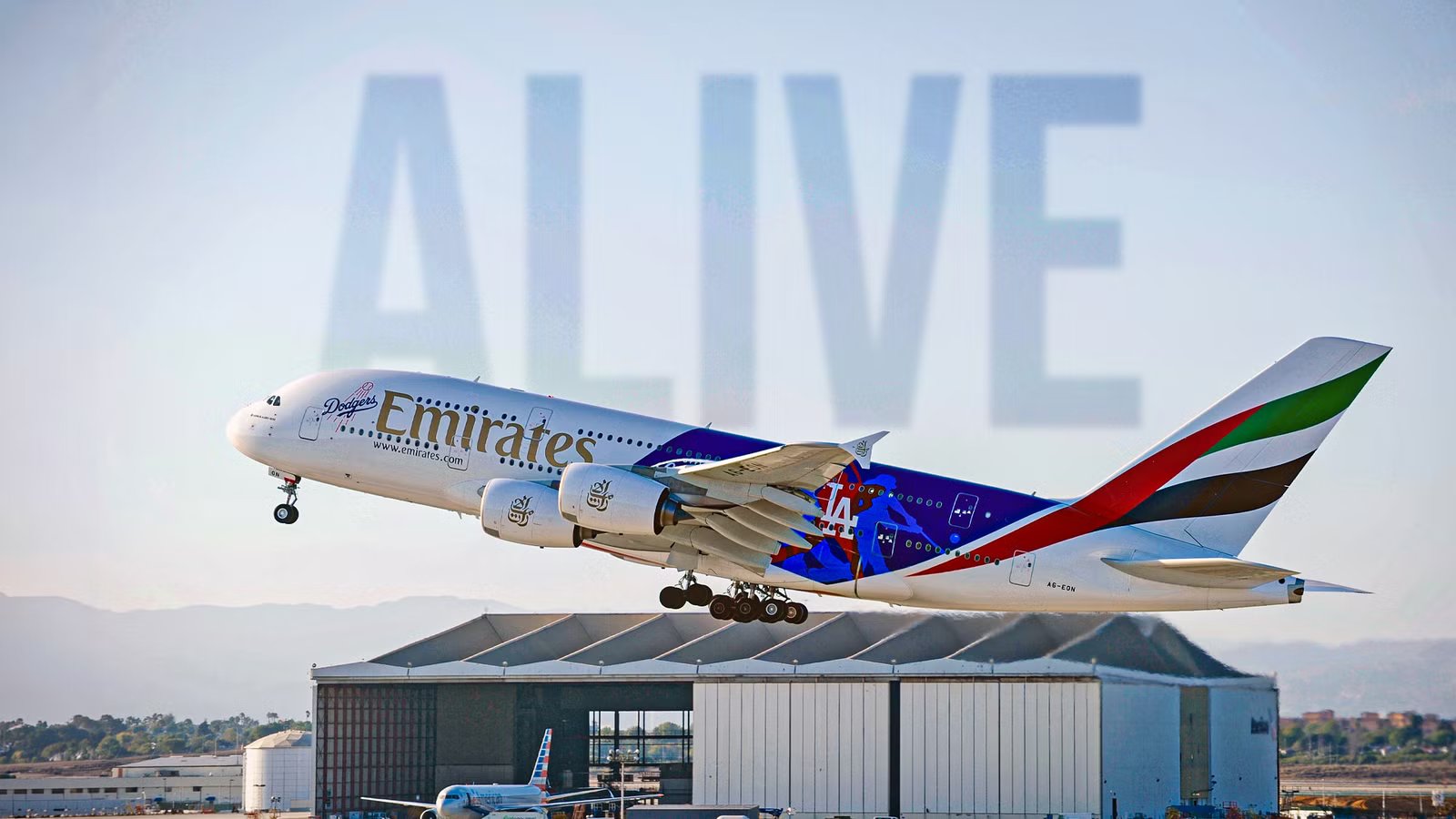
The physical survival of the world’s largest passenger aircraft has become a complex exercise in industrial recycling as the global fleet enters its second decade of operation. Every Airbus A380 currently in the sky depends on a hidden supply chain built from the bones of retired superjumbos, and this guide maps that circular-economy pipeline from the teardown hangars in France to the active flight lines in Dubai and London. With the production line in Toulouse permanently closed since 2021, the 190 aircraft remaining in service in 2026 rely on a finite pool of used serviceable material to remain airworthy.
This reliance on organ-donor aircraft results from the presence of rare components that are no longer being manufactured by original equipment suppliers. The delay of next-generation widebodies, specifically the Boeing 777X, has forced a massive life-extension program for the A380, with airlines now turning back to the superjumbo even after it was deemed a failure.
One Sacrificed For Five

Just the name Airbus A380 instantly brings to mind a symbol of aviation luxury from a different age of aviation. That age is not over yet, thanks to a masterclass in cannibalization that has accelerated as the fleet reaches its primary heavy maintenance intervals. In May 2026, the operational reality for the 190 active superjumbos is defined by a lack of new-build spare parts, meaning that a grounded aircraft might wait weeks for a component that can only be sourced from a retired frame in a different part of the world. The current system of harvesting parts, often referred to as the organ-donor model, is the only way to sustain the high-frequency schedules maintained by carriers like  Emirates and
  British Airways.
The physical dismantling process is an operation managed by specialized firms such as VAS Aero Services and Tarmac Aerosave. In April 2025, these companies announced the teardown of three specific airframes: MSN 61 and MSN 66 (formerly of Lufthansa) and MSN 84 (formerly of Malaysia Airlines). These three aircraft are being reduced to their composite and metallic shells in Tarbes, France, to provide a steady stream of avionics, actuators, and flight control surfaces for the active fleet. Without this steady influx of harvested material, the cost of maintaining the A380 would spiral beyond the point of commercial viability for most operators.
A single landing gear set for the superjumbo weighs approximately 12,000 lb (5,443 kg) and is valued at several million dollars on the secondary market, so by harvesting these massive assemblies from retired frames, airlines can avoid the multi-year lead times and exorbitant costs associated with custom-ordering legacy parts from original manufacturers. It is a mathematical survival strategy where the death of one airframe effectively extends the lives of five others.
The Hidden Airport Powering The Comeback

Tarbes-Lourdes-Pyrénées Airport in southwestern France has evolved into the central nervous system for the global A380 fleet, serving as both a final destination for retired airframes and a vital warehouse for those still in service, and the dismantling of three additional aircraft highlighted the industry’s total reliance on this specific geographical hub. The facility at Tarbes is uniquely equipped to handle the 1.2 million lb (560,000 kg) maximum takeoff weight of the A380, providing the specialized cranes and environmental containment systems necessary to strip a superjumbo down to its skeleton in approximately three to four months.
The harvest from MSN 61, MSN 66, and MSN 84 represents a massive injection of inventory into the EMEA region. Specifically, the landing gear sets, consisting of five separate legs and 22 wheels, are among the first items to be refurbished and recertified. Given that a single Rolls-Royce Trent 900 engine can be sold for approximately $10 million in serviceable condition, the disassembly of these three frames alone creates a parts catalog worth nearly $150 million. Importantly, the inventory is strategically positioned in European warehouses to minimize the AOG time for the carriers operating high-density routes with numerous A380s in active service.
VAS Aero Services operates as a central clearinghouse, ensuring that the components recovered from a former  Lufthansa frame meet the rigorous certification standards required for installation on an Emirates or
  Singapore Airlines aircraft, for example. Here, the circular economy is not merely about finding cheap parts, but more about finding any parts in a market where the original supply lines have almost entirely dried up. As the 777X delays continue, the Tarbes pipeline has become a permanent fixture of the aviation landscape rather than a temporary solution.
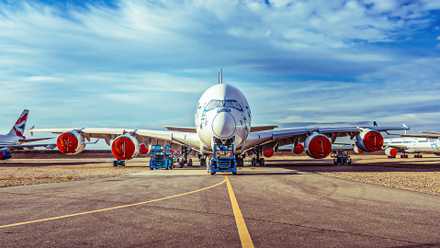
Back From The Desert: How 190 Airbus A380s Became Airlines’ Most Valuable Asset In 2026
This is why some airlines still love the Airbus A380 in 2026, despite production ending years ago.
Checks Can Be Costly

The 12-year heavy maintenance check, commonly referred to as the D-check, is the ultimate test of an airline’s commitment to the A380 program. For a jet as massive as the superjumbo, this inspection involves the total stripping of the cabin, the removal of all four engines, and a microscopic examination of the airframe for structural fatigue or corrosion. A significant portion of the global fleet has now hit this milestone, requiring a capital investment of up to $25 million per aircraft. Such incredible expenditure is roughly equivalent to the purchase price of a new mid-sized business jet, yet it is a necessary cost for airlines that lack a viable 400-seat replacement.
Lufthansa Technik Philippines (LTP) in Manila has emerged as the global leader for these humongous maintenance projects, securing a long-term agreement to service the Emirates fleet through October 2026. The facility has dedicated specialized hangars for the A380, where hundreds of technicians work in shifts to complete the 100,000 work hours required for a single D-check. Staying in Asia for a moment, Japan has also remained a focal point for A380 operations, with All Nippon Airways maintaining its Flying Honu fleet through meticulous local and regional maintenance partnerships.
Comparing the maintenance profile of the A380 to its closest contemporary, the Boeing 777-300ER, reveals why the superjumbo is often considered a financial liability for all but the largest carriers. A heavy check for a 777-300ER typically costs less than $5 million and requires a fraction of the ground time. However, for an airline like Emirates, the A380 occupies a unique niche that even two 777s cannot fill, which is the ability to move over 500 passengers into slot-constrained airports like London Heathrow. Slot efficiency is the primary reason why airlines are willing to pay the D-check tax, provided they can secure the necessary used parts to complete the work.
A Helping Hand From Boeing

The precarious survival of the Airbus A380 into the latter half of this decade is inextricably linked to the production struggles occurring 5,000 miles (8,046 km) away in Everett, Washington. Originally, the aviation industry expected the Boeing 777X to begin replacing the superjumbo as early as 2020, offering a twin-engine efficiency that promised to render the four-engine A380 obsolete. However, as of May 2026,  Boeing has confirmed that first deliveries are now pushed to 2027, following a series of certification hurdles and a staggering $15 billion in development overruns. This seven-year delay has transformed the A380 from a retired asset into a critical capacity bridge that airlines simply cannot afford to ground anymore.
For major carriers like Emirates, which holds a massive backlog of 270 777X aircraft, the absence of this new flagship has necessitated a multi-billion dollar reinvestment in the existing A380 fleet. Rather than phasing out older airframes, airlines are now scouring the secondary market for used serviceable material to keep their current double-deckers flying for another decade. The delay has created an artificial floor for the value of A380 parts as a set of refurbished flight control actuators that might have been scrap in 2023 is now a high-demand commodity.
Airline | 777X Order Backlog | Expected Delivery | A380 Retirement Shift |
Emirates | 270 Units | Late 2027 | Extended to mid-2030s |
Lufthansa | 27 Units | Early 2027 | Reactivated 8 units |
Qatar Airways | 60 Units | 2027 | 8 units retained |
Singapore Airlines | 31 Units | 2027 | 12 units in active service |
The lack of a 400-seat alternative has also impacted airport slot management in major hubs. The 777-9, on paper, is the only aircraft capable of matching the A380’s passenger density per slot, so its absence has forced airlines to make do with existing fleet options. As a result, these decisions have solidified the role of third-party part suppliers as the unsung heroes of modern fleet management.
Simple Flying Quiz
Easy (15s)Medium (10s)Hard (5s)
Still A Future

Doubts have been cast over whether the A380 has a future beyond the Middle East, yet the 190 aircraft flying today tell a different story of resilience. In actuality, nearly every major operator returns their stored fleet to the skies to meet an unprecedented surge in international travel demand. The reintroduction process is a logistical ordeal that requires more than just a fresh battery and a tank of fuel, but this has not seemed to faze any of the operators that have brought the A380 back into the skies.
This resurgence is best exemplified by  Etihad Airways, which is set to return its eighth A380 to the skies on June 16, 2026, specifically for the Abu Dhabi-Narita route. Meanwhile, Global Airlines, the first new-entrant carrier to build an entire business model around used A380s, brought an A380 back into service, though prolonged grounding has set plans back. These reactivations are only possible because of the donor pipeline, which provides the necessary replacement parts for airframes that have sat idle for over four years.
The reintroduction of these aircraft has also sparked a wave of interior retrofits. British Airways has committed to a new first class cabin for its A380s, showing that the airline expects the type to remain its long-haul slot maximizer for the time being. In Australia, Qantas has recently reactivated its final stored example, completing a multi-year effort to return its entire A380 fleet to service.
A Win For Everyone

The current parts-harvesting ecosystem for the A380 mirrors the late-stage lifecycle of the Boeing 747-400, but with a critical difference in scale and scarcity. When the 747 began its decline, there were over 400 active airframes and a massive secondary market for parts, yet the A380 entered its twilight with a much smaller footprint of only 251 total units ever built. This creates a far more intense competition for components like the high-pressure turbine blades in the GP7200 engines or the specialized Class D avionics modules. The A380 is almost like a boutique aircraft in a world of mass-produced twins, making the work of Tarmac Aerosave in France more akin to art restoration than traditional demolition.
Circular economy is no longer an optional sustainability goal but a mandatory business strategy. The ability to monetize a retired airframe like MSN 84 allows Malaysia Airlines to recoup value while simultaneously lowering the maintenance costs for Emirates or Lufthansa. It develops an interconnected web of support that ensures that the superjumbo can bridge the gap until the 777X finally arrives in 2027.
The A380 fleet is inevitably going to shrink once more, as the 777X and A350-1000 take over the most congested routes. However, for as long as 190 of these giants remain in the sky, the organ-donor system will remain the most efficient way to balance the books. The legacy of the A380 will not just be its size or its double-deck staircase, but the way it forced the aviation world to rethink how we maintain, dismantle, and respect the world’s most complex flying machines.


![Air Canada & Air Transat Are Launching These 5 New Transatlantic Routes Soon [Map]](https://dailynewsnblog.com/wp-content/uploads/2026/08/797-air-transat-airbus-a330-ross-howey-photo-_-shutterstock.jpg)