dailynewsnblog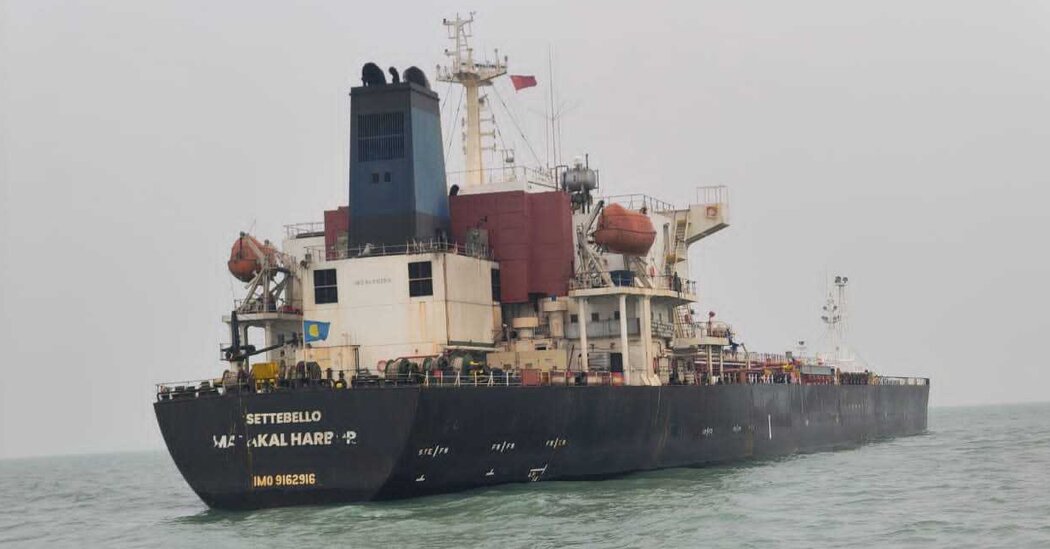
To the sailors recruited from India, it was just another job. But the ship they boarded was a shadow fleet tanker destined for a war zone.
The Settebello had spent at least five years moving Iranian oil that was under U.S. sanctions, often disguising its location, according to a maritime tracking firm. It hid again in early June in the Gulf of Oman, east of the Strait of Hormuz, where it loaded fuel from other ships at sea.
On the morning of June 10, it became a target of the U.S. Navy.
Shortly after 7 a.m., U.S. missiles blasted into the engine room where an engineer and mechanic had just begun their shifts, killing both men instantly. A young cadet, having breakfast next door, suffered fatal head wounds.
They were the first and only civilian victims of America’s blockade on Iranian ports — and among at least 17 sailors killed since the war began, according to the United Nations, most of them casualties of Iranian strikes.
Just how they became casualties of a war they weren’t part of offers a window into the dangers faced by merchant sailors in the Middle East, where fighting between the United States and Iran have made the waters in and around the Strait of Hormuz some of the world’s deadliest.
The U.S. military said it fired precision munitions into the Settebello’s engine room because it was violating the American blockade on Iranian ports and repeatedly failed to comply with directions.
At the same time, evidence suggests the ship was drifting with its engine off at the time of the strike, leading experts to ask whether it was an avoidable and excessive use of force by the United States.
The ship’s crew faced heightened danger because of risky decisions by its command to load up oil, most likely Iranian, in a series of ship-to-ship transfers in the days before the strike, despite Navy warnings about the U.S. blockade.
This account of the days and hours before the fatal encounter was pieced together through interviews with crew members, U.S. military officials and the families of victims. The crew members spoke on the condition of anonymity for fear of reprisal by their employers.
Both the sailors’ and military’s accounts are incomplete. U.S. Central Command declined to share recordings of the communications made with the crew and specify when exactly they occurred. But the findings offer the most detailed account of the events that turned the Settebello’s cargo mission into a fatal encounter.
A Risky Job
The 28 men aboard the ship were mostly Indian, and a majority had joined within the past year, according to records obtained from their recruitment agency.
The Settebello had a five-year history of moving Iranian oil, according to TankerTrackers.com, a company that monitors global shipping. The U.S. military said it was a part of a shadow fleet designed to evade sanctions, even though the ship itself was not under sanctions by the United States.
In late April, the crew began its journey from the Chinese port of Lianyungang and headed to the Gulf of Oman, according to ship-tracking data.
In daily calls, Rajesh Sharma, whose son, Aditya, was the trainee cadet killed in the attack, had urged his son to leave and come home. But his son said that he needed to keep working if he wanted to achieve his dream of one day becoming a captain, Mr. Sharma said.
Over the first eight days of June, critical days before the strike, the ship appeared to be stationary in Oman’s territorial waters off the port of Shinas, according to analysis of satellite imagery by TankerTrackers.com. A crew member said the ship had its anchor down during this period.
On June 2, a new captain, Sanjeet Kumar Behera, joined the ship. Then the Settebello loaded oil at sea from several ships, according to two crew members. One of them said he suspected the fuel was Iranian but the crew was not told the source of oil. That, he said, would be known only by the ship’s owner and captain.
A spokesman for U.S. Central Command, Capt. Tim Hawkins, told The Times that U.S. intelligence determined the oil was Iranian. He said that in the days before the strike, the Settebello’s crew dismissed nearly 60 verbal warnings relayed via radio, often retorting “belligerently” and ignoring at least eight military shows of force that included flares and fighter jet flyovers.
“The vessel went out of its way to not comply,” he said.
Manoj Yadav, the general secretary of the Forward Seamen’s Union of India, told The Times he had been briefed by Captain Behera and other senior crew members.
They told him they had only received general warnings after June 2 that they did not believe applied to the Settebello. The warnings instructed vessels not to move toward blockaded Iranian ports and were announced over a radio system used by many ships, he said. Mr. Yadav added that the crew denied responding to U.S. warnings.
“Sailors are ordinary people, not combatants trained for war.” said Mr. Yadav.
The Final Moments
On June 8, as a spasm of hostilities jeopardized a two-month cease-fire, the Settebello made its riskiest gambit. The crew sailed for a few hours into the middle of the Gulf of Oman where they expected a second ship to transfer oil to the Settebello, one crew member said.
By now, the Settebello was carrying 26,000 metric tons of bitumen, a thick petroleum product used in road construction, according to a crew member.
Then they turned the engine off, and the ship began to drift, according to three crew members.
The second ship never came, a crew member said.
The sailors were worried. They heard that other ships had been struck by the United States, including in late May and early June. On June 8, another tanker, the Marivex, was struck in the Gulf of Oman. Still, the Settebello crew went about their daily routines. They drifted for more than a day, one crew member said.
At the time of the strike, at 7:14 a.m. on June 10, the ship’s crew was largely asleep. A cadet was manning the radio on the bridge, as the captain rested in his room, according to two sailors.
Captain Hawkins said the ship received two final warnings, the last telling the crew it had 15 minutes to evacuate the engine room. He declined to say if the ship responded.
Mr. Yadav said a cadet, who was on the bridge for three hours before the attack, told him he had heard no warnings.
The missiles fired from a U.S. warplane rocked the 600-foot tanker and killed Suresh Patnala, the Settebello’s chief engineer; Shivanand Chaurasia, a fitter; and the trainee cadet, Aditya Sharma.
The Aftermath
Their deaths drew a diplomatic protest from India, which supplies 12 percent of the world’s merchant shipping work force. But more persistent has been a campaign led by the Indian seamen’s union. It is demanding compensation from the U.S. government for the victims’ families and an independent investigation into what it has publicly called a “war crime.”
Several naval warfare experts who reviewed footage of the strike, which was released by the U.S. military, said the ship appeared to be drifting or at rest. There was no indication the ship was moving.
The U.S. military declined to comment on whether the ship was drifting.
International law requires countries to pursue the least destructive means to stop ships suspected of carrying contraband. Whether the U.S. Navy did so is the central question in the attack on the Settebello.
Whether a vessel is moving or resting is key to determining if a military strike is legal when enforcing a blockade, according to Dr. Ian Ralby, who is president of the maritime governance nonprofit group, Auxilium Worldwide.
“You disable a vessel that is actively in violation — as in, it is underway. Why shoot out the engine room if the engines aren’t even running?” he said.
Todd Huntley, a retired Navy captain and national security law expert at Georgetown Law, said there were questions about why the military did not choose to search the vessel, but the military’s account of multiple warnings being rebuffed by the crew would make the use of disabling force “much more reasonable.”
The Central Command spokesman, Captain Hawkins, said seizing a ship resisting the blockade is a potentially risky operation, and it is safer to disable it.
The ship’s Emirates-based manager, IOS Marine FZE, could not be reached by phone. The surviving crew members and relatives of those killed said they have been unable to reach the tanker’s owner, Aqua Aurora Shipping Lines, which does not have publicly listed contact information.
For the families of the three men killed, grief is mixed with anger.
“He was doing his job there. They don’t have weapons. They are all civilians,” said Mr. Sharma, who said this was his son’s first voyage as a trainee, earning a $200 monthly stipend.
Mr. Sharma attended a union meeting this month in Mumbai, where he scrolled through photos of his son on his phone. “This was Aditya’s last selfie,” he said, pointing to his son, in a Batman T-shirt with the open sea behind him. Another photograph he received hours later showed his son lying unconscious, a cloth tied around his head to stem the bleeding, wearing the same T-shirt.
Patnala Bala Bhargavi, 39, the wife of the Settebello’s chief engineer, who was also killed, said, “Someone killed my husband. No one is accepting the blame, but someone is responsible.”