dailynewsnblog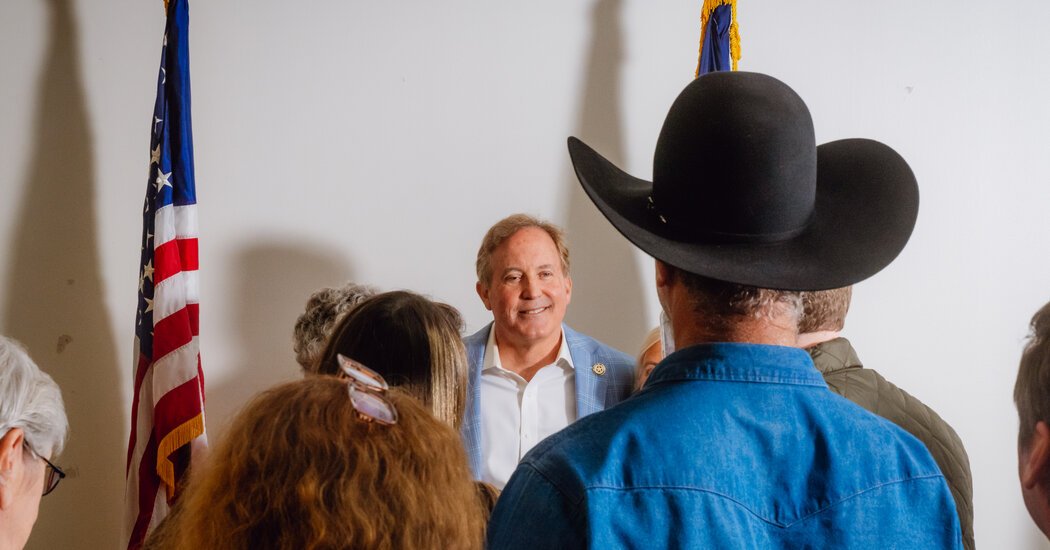
Sharron Albertson, a longtime Republican activist, has been exchanging text messages with her old friend Ken Paxton, and she is not happy with his answers. Among the topics: the welfare of his estranged wife.
“One of the recent ones was, ‘People are thinking that Angela’s getting a bad deal in the divorce.’ He wrote back, ‘She’s getting a better deal than I am,’” Ms. Albertson said.
Mr. Paxton, the Texas attorney general, has been accused of adultery by his wife of 38 years, Angela Paxton, who last year filed for divorce “on biblical grounds.” He’s been indicted on charges of felony securities fraud, and he’s been impeached, too — with votes from members of his own party — on allegations of bribery, dereliction of duty, obstruction of justice and abuse of the public trust, and other misdeeds.
But none of that has stopped him from shaking up the U.S. Senate race in Texas, where he is battling Senator John Cornyn, the four-term incumbent, in a runoff later this month despite being outspent by tens of millions of dollars in the Republican primary. Characteristically, Mr. Paxton may be his own most formidable opponent.
“If he loses,” said Ms. Albertson, who has known him for decades, “it will be his own doing.”
Maybe, though, it won’t be hers. “I can’t really go against Ken,” she said. “I cannot do John Cornyn.”
The conundrum of Ms. Albertson underscores the strange state of a high-stakes race that could determine the partisan balance of power in Washington.
Mr. Paxton, 63, has, in his quarter-century of public life, never lost an election. Despite his failures and faults, and in some ways because of them, he’s won crowded primaries and make-or-break runoffs — and polls show he could win this next one as well. In November, the winner will face an ascendant and cash-flush Democrat, James Talarico.
Mr. Paxton keeps getting elected in spite of it all because of his lifeblood bond with a core group within the Republican base — conservative acolytes who actually show up to vote in the state’s historically low-turnout primaries. His hero’s journey, or villain origin story, depending on one’s perspective, relies on a narrative of political persecution, the notion that he is hounded by a cabal of old-school Texas Republicans clinging to outdated values — a cabal, Mr. Paxton’s backers believe, that includes Mr. Cornyn.
Mr. Cornyn has called him “flawed, self-centered and shameless.” Mr. Talarico once described Mr. Paxton as “the rot at the core of our broken political system.” Both campaigns believe a reckoning is, at long last, nigh.
Regardless of the outcome, Mr. Paxton stands as one of the most important and instructive figures in American politics today. He’s manifestly less showy and far less ideologically malleable than President Trump. And he’s something short of Mr. Trump’s “central casting” — he has a past-middle-age paunch, a slightly lopsided smile and one eye with almost perfect vision and another in which he’s nearly blind. Still, Mr. Paxton is as indicative of this era as perhaps anybody this side of the president himself.
“He was Trump before Trump was Trump,” said Michelle Smith, a longtime Paxton aide.
“Had Trump not been normalized by the party, Paxton would never have had a chance,” said Stuart Stevens, the anti-Trump former adviser to Mitt Romney, John McCain and George W. Bush. “But now that he has been normalized, he’s the future.”
Last month, after a standing ovation at the potluck supper of the Republican Party of Victoria, a small South Texas city, Mr. Paxton, a better small-talker than speech-giver, lingered in a meet-and-greet queue, shaking hand after hand. On his way out, he stopped in a hallway for a 10-minute interview with The New York Times.
Why does the base stick with him, he was asked, when he’s been indicted and impeached — when he’s been accused of adultery?
“Why does the base stick with President Trump,” he said, “when you can say all those same things?”
‘Do Not Underestimate Him’
Mr. Paxton came of political age in the primordial ooze of this destabilizing time.
In the 1990s, he was just another 30-something will-and-trust attorney in the swelling suburbs of Collin County, north of Dallas. He and his guitar-picking, home-schooling wife traveled in intersecting business, social and political circles with megachurch evangelicals and grass-roots anti-abortion activists — steeped in an inchoate, Christian nationalist, proto-Tea Party energy and budding establishment-doubting discontent.
Mr. Paxton, though, was not an obvious contender for even down-ballot office. He had been involved in student government in high school in Lawton, Okla., he was the student body president at Baylor University in Waco, Texas, and he had a law degree from the University of Virginia. But he was, as one Baylor buddy put it, more a “blender” than a big man on campus.
When he decided to run for state representative in 2002, even supporters questioned his chances. But he had an odd, unimposing charm and a knack for names. He was receptive to the point of pliant. “He listened,” said Ms. Albertson, who was a leader of an influential club of local Republican women called the Golden Corridor, “and did the stuff that we suggested.”
He had assets in his four young kids and his wife, who was an ebullient partner in his political efforts. He got the most votes in a five-person primary and then bested an older, establishment-backed attorney in a runoff — part of a new class of elected officials that gave Republicans total control of state government for the first time since Reconstruction.
“He was just so unimpressive,” said Chris Oldner, a former Collin County judge who is no friend of Mr. Paxton. “But after that race, I’d tell everybody I talked to, ‘Do not underestimate him.’”
As a state legislator, during a decade in which Mr. Paxton’s most ardent supporters became disenchanted by the presidency of George W. Bush, enraged by the election of Barack Obama and primed for the rise of Donald J. Trump, Mr. Paxton earned top ratings from conservative watchdogs.
He worked to prevent undocumented students from getting in-state college tuition. He favored public school curriculums that instilled a “sense of pride in our country” rather than “a source of shame.” Most significantly, he mounted a campaign to become speaker of the Texas House, challenging the incumbent, Joe Straus, whom he considered too willing to work with Democrats. Mr. Paxton’s push failed — he dropped out just before the vote — but only in the most technical sense.
“It branded him,” said Brendan Steinhauser, an Austin-based Republican strategist, “as a guy willing to take on the establishment.”
And it set him up to run for State Senate in 2012 — and then for attorney general two years later. During his bid to be the state’s top law enforcement official, however, he was found to have flouted the law.
In the spring of 2014, Mr. Paxton was fined $1,000 for violating state securities laws by soliciting investors in the company of an associate without being registered with the state and without letting them know he was taking a cut.
The election established a pattern: The legal transgression did not get in the way of the campaign, he emerged from a primary to compete in a runoff against a more traditional Republican and he weathered opposing ads painting him as an untrustworthy lawbreaker. And he won.
Then, his first summer as attorney general, he was indicted on three felony fraud charges related to the securities case. He was arrested, fingerprinted and booked.
For critics, including the anti-Paxton protesters who gathered at the Collin County courthouse, it confirmed his reputation as a legislator who was more focused on making money than making law — a workaday attorney enamored by the ambient wealth of the lobbyists of Austin and the oil-rich donors of West Texas. For supporters, though, the indictment reeked of political payback.
Years before Mr. Trump sat for a mug shot and scowled, Mr. Paxton sat for a mug shot and smirked.
Lawsuit After Lawsuit
Mr. Paxton used the office of the attorney general to build his political prospects while simultaneously tempting political fate.
He sued President Obama a lot — “27 times” in two years, he says in speeches. “I’m a pistol-packin’ mama, and my husband sues Obama,” Angela Paxton liked to sing on the stump.
Abortion and guns, environmental regulations and other culture-war cudgels — Mr. Paxton filed suit after suit, creating headline after headline.
In 2018, a difficult year for Republicans, Mr. Paxton was re-elected — beating a former Supreme Court clerk for Sandra Day O’Connor despite ads against him that included an “indictment explainer” and a reminder of the time Mr. Paxton was caught on a security camera at a courthouse checkpoint pocketing a $1,000 Montblanc pen that wasn’t his (he gave it back).
Angela Paxton ran and won, too, taking the State Senate seat her husband had once held.
But the most significant challenge to Mr. Paxton’s ascendant political career came in 2020. That fall, eight of his top deputies accused him of bribery and abuse of office, asking federal law enforcement officials to do something. Mr. Paxton had improperly aided a real estate developer who was also a campaign donor and the employer of a woman with whom Mr. Paxton was cheating on his wife, they told a Texas House investigative committee. The staffers then quit or were fired; those who had been fired sued Mr. Paxton, claiming whistle-blower retaliation.
He also was investigated by a grand jury for self-dealing in a land development in Collin County (he was cleared) and for bribery related to a campaign contribution from a donor his office had investigated for fraud (the investigation was dropped). The securities fraud case, meanwhile, languished — getting delayed, getting moved, getting old.
In 2024, he cut a deal to drop the fraud charges in exchange for performing community service and paying restitution. He did not admit guilt.
All along, Mr. Paxton kept getting richer. When he first won public office, he listed his assets as less than $200,000. Two decades later, on an annual state salary of about $150,000, he reported a net worth approaching $8 million with residential properties in Oklahoma, Florida, Utah and Hawaii. Mr. Paxton has been secretive about the source of his wealth, creating a blind trust and then failing for years to disclose to regulators the assets in that trust as required by state ethics rules.
After Mr. Trump lost in November 2020, Mr. Paxton sued Georgia, Michigan, Pennsylvania and Wisconsin to challenge the results. And on Jan. 6, 2021, he spoke at the rally before the riot at the Capitol.
When President Joseph R. Biden Jr. took office, Mr. Paxton began suing the federal government in earnest again — more than 100 times in all.
The party base couldn’t get enough of him. In 2022, Mr. Paxton again topped a primary field and again moved to a runoff, this time against a Bush. “This race isn’t about my last name,” George P. Bush, the son of Jeb Bush and the grandson of George H.W. Bush, said in an ad. “It’s about Ken Paxton’s crimes.” Mr. Paxton beat him by better than 2 to 1.
“Like Trump, he’s got a pretty good gut for the base and where the base is,” said Sam Cooper, a consultant to Mr. Paxton — and, he added, “where they’re going.”
Impeachment
The closest Mr. Paxton came to comeuppance was also what cemented his connection to the base.
In February 2023, he settled the suit with the employees turned whistle-blowers for $3.3 million. He wanted the State Legislature to pay the bill. The Republican-controlled House wanted to know more. Three months later, a House investigative committee returned with 20 articles of impeachment.
Republicans held a four-hour hearing to decide whether to proceed. Some heard from Mr. Paxton directly.
“He was calling a lot of members on the floor right before the vote,” Craig Goldman, a former state representative and current congressman, said in an interview.
The vote was overwhelming — 121 yes, 23 no. Sixty Republicans voted to send the impeachment of Mr. Paxton to the Senate for trial.
Mr. Trump, who had been impeached twice and indicted that March, called the Paxton decision “very unfair.” Mr. Talarico, then a state representative, went on CNN. “This all could have been avoided if Paxton just resigned,” he said. “But he doesn’t feel shame.”
The 10-day trial at the Capitol in Austin presented political peril — and opportunity.
The prosecution laid out evidence accusing Mr. Paxton of abusing his office to help a donor. But Mr. Paxton’s attorneys played to the cameras and the politics of the moment, portraying Mr. Paxton as a victim of deep-state G.O.P. forces.
State senators felt pressure from Paxton fans. They told Drew Springer, a former senator, in Mr. Springer’s recollection: “We love Paxton. None of this matters. He shouldn’t be getting impeached. This is the same as Trump.”
Angela Paxton, barred from voting as a senator because of the conflict of interest, listened during the trial to her husband’s former chief of staff testifying about Mr. Paxton’s alleged infidelity. Ms. Paxton declined to be interviewed for this story.
Seemingly unconcerned, Mr. Paxton ate barbecue during the trial at the home of Bill Miller, an Austin-based lobbyist and friend. “You’d never know there was an impeachment going on,” Mr. Miller said. “You know the old saying ‘as easy as pie’? It was as easy as pie.”
In his closing argument, Mr. Paxton’s top attorney, Tony Buzbee, made the point bluntly. “This is a political witch hunt,” Mr. Buzbee said. “The Bush era ends today.”
Mr. Paxton was acquitted.
Newly emboldened, he sought revenge — campaigning for primary challengers to the House members who had voted to impeach him. Among the winners was one of his impeachment attorneys, Mitch Little. “I have zero doubt in my mind if that had not happened, I would not be serving in the Texas House of Representatives,” Mr. Little said.
Impeachment, it appears, only made Mr. Paxton stronger.
“The grass roots were furious,” said Abraham George, the state Republican Party chair. “It made him more popular and more powerful than ever.”
‘Just a Normal-Looking Guy’
Three days after last month’s potluck in Victoria, Mr. Paxton stood in ostrich-skin boots in a room on the third floor of a furniture store across from a shooting range called the Texas Gun Experience, waiting to talk to the Grapevine Republican Club.
In a quiet conversation with The Times, he said his life had changed at age 12, when another boy accidentally pelted him in the right eye with a chinaberry, the size of a marble and nearly as hard. The damage led to surgeries that left his eye with no lens. In a pickup basketball game at Baylor, he took an elbow to the face and broke bones around the same eye.
His healthy left eye is lighter, his wounded right eye darker. The incongruity is distracting to some and disarming to others, and so Mr. Paxton has learned to use what he has, good and bad.
“He’s not larger than life,” said Mr. Miller, the lobbyist. “He’s not got great hair. He’s not good-looking. He’s just a normal-looking guy who can make you like him about as easy as you can imagine.”
Approaching the May 26 runoff, polls are tight. Mr. Paxton has in his campaign coffers less than half of what Mr. Cornyn has — but a $70 million onslaught of ads for Mr. Cornyn earlier in the primary didn’t prevent Mr. Paxton from getting almost as many votes. In March, Mr. Paxton savvily managed to ward off what many suspected was Mr. Trump’s pending endorsement of Mr. Cornyn.
Mr. Paxton’s divorce is bitter, public — and ongoing.
For supporters of Mr. Paxton, though, his alleged infidelity is not determinative. “I’m not voting him in to be my husband,” said Shelley Luther, a state legislator.
Even some Democrats are resigned to Mr. Paxton’s Trump-like Teflon. If he manages to win this year, he almost certainly will outlast Mr. Trump himself. “For sure he could get elected to the U.S. Senate and serve three terms,” said Luke Warford, an Austin-based Democratic strategist. “We could be talking about Ken Paxton 20 years from now.”
In Grapevine, after his speech, Mr. Paxton again shook hand after hand. “How are you?” he said. “Tell your friends,” he said. He leaned down to listen to a woman who had been waiting until the very end. Peggy Borchert, 85, put a hand on his shoulder.
Afterward, she was asked about what they talked about. “None of your business,” she said.
She was asked about Mr. Paxton’s scandals. “I’m not going to talk about that,” she said.
“When you believe in Jesus, you’re a new creation, because Jesus comes into your heart,” she said. “But you still have a nature, a flesh, that’s mean and nasty.”
Was she going to vote for Mr. Paxton in the runoff?
“Absolutely.”