dailynewsnblog
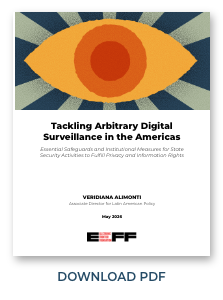
Poor accountability, feeble control mechanisms, and insufficient legal frameworks have led to systematic human rights violations in the Americas, with no consistent remedy or reparation to victims. What’s needed is to materialize essential guarantees and measures to combat repeated surveillance abuses in the region. To help build a path for solutions, EFF launches the guide Tackling Arbitrary Digital Surveillance in the Americas, adding to our extensive work leveraging human rights norms to confront state privacy violations.
The document compiles privacy, data protection, and access to information guarantees established within the Inter-American Human Rights System to provide concrete, actionable guidance to governments in the Americas to curb the vicious cycle of state digital surveillance abuses. It outlines the safeguards and institutional measures necessary to protect individuals and details rules, parameters, and standards to overcome current pernicious practices and trends.
As concerns over national and public security intensify, countries in the region seem to increasingly normalize the pervasiveness of digital surveillance technologies and their arbitrary use by security forces as a distorted form of protection. However, no actual protection can arise from arbitrary surveillance.
When public security, intelligence, and law enforcement agencies neglect or harm settled rights in the name of national security or public order, they too become a threat. Tolerating rights violations creates the dire situation that the Freedom of Expression Special Rapporteur of the Inter-American Commission on Human Rights thoroughly analyzed in his report about the serious impacts of digital surveillance on freedom of expression in the Americas.
The great majority of states in Latin America have ratified the American Convention on Human Rights. As such, the parameters and rules our new guide describes stem directly from their obligations before international human rights law. State agents and institutions must take the necessary measures to make them a reality.
As EFF’s guide points out, states must implement clear and precise legal frameworks that:
- define surveillance powers and limitations;
- ensure all surveillance measures pursue legitimate aims without discriminatory ends;
- subject interference with privacy to rigorous necessity and proportionality analysis;
- require prior judicial authorization for digital surveillance measures;
- maintain detailed records of surveillance operations;
- establish independent civilian oversight institutions with technical expertise and enforcement powers;
- guarantee individuals’ right to informational self-determination and proper notification; and
- provide effective remedies and reparation for victims of surveillance abuses.
States must also put in place the institutional processes and structures to give effect to these legal guarantees. As we stress in the document, States that embrace the guide’s recommendations will not only comply with their international obligations, but will also build more resilient, rights-respecting security architectures capable of addressing genuine threats without sacrificing the freedoms they exist to protect.
Civil society leaders, activists, legal experts, public defenders, oversight institutions, and state officials committed to human rights must gather and ramp up the fight against the normalization of digital surveillance abuses in the Americas. We hope that EFF’s new guide can serve as a crucial tool in strengthening this fight, one that we have joined since our early days.