dailynewsnblog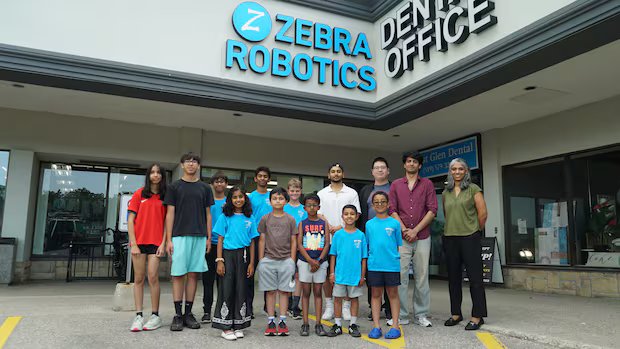
Nine-year-old Keshav Malhotra’s eyes lit up when he realized he and his teammates had just won gold in an international robotics competition.
“I was shocked,” said Keshav, a student at Zebra Robotics, a Kitchener-based learning centre based that teaches children how to code.
Keshav and two other students make up Team KAAmazing Robotics, a junior robotics team from Zebra Robotics. They took the gold prize for their design in the junior robotics category at the STRIPE Competition International at the Niagara Falls Convention Centre last month.
He wasn’t expecting the win, especially since his team joined the competition as a wild card.
“On the third [place], I was like, no, it’s not us. On the second one, I was like, it can’t be us. Then on the first one, my eyes just went up.”
Eight-year-old Alisha Bathla, a teammate, said the win made her really happy.
“I felt pretty excited. It was pretty nice and I was really surprised that we got first.”

A team of junior robotics students won the top prize at the STRIPE Robotics International Tournament last month. They were one of three teams representing Zebra Robotics in the tournament’s international finals, facing more than 50 teams from across Canada and the United States. CBC K-W’s John Dalusong met with the winning team KAAmazing Robotics at Zebra Robotics as well as other participants in the competition.
STRIPE stands for science, technology, robotics, innovation, programming and engineering. During the two-day event, 101 teams from across Canada and the United States came together to showcase their science, technology, engineering and math (STEM) expertise.
Four teams from Zebra Robotics competed. Two senior teams took the top seven and top 20 spots in the senior robotics category.
‘Extremely proud’ of the students
The theme for the junior robotics category was amusement parks.
Team KAAmazing Robotics had to design, build and code an amusement park out of Lego bricks.
Through team effort, the group built what they named Lego Park, which featured a main entrance, a ticket stand, a garden and a pond. The park’s main attraction was a drop tower-inspired motorized ride that the students coded themselves.

Abbas Dholkawala, who worked on the coding of the build, said he was confident about their design from the get-go.
“It was all good. I didn’t feel nervous,” the eight-year-old said, explaining how the coding process was simple and straightforward because they worked as a team. “I just wanted to get to the top 10, but then I got first [place].”
Jeffery Jiang, a coach at Zebra Robotics, guided the junior teams’ preparation for the competition.
He said while he couldn’t be with the team due to sickness, he’s “extremely proud” of what the students achieved, especially considering it was the first time they were in a competition.
“I really thought of them, and I knew that they must have really pulled together at the last minute and rehearsed very hard and diligently,” Jiang said. “I’m just extremely proud of them for all the hard work they put in. It was very rewarding to see that the hard work paid off.”

Similarly for the senior robotics category, teams had to design and build Lego. Instead of amusement park rides, the robots had to be able to clear challenges and hurdles, each worth points. Each robot looked different from the next, but they’re all meant to complete the same challenges.
Hasan Dholkawala was the only student on Team Robo Vortex. He designed a robot that earned seventh place in the competition. The design had large wheels and claws, all purposely attached to help the robot clear obstacles. Despite not winning, he said he enjoyed the experience as a whole.
“It was pretty nerve-racking, but it was also very exciting to have that experience,” he said. “Building the robot, collaborating with other teams and sharing the mats [with competitors].”
‘Optimistic about the future’
The success of Zebra Robotics teams in the international competition is something coach Syed Farrukh Saif feels great about.
“Ever since I’ve joined Zebra, I’ve been shocked at how smart these kids can actually be — sometimes smarter than us adults.”
Saif believes there’s a bright future for these students especially since they’re into robotics and coding at an early age.
“I’m a computer engineer … I started learning coding at 17,” he said. “These kids are getting into coding at like six … with Scratch and even Python they’re writing it as if it’s their native tongue.”
Scratch and Python are programming languages that can be used to write instructions for computers and robots to execute tasks, solve problems and build software.
“I’m pretty optimistic about the future,” Saif said.

Shalina Uthappa, owner and operator of Zebra Robotics, said that while robotics and coding may look intimidating, any child can get into the field and learn more than just programming, computers and robots.
“There are a lot of life lessons that are part of just being here. They work together as a team and they take part in competitions. Some experience success, some experience failures, and those are important … they’re constantly pushing themselves to do better.”
With the school year set to start in September, Uthappa said both the students and coaches are raring to go for other competitions, especially now that they’ve experienced the thrill.
“Everybody is already gearing up,” she said. “We are definitely going to be doing more.”