dailynewsnblog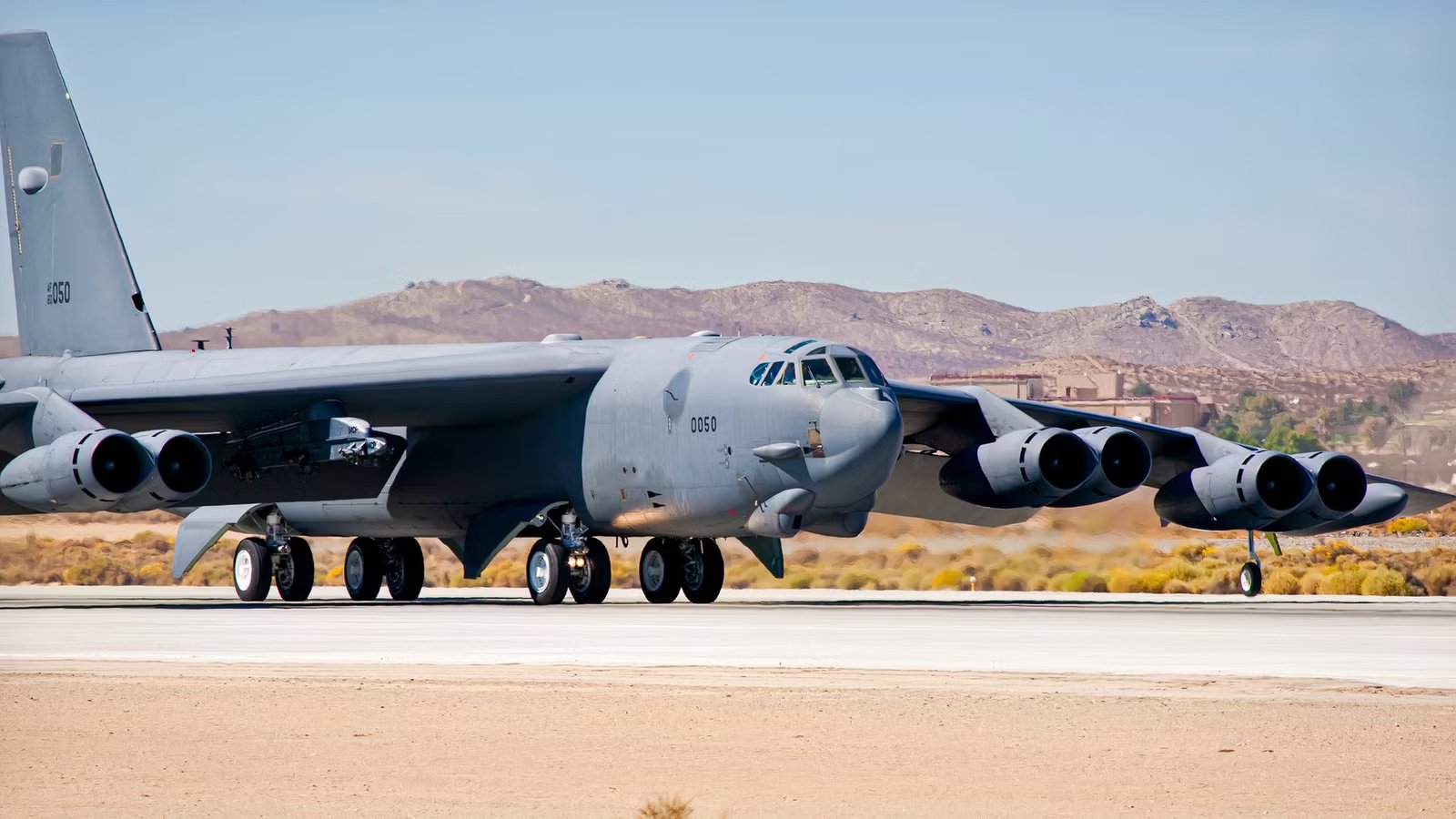
Operation Epic Fury, the US military offensive in Iran, has had numerous objectives. Foremost among them is the degradation or all-out destruction of Iran’s nuclear facilities, which, according to numerous experts, was headed toward a nuclear weapons capability. Additional objectives were to destroy stockpiles of ballistic missiles and the means to produce them, and, if possible, the operation would be the primer for a revolution or, at the very least, a change in leadership.
While there have certainly been ground operations carried out by US and Israeli special forces, the primary vector for kinetic strikes has been via air strikes. These have been carried out in large part by strike aircraft/multirole strike aircraft such as the F-18 and F-35. However, recently, B-52s, operating out of RAF Fairford in the UK, have been utilized to drop ordnance directly above Iran. This action demonstrates that air superiority has been achieved, and combat aircraft of both the US and Israel have taken effective ownership of Iranian airspace.
Operation Epic Fury

Thus far, Epic Fury has firmly remained within the confines of an intense and crippling air campaign. Controlling the air domain is a central pillar of a large-scale war or short, sharp military action, and it has been this way since the 1930s. Gaining firm control of this domain provides numerous advantages to a combatant. The US Air Force’s 2030 Flight Plan perfectly encapsulates this central truth of modern warfare:
Air superiority provides freedom from attack, freedom to attack, freedom of action, freedom of access, and freedom of awareness. Importantly, it also precludes adversaries from exploiting similar advantages. As such, air superiority underwrites the full spectrum of joint military operations and provides an asymmetric advantage to friendly forces.
The effort to gain air superiority and, likewise, cripple the Iranian military and command structure, has been both immense and fast-paced. According to the Center for Strategic and International Studies, within the first 24 hours, US aircraft decimated 1,000 targets as designated from a long-standing US Central Command target list. During this same time, the Israeli Air Force pummeled an additional 750 targets. After day 10, the pace of daily strikes on Iranian Military targets and key infrastructure was between 300 and 500 per day.
By Day 14 of the air campaign, the US and Israel had destroyed over 15,000 targets. As of late March, US President Donald Trump stated that there remained 3,000 more targets that remained on the “to-do list.” However, this massive aerial effort has, in many respects, rendered the Iranian military blind, mute, and immobile. An element of this massive and complex effort has been to pave the way for the oldest, active-duty combat aircraft in the US Air Force’s arsenal: the B-52 Stratofortress.

How The US Air Force’s B-52 Fleet Maintains Global Strategic Presence
After six decades of vigilance, the US’s mighty fleet of B-52 Stratofortress’ endure to provide deterrence and ensure global security.
The Mighty B-52 Was Initially A Bit Standoffish

The B-52 is the US Air Force’s lumbering, some may say unsightly, air-giant. It has a massive radar cross-section of roughly 1,076 square feet or 100 square meters. What makes this behemoth stand out on radar is its huge vertical stabilizer, heavy body, and its engine pods carrying a combined total of eight engines (these pods concentrate radar signals and echo them back with great clarity). The B-52’s radar cross-section is roughly the size of a barn door, compared to that of the golf-ball-sized F-35 Lightning.
This makes the B-52 a wonderful target for surface-to-air missile crews, and definitely bragging rights to those who could bring one of these Cold War relics down. These attributes are precisely why these bombers were initially not flying missions over Iran, dropping copious amounts of ordnance from their cavernous interiors or wing pylons. Rather, in the first phase of Operation Epic Fury’s air campaign, the B-52 was utilized as a platform for stand-off munitions such as the AGM-158 JASSM.
The AGM-158 JASSM is 14 feet long (4.3 meters), and weighs in at 2,250 pounds (1,020 kilograms). What makes this weapon system ideal for the B-52 is the fact that it can be released at a range of 200 nautical miles (370.4 kilometers). It uses its GPS-aided internal navigation for mid-course flight, and its imaging infrared seeker with automatic target recognition for terminal homing.
All of this works together to not only completely level several types of targets, including those that are high-value, well-defended, fixed, or mobile targets. In any case, this weapon system keeps a large, easily targetable aircraft like the B-52 well out of reach of an enemy’s air defense network.
From Stand-Off To Stand-In

By March 31, what had been B-52’s greatest weakness, its enormous radar cross-section and lack of stealth, had become its greatest attribute. Once the 15,000-plus targets (a premium was placed on Iran’s S-300 and Bavar-373 SAMs) had been largely destroyed by lighter, faster, stealthier aircraft, such as the F-35 and F-18s, the far larger B-52s could now operate in the skies over Iran with essential impunity. This allowed the aircraft to make use of its massive ordnance carrying capacity.
|
B-52 Specifications |
Related Data |
|
Crew |
Five (aircraft commander, pilot, radar navigator, navigator, and electronic warfare officer) |
|
Contractor |
Boeing Military Airplane Company |
|
Power plant |
Eight Pratt & Whitney engines TF33-P-3/103 turbofan |
|
Wingspan |
185 feet (56.4 meters) |
|
Length |
159 feet, 4 inches (48.5 meters) |
|
Height |
40 feet, 8 inches (12.4 meters) |
|
Weight |
Approximately 185,000 pounds (83,250 kilograms) |
What the B-52 lacks in speed and stealth, it makes up for in sheer volume, in terms of payload. The latter refers to the ability of a single B-52 to carry 70,000 pounds of ordnance as compared to a single F-35, which can carry 18,000 pounds (8,160 kilograms). As air superiority had been gained, the B-52 could go after many more targets with one payload or saturate a few high-value targets.
|
B-52 Performance Statistics |
Related Data |
|---|---|
|
Speed |
650 miles per hour (1,046 kilometers per hour) |
|
Range |
8,800 miles (7,652 nautical miles) |
|
Ceiling |
50,000 feet (15,151.5 meters) |
|
Maximum Takeoff Weight |
488,000 pounds (219,600 kilograms) |
|
Thrust |
Each engine up to 17,000 pounds (7,711 kilograms) |
|
Fuel Capacity |
312,197 pounds (141,610 kilograms) |
|
Payload |
70,000 pounds (31,500 kilograms) |
|
Armamant |
Approximately 70,000 pounds (31,500 kilograms) of mixed ordnance: bombs, mines, and missiles. (Modified to carry air-launched cruise missiles) |
|
Unit Cost |
$84 million (fiscal 2012 constant dollars) |
|
Initial Operating Capacity |
April 1952 |
|
Inventory |
Active force: 58 Air National Guard: 0 Reserve: 18 Test: 4 |
Once operating in relative safety over Iran, the B-52 crews likely targeted and saturated missile production sites, underground bunkers, and remaining airfields. Additional targets would have also included command and control sites and logistical hubs. The effect of such attacks would be to deepen the severity of the damage that had already been inflicted, greatly reduce the operating capacity and effectiveness of Iranian ground and air units and their command elements.
The primary weapon of choice for these follow-on missions was the Joint Direct Attack Munition or JDAM, which was first used during Operation Allied Force in 1999. A single B-52 is capable of carrying 20 2,000lb JDAMs or 30 1,000lb JDAMs from its bomb bay and wing-mounted pylons.

New USAF B-52J Upgrades: What They Mean for Long-Range Missions
The B-52J will see the massive bomber used for missions launching long-range missiles for many years to come.
The JDAM Is Known As The Smart ‘Dumb Bomb’

In production since 1998, the JDAM is a conventional bomb fitted with a new tail section containing an Inertial Navigation System/Global Positioning System. Upon release from an aircraft, the JDAM is capable of autonomously navigating to its designated target coordinates, and it is capable of striking a target, vertically or horizontally, from any desired attack axis, in spite of poor weather conditions and under GPS-denied environments. Once a mission has been ordered, Boeing explains that:
“Target coordinates can be loaded into the aircraft before takeoff, manually altered by the aircrew before weapon release, or automatically entered through target designation with onboard aircraft sensors. In its most accurate mode, the JDAM system will provide a weapon circular error probable of 5 meters or less during free flight when GPS data is available.”
So successful, the JDAM has been integrated onto nearly every US Air Force, US Navy, and US Marine Corps combat aircraft, including the F-35. Additionally, the JDAM has achieved a remarkable success rate, both in testing and in combat. Regarding the former, the JDAM has a proven 95% system reliability during testing, and it has likewise achieved less than 1.7 meters of Circular Error Probability against a 3.3-meter requirement.

USA’s Largest Warplane Ever: The Massive Convair B-36 Peacemaker
The B-36, was too late for service during World War II, however, it did play an initial and important role at the outset of the Cold War.
Does The B-52 Have A Future?

If you were to ask a US Air Force official if the B-52 has a future, the quick answer would be a firm and unequivocal yes, and the reasoning is sound. After all, the B-52 is mechanically less complicated than the other heavy lifter, the B-1, giving it a higher mission-capable rate, and it is cheaper to maintain. Additionally, the B-52 costs less to operate per flight hour, and it has a greater loiter time over a target area. These are just some of the benefits of the B-52.
While these two bombers are, of course, not the same and have different mission parameters, the B-52 still has a place despite its age, and the USAF is banking on this. In fact, by 2015, the USAF realized that to keep these bombers operational, it would require additional modernization efforts. To this point, the USAF Material Command stated that “multiple upgrade programs were initiated that should keep the aircraft flying until the 2050s, with some predictions being the 2060s.”
The air campaign over Iran proves why the USAF is keen on keeping the B-52 flight capable and ready to use on short notice. Once a path has been cleared, this aircraft can unleash an extraordinary amount of damage, supplementing and deepening prior efforts. This is why we will continue to see this Cold War dinosaur in the air for decades to come.