dailynewsnblog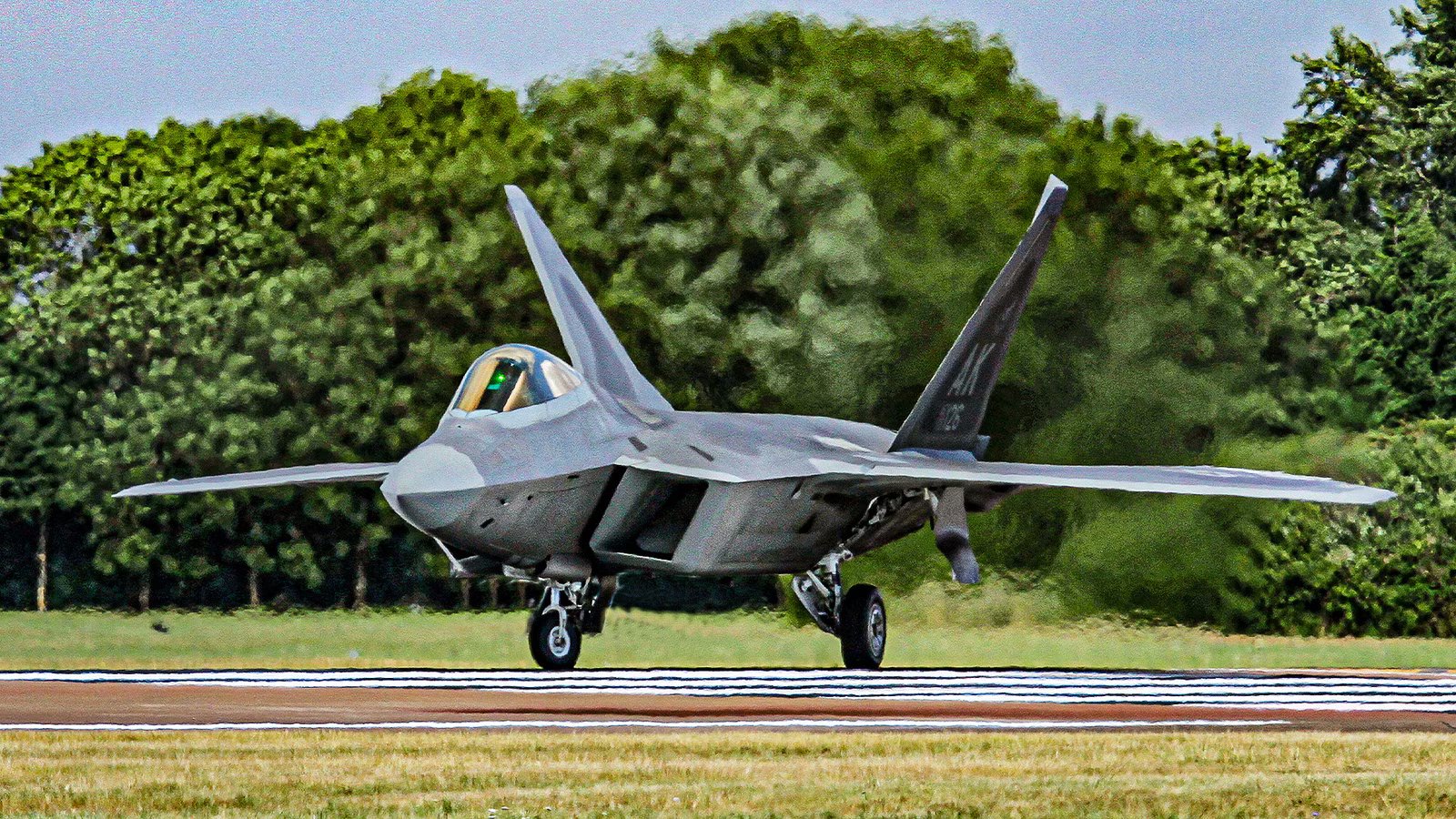
The evolution of the Lockheed Martin F-22 Raptor from a pure Cold War hunter-killer, to a modern, data-centric, quarterback, is a result of changes across decades of design eras. It remains the ultimate apex predator of air warfare and its cockpit has been tailor-made so its pilots can maximize the jet’s capabilities to rule the skies.
The F-22 Raptor is not only the world’s first 5th generation, stealth fighter but it was also the first supermaneuverable combat jet. Its ability to perform post-stall maneuvers and outfly lighter and more agile fighters through sheer power is complemented by its incredible supercruise capability and other features unmatched by rivals to this day.
Starting with the ergonomics, all essential combat functions are condensed down to a simple interface, the Hands-On Throttle and Stick. The pilot never has to look down during a 9-G dogfight because radar modes, weapons, and radios are all at their fingertips, no matter the situation. The glass cockpit’s central screen provides the big picture while side displays handle details, allowing the pilot to make ‘engage or evade’ decisions in seconds.
F-22: First-Look, First-Shot, First-Kill

The Raptor’s ability to kill before being detected, or the first-look, first-shot, first-kill advantage, is powered by automated data processing. The system pulls data from the APG-77 active electronic radar, the Electronic Warfare suite, and infrared sensors. Its computer merges these into a single track file that shows the pilot one master icon for every friend or foe in the sky.
The Raptor was the first to adopt a Common Integrated Processor that handles everything from fly-by-wire calculations to threat tracking. Information is prioritized across six LCDs. As an enemy target gets closer, the computer automatically narrows accuracy without pilot input until it is fully cued for a long-range AIM-120 AMRAAM missile launch.
The Raptor typically carries up to six AMRAAMs internally to maintain its stealth profile. The latest operational variant features GPS-assisted navigation and a two-way datalink, with an estimated range exceeding 100 miles (160 km). Its powerful radar can identify and track hostiles from more than twice that distance, giving it an immense advantage in aerial warfare against even the best-equipped adversaries.
The Raptor’s Hunter-Killer Cockpit

While the Chinese J-20 Mighty Dragon and Russian Air Force Su-57 Felon have modern cockpits, the F-22’s Sensor Fusion is more mature. Its refined tactical systems declutter the pilot’s scope, or display, and craft a picture of the battlefield with the correct amount of data for BVR combat. When an F-22 fires an AIM-120D or the new AIM-260 JATM while supercruising at Mach 1.5+ at 60,000 feet, it acts as a supersonic catapult.
Its intelligent targeting system automatically ranks threats for the pilot. If a Raptor jockey, aka pilot, encounters a Su-57 and a SAM site at the same time, the scope highlights the most immediate threat in red, allowing the pilot to focus on positioning for the kill rather than sorting through raw data.
The J-20 is a formidable long-range sniper. The F-22 counters this by using its superior EW suite that is integrated into the cockpit displays while closing the distance for a high-energy AMRAAM shot. The AIM-260 JATM is specifically designed to outrange the Chinese PL-15. Because it fits in the Raptor’s internal bays, the F-22 retains its stealth while lining up a shot.
The Su-57 is highly maneuverable but has a higher radar cross-section. The Raptor’s altitude and speed expand the No-Escape Zone, or the range at which an enemy aircraft simply cannot maneuver or outrun the incoming missile, even with high-G turns. The F-22’s cockpit displays are also likely to see the Su-57 first, allowing for a BVR kill before the Sukhoi can close for a dogfight.
Even if an agile adversary does manage to close the distance and bring the Raptor to a merge, the thrust vectoring and immense power of its Pratt & Whitney F119 engines allow it to perform stunning post-stall maneuvers and other aerobatic feats to win the day. The intuitively reflexive controls in the F-22 coupled with a Scorpion Helmet-Mounted Display, allow pilots to cue AIM-9X Sidewinder missiles simply by looking at the enemy, even if they are far ‘off boresight.’
Sensor Fusion And Information Dominance In The F-22

The new Super Raptor program is a multibillion-dollar effort to transform some feaures of the F-22 Raptor. Lockheed Martin’s goal is to make it into a data-centric command node for modern battlespaces. These upgrades are vital for the F-22 to stay relevant as the ‘quarterback’ for Collaborative Combat Aircraft, or Loyal Wingman drones, and to integrate with the upcoming 6th-Gen Boeing F-47 stealth jet, the Next Generation Air Dominance fighter.
In addition to a host of upgrades to its stealth, weapons, and sensor systems, the Raptor is finally getting the first helmet-mounted display system since it entered service. This is a key area where it has lagged behind other platforms, including the General Dynamics F-16 Fighting Falcon and Lockheed Martin F-35 Lightning II. The addition of the helmet-mounted display makes the F-22 cockpit a more lethal flight deck than ever before. Pilots can now cue the AIM-9X Sidewinder and the APG-77 radar just by looking at a target.
Critical flight data and sensor alerts move from the dashboard to the visor, allowing the pilot to maintain 100% eyes-out awareness during complex air-to-air engagements. The Scorpion projects full-color symbology directly over the pilot’s real-world view, marking friendly and enemy aircraft positions even if they are behind the pilot or obscured by clouds. If a pilot sees an enemy over their shoulder, they can lock and fire without maneuvering the nose of the plane.

Here’s Why Air Forces Are Expanding Their Stealth Fighter Programs
The global race for the ultimate stealth jet.
The Raptor’s AWACS Lite Capability

The Super Raptor evolution is centered on turning the F-22 from a stealthy ‘lone wolf’ into a connected node that rivals the F-35’s networking capabilities. The Raptor can already share its tactical picture with other aircraft via the Intra-Flight Data Link. It can even designate targets for older aircraft like the F-15 and F-16, effectively acting as a forward battlefield manager.
New upgrades will shift the aircraft from a primarily solo hunter-killer to a central quarterback capable of managing diverse multi-role missions. The shift to an Open System Architecture (OSA) allows for rapid, commercial-style, software updates. Historically limited to receiving data, the Raptor is receiving two-way Link 16 transmit capability.
Data link allows it to share its superior tactical picture in real-time. The F-22 is even being upgraded to act as a mothership for drone swarms. Pilots have already demonstrated the ability to command MQ-20 Avenger drones from the cockpit via an autonomous pilot interface.
To make it a more persistent data node and shot-caller behind enemy lines, testing is underway for new, mirror-like coatings to improve all-aspect stealth. New stealthy 600-gallon external fuel tanks will also extend the Raptor’s combat radius, and wing-mounted, stealth-contoured Infrared Search and Track pods will track enemy stealth targets by their heat signatures without emitting detectable radar signals.

Why The Pentagon Is Worried About International Stealth Fighter Development
The new 5th-generation arms race.
Making The F-22: Not A Pound For Air-To-Ground

It is the direct successor to the McDonnell Douglas F-15 Eagle. The Raptor followed a similar philosophy during development to become a pure air superiority platform, as Airman Magazine wrote. The catchphrase that was coined during the development of the F-15, not a pound for air to ground, was also applied to the F-22 until the post-Cold War landscape of defense forced it to evolve. In the late stages of development, the USAF even briefly redesignated it F/A-22 to highlight its new multirole capability before opting to go with the F-22A when it entered service in 2005.
Like the F-15 Eagle before it, the F-22 was born from the Advanced Tactical Fighter program to counter high-end Soviet threats like the Sukhoi Su-27 Flanker and Mikoyan-Gurevich MiG-29 Fulcrum. Yet, Raptor’s internal bays were found to be large enough to carry two 1,000-lb GBU-32 JDAMs or eight Small Diameter Bombs. The F-22’s combat debut in 2014 was not an air-to-air dogfight, but a strike mission against ISIS targets in Syria.
The collapse of the Soviet Union removed the Raptor’s primary adversary, leading critics to label it a Cold War relic. To justify its high cost and continued production, the Air Force expanded its mission set. Its advanced AESA radar and sensor suite allow it to perform electronic attack and intelligence gathering, roles often more critical in modern gray zone conflicts than traditional dogfighting.

Inside The F-35’s Cockpit System
At the controls of flying supercomputer.
Updating The Raptor For Multirole And Ground-Attack

While optimized for air superiority, the F-22’s cockpit was advanced in its original design, which made it possible to transition its systems to air-to-ground missions in a process that is now seamless for the pilot. The glass cockpit with its displays allows the pilot to easily monitor the offensive weapon range to drop precision-guided munitions while also tracking defensive threats on the ground. Its advanced systems that were originally designed to perform complex BVR intercepts have been updated to a powerful ground targeting system as well.
The AN/APG-77 radar system is the powerhouse behind the F-22’s ability to identify and engage ground targets. The AESA radar supports synthetic aperture radar modes, providing high-resolution imagery of ground targets in all conditions. The introduction of SAR transformed the Raptor from a purely air-to-air platform into a sophisticated multi-role strike fighter.
Pilots can use SAR to dynamically survey a target area and adjust to new targets while in flight. SAR uses electromagnetic pings to calculate the contours of the ground, delivering a detailed picture of the terrain even through weather, smoke, or haze. The system allows for better identification of ground targets like vehicles, buildings, or infrastructure, with accuracy down to one meter.