dailynewsnblog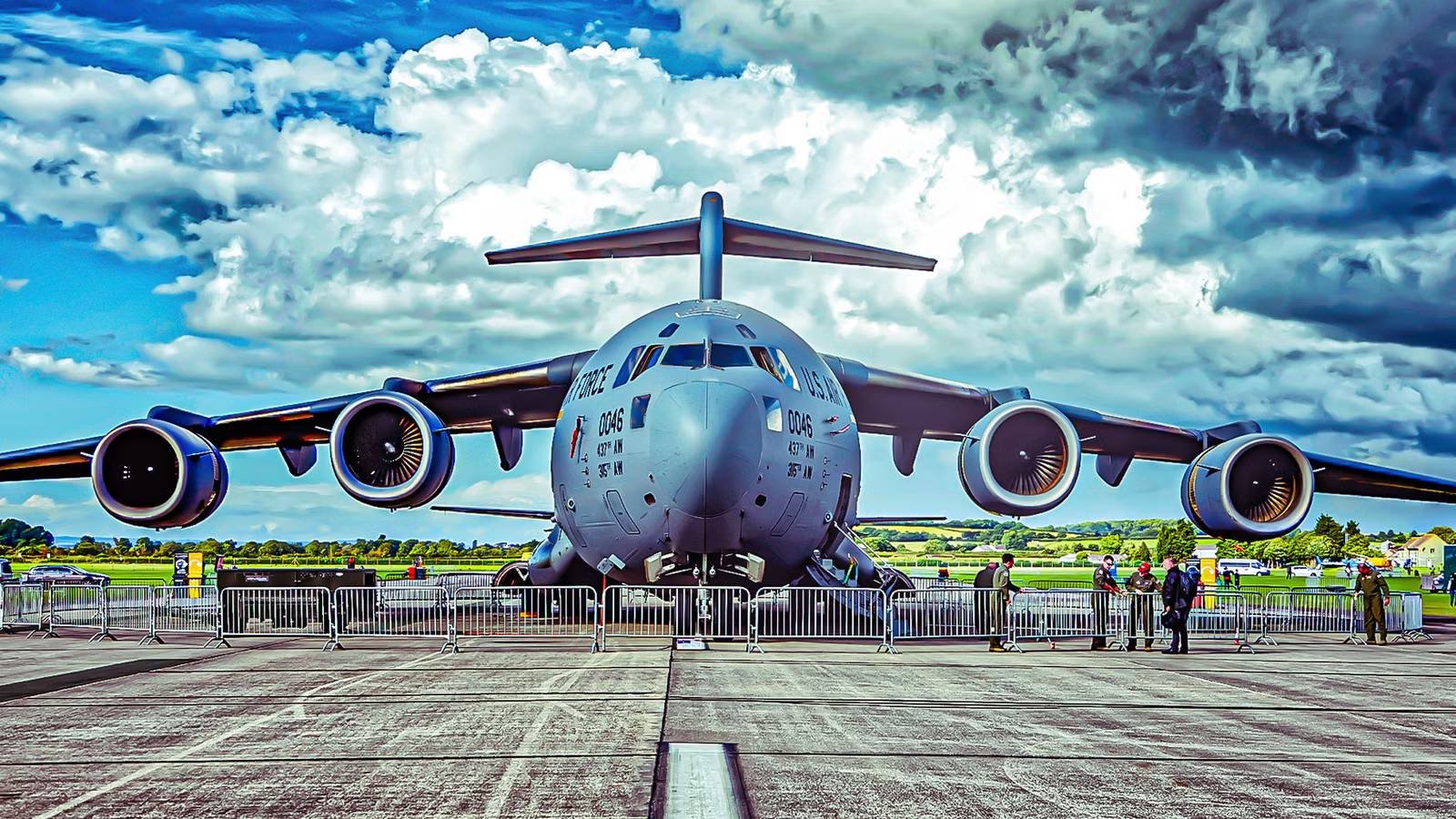
The  BoeingC-17 Globemaster is the only operational military transport aircraft that uses an externally blown flap system, a propulsive lift configuration in which engine exhaust is directed onto extended wing flaps to generate additional lift at low speeds. The system allows the C-17 to land payloads exceeding 160,000 pounds (72,575 kg) on runways as short as 3,000 feet (914 m), a capability that no other strategic airlifter can match.
That capability comes with an acoustic trade-off. Directing high-velocity jet exhaust onto flap surfaces produces a noise source that conventional transport aircraft do not have, and the noise is most intense during the approach and landing phase when the aircraft is at low altitude with flaps fully extended. NASA has studied the problem since the 1950s, and the Air Force continues to manage it at bases and shared-use airfields near residential communities across the United States and allied nations.
How The C-17’s Externally Blown Flap System Works

The C-17 Globemaster III uses four Pratt & Whitney turbofan engines mounted on pylons beneath the wing. The engines are positioned so that when the trailing-edge flaps are extended, the exhaust flows directly onto and through double-slotted flap surfaces behind each engine. The exhaust energy is redirected downward by the flaps, generating additional lift beyond what the wing produces on its own. The result is roughly twice the lift of a conventional transport aircraft wing of the same size, which is what allows a 585,000-pound (265,352 kg) maximum gross weight aircraft to fly controlled approaches at speeds as low as 150 to 160 knots.
The system exists because the C-17 was designed to land heavy payloads on short, austere runways that other strategic airlifters cannot use. With a cargo load of 160,000 pounds (72,575 kg), the C-17 can land on a paved or unpaved runway as short as 3,000 feet (914 m). That requirement drove the entire propulsive lift design. A conventional high-lift wing system using slats and flaps alone cannot generate enough lift at the speeds and weights the C-17 operates at to achieve that kind of short-field performance. Directing engine exhaust over the flaps bridges the gap between what aerodynamic surfaces can do on their own and what the mission requires.
The flap system works in conjunction with direct lift control spoilers on the upper wing surface and a high-impact landing gear system designed for repeated operations on rough surfaces. The engines also feature a forward and upward thrust reverser configuration that allows the C-17 to back up on the ground under its own power, reduce ramp space requirements, and direct exhaust and debris away from ground personnel during operations at austere airfields.
NASA’s Role In Developing The Technology

The externally blown flap concept was not developed for the C-17. It predates the aircraft by several decades. Researchers at NASA’s Langley Research Center began studying the idea of directing jet exhaust over wing flap surfaces in the mid-1950s, testing the concept in wind tunnels, including the 30 by 60 foot (9.1 by 18.3 m) Full-Scale Tunnel, using powered models of jet transports with both conventional and swept wings. The basic finding was that engine exhaust impacting extended flaps could produce substantial additional lift at low speeds, and that the effect could be controlled through flap deflection angle and engine power settings. NASA patented the flap configuration that came out of that research.
The first full-scale flight demonstration came in the 1970s with the McDonnell Douglas YC-15, a four-engine experimental short takeoff and landing transport built for the Air Force’s Advanced Medium STOL Transport program. The YC-15 used the externally blown flap system to demonstrate that a jet-powered transport could operate from runways far shorter than conventional jet transports required. The aircraft proved the concept worked in practice, but the program did not proceed to production. When the Air Force launched the C-X competition in 1979 to find a new strategic airlifter, McDonnell Douglas drew directly on the YC-15’s aerodynamic and propulsive lift work to design what became the C-17.
Four NASA centers contributed to the C-17’s development. Langley provided the foundational blown flap aerodynamics. Ames Research Center handled additional wind tunnel testing. Lewis Research Center worked on propulsion integration. Dryden Flight Research Center supported flight testing after the first C-17 flew on September 15, 1991. The technology that allows the C-17 to land on a 3,000 foot (914 m) strip had been in development for roughly 35 years before the aircraft entered service in 1995.
What’s Is The Boeing C-17 HUD Upgrade?
Boeing is contracting Elbit Systems to provide HUD upgrades to its fleets of C-17 Globemasters (including for export aircraft).
Where The Noise Comes From

Directing high-energy jet exhaust onto metal flap surfaces produces noise that conventional transport aircraft do not generate. On a standard commercial or military jet, approach noise comes primarily from the engines at reduced power settings and from aerodynamic sources, including the landing gear, slats, and flap edges interacting with airflow. On the C-17, a significant additional noise source is the jet-flap interaction itself, where exhaust from four turbofan engines impacts the extended double-slotted flaps at high velocity and is deflected downward.
The acoustic mechanism is straightforward. When a high-speed exhaust stream hits a solid surface and is redirected, the interaction generates broadband noise across a wide frequency range. The intensity of that noise scales with the velocity of the exhaust and the surface area of the flap. On the C-17, the flaps are large, the exhaust velocity is high, and the interaction occurs across the full span of both engine pairs. The noise radiates primarily downward and behind the aircraft, which means it is directed toward the ground during the approach and landing phase when the flaps are fully extended, and the aircraft is at low altitude.
The practical effect is that a C-17 on approach with its externally blown flap system active produces a noise footprint that is different in character and intensity from other aircraft of comparable size. A C-5 Galaxy on approach generates engine and airframe noise in a conventional pattern. A C-17 on approach adds the jet-flap interaction component on top of those same sources.
Measuring And Reducing C-17 Landing Noise

In September 2005, NASA conducted a dedicated noise measurement study at Edwards Air Force Base using a C-17 flying a series of approach profiles while researchers on the ground recorded acoustic data. Students from California Polytechnic State University collected landing noise measurements using laptops with sound cards connected to GPS receivers, positioned on Rogers Dry Lake beneath the approach path. The study had the C-17 fly multiple landing profiles at varying altitudes, speeds, and flap settings to map how changes in approach procedure affected the noise footprint on the ground.
The research was part of NASA’s broader effort to understand whether modified approach procedures could reduce community noise impact from military aircraft operating at shared-use airfields and bases near populated areas. The C-17 operates from joint civil-military airports and bases adjacent to residential communities across the United States and in allied nations, making its noise signature a practical concern rather than a purely academic one. Charleston Air Force Base in South Carolina, Joint Base Lewis-McChord in Washington, and March Air Reserve Base in California are among the facilities where C-17 operations and residential proximity overlap.
The general approach to noise reduction on EBF-equipped aircraft focuses on what can be changed operationally rather than structurally. Steeper approach angles reduce the time the aircraft spends at low altitude over noise-sensitive areas. Higher approach speeds with reduced flap deflection decrease the amount of exhaust directed onto the flap surfaces, which reduces jet-flap interaction noise but also reduces the lift advantage the system provides. The trade-off is direct. The same configuration that gives the C-17 its short-field landing capability is the configuration that produces the most noise, and any procedure that reduces noise also reduces the performance margin that the system was designed to deliver.
No Flight Attendants: The Gritty Reality Of A C-17 Rescue Flight
Middle Eastern evacuation operations are undoubtedly underway.
The C-17 Globemaster By The Numbers

The C-17 Globemaster III entered service with the United States Air Force on January 17, 1995, and production continued until 2015 when the 279th and final aircraft rolled off Boeing’s assembly line in Long Beach, California. The aircraft measures 174 feet (53 m) in length with a wingspan of 169 feet 10 inches (51.7 m) and a maximum gross weight of 585,000 pounds (265,352 kg). It is powered by four Pratt & Whitney F117-PW-100 engines, each producing 40,440 pounds (180 kN) of thrust.
The cargo hold measures 88 feet (26.8 m) in length, 18 feet (5.5 m) in width, and 12 feet 4 inches (3.8 m) in height, large enough to carry an M1 Abrams main battle tank, three AH-64 Apache helicopters, or a combination of wheeled vehicles in two side-by-side rows. Maximum payload is 170,900 pounds (77,519 kg). The aircraft can drop a single airdrop load of 60,000 pounds (27,216 kg) or sequential loads totaling 110,000 pounds (49,895 kg). Range with a full payload is approximately 2,400 nautical miles (4,444 km), extending to 4,400 nautical miles (8,149 km) when unloaded. The aircraft can be refueled in flight through a receiver boom mounted above the cockpit.
Catch what other flight trackers miss
Emergency squawks, holds, NOTAMs — live signals, no signup.
Open tracker
Catch what other flight trackers miss
Emergency squawks, holds, NOTAMs — live signals, no signup.
Open tracker
The U.S. Air Force operates 223 C-17s across 12 bases. Eight additional nations and one multinational consortium operate the type, including the United Kingdom, Australia, Canada, India, the United Arab Emirates, Kuwait, Qatar, and the 12-nation NATO Strategic Airlift Capability based in Hungary. The C-17 is operated by a crew of three: two pilots and a single loadmaster. No replacement program has been announced for the type, and the Air Force expects to operate its C-17 fleet through at least the 2040s.