dailynewsnblog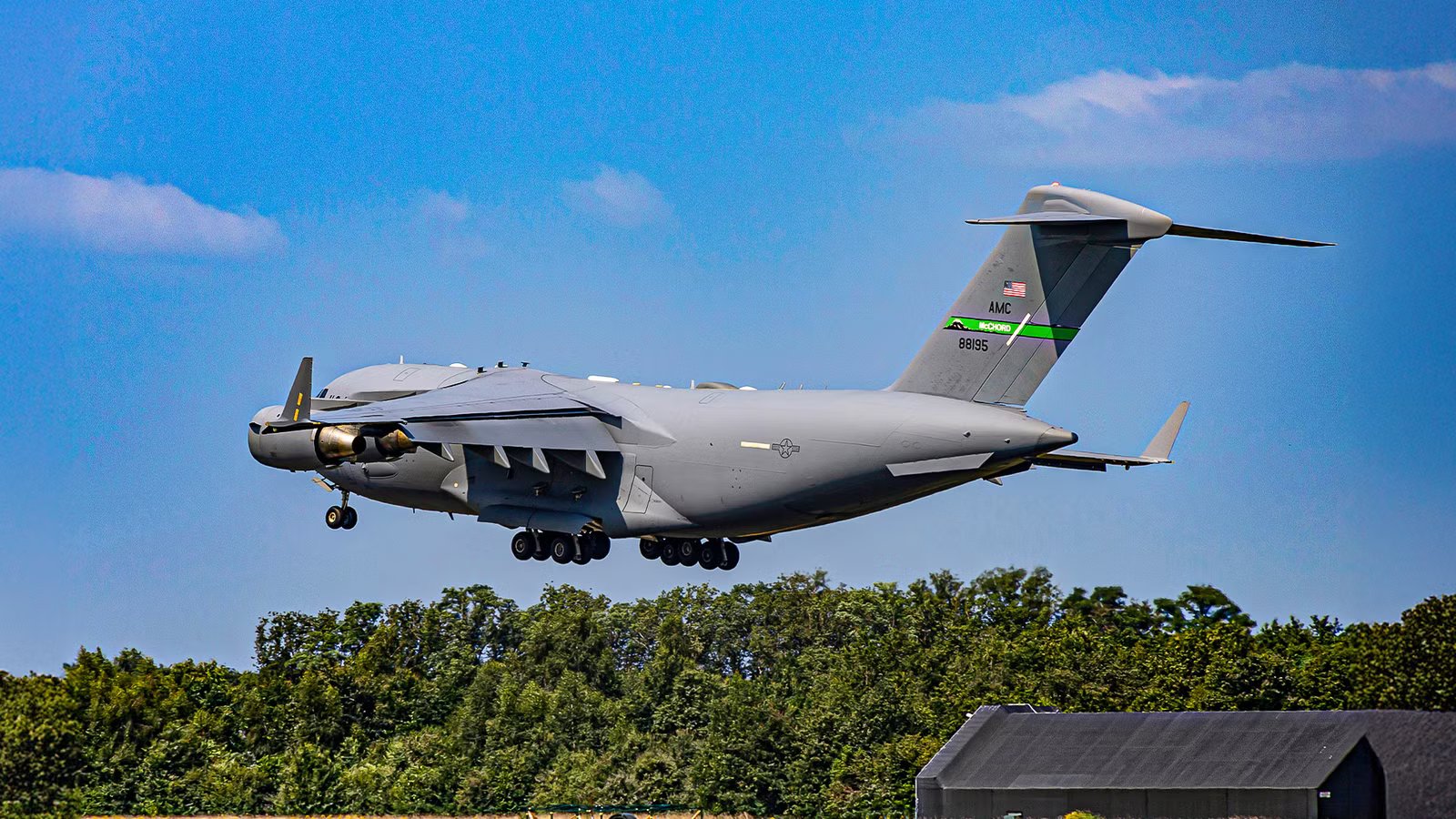
The  Boeing C-17 Globemaster III of the United States Air Force has a rare modification that allows it to do a unique feat in the world of aviation. The enormous tactical quadjet can switch to reverse thrust on all four of its Pratt & Whitney turbofan engines from high altitude and drop 25,000 feet down to ‘the deck’ on a tactical descent into a combat zone to make deliveries to troops on the ground. This unique ability allows it to stay at high altitude, where it is safe from many anti-aircraft threats until the very last moment, and then pass through the hazardous low-level as quickly as possible.
When pilots pull the throttles back to idle and engage the reversers, the engine airflow is deflected upward and forward. This creates intense aerodynamic drag without stalling the wings. The C-17’s deliveries sometimes include basic supplies, and the fast drop is a precaution to avoid being targeted, but on other missions it could be delivering a main battle tank to the front line and potentially coming under direct fire. The engines enable jaw-dropping descent rates of up to 15,000 feet per minute, four to five times steeper than a standard commercial airliner, and keep the C-17 safe in hostile skies.
Cruising Through The Danger Zone

The C-17 was built with a unique reverse-thrust capability to accomplish two important tactical objectives: avoiding surface-to-air weapons threats and navigating austere Drop Zones on the ground. Not only can the plane drop from high altitude to the ground in stunningly quick descents, but once it’s there, the engines also allow it to reposition itself even on rough terrain. The C-17 can back up on a 2% slope and execute tight 180-degree turns on narrow, primitive runways, getting the payload offloaded and the plane back in the air.
Flying low makes a cargo plane an easy target for Man-Portable Air Defense Systems (MANPADS), like the Stinger missiles. These weapon systems are generally unable to reach above 12,000 or 15,000 feet, while anti-aircraft artillery is also ineffective above about 10,000 feet. By maintaining a cruise altitude above 25,000 feet, the C-17 remains physically out of reach of these low-tier, widely proliferated weapons. Radar systems and human operators on the ground also struggle to track targets that are moving rapidly and vertically directly above them.
Another reason why the C-17’s reverse thrust capability is so vital is that ground vulnerability can become the deadliest phase of any airlift mission. A cargo plane sitting stationary on a runway is nothing more than a multi-million dollar target for enemy mortars, artillery, drones, and rocket-propelled grenades. When the plane hits the ground, the cargo rolls, or marches, off the ramp immediately.
The steep angle of the upward and forward P&W F117 engines is also intended to ensure that debris does not enter the four turbofans and that the visibility of the pilots is not obscured, to ensure the plane is not damaged by debris and can rapidly taxi and execute a steep takeoff. When the Globemaster hits the ground behind the front line, the engines stay on, and as soon as the big jet is ready to depart, it just takes a matter of seconds to reach full takeoff.
Catch what other flight trackers miss
Emergency squawks, holds, NOTAMs — live signals, no signup.
Open tracker
Catch what other flight trackers miss
Emergency squawks, holds, NOTAMs — live signals, no signup.
Open tracker
Powered By Pratt & Whitney: The F117 Engines

The C-17 Globemaster III is equipped with four engines, each producing 40,440 pounds of thrust, the F117-PW-100. These engines are famously derived from the same power plants used in the Boeing 757, which is known as one of the best-performing commercial aircraft in hot and high conditions, thanks to a thrust-to-weight ratio superior to that of virtually every other airliner in service. The C-17 takes that capability and turns it up to eleven.
The reverse thrust on the C-17 uses a unique translating sleeve that blows air up and forward at 45 degrees, rather than out to the side as on many jets. When engaged, the outer cowl of the engine slides backward, exposing a ring of cascading vanes. These vanes are precisely angled to direct 100% of the fan bypass air. This pushes the nose of the jet down, which not only helps its rapid descent performance but also improves the aircraft’s ground characteristics when performing combat landings.
The F117 engines not only feature powerful thrust reversal but are also equipped with what’s known as externally blown flaps that make it possible for the C-17 to fly extremely slow final approaches and short takeoffs. The engines themselves are mounted far forward and high up on the wings. When the flaps engage, the high-velocity exhaust of the turbofan engines is forced downward. This design uses the curved surface to generate massive amounts of powered lift that allow the plane to fly stably at speeds as low as 115 knots or take off from very short fields, even when heavily loaded.
Why Did McDonnell Douglas Build The C-17 Globemaster With 4 Engines?
The C-17 Globemaster III’s four-engine design holds the key to its unrivaled capabilities, but was this a choice of power or necessity?
Anatomy Of An Airlifter

Derived from the commercial PW2000 series, the F117 is engineered specifically to withstand the extreme dynamics of combat air drops while also having the fuel efficiency to make transoceanic transits possible. It has a bypass ratio of 5.9-to-1.0 to deliver the performance needed for tactical operations, and a payload capacity of 170,900 pounds (77,519 kg) for carrying heavy equipment like an M1 Abrams main battle tank.
During standard high-altitude transit, the C-17 cruises at 450 knots (833 km/h), which translates to Mach 0.74, and flies at a maximum service ceiling of 45,000 feet (13,716 m). When executing a tactical approach or landing on a short runway, the aircraft slows down to a stable 115 knots (213 km/h). When carrying its absolute maximum payload of 170,900 pounds (77,519 kg), the unrefueled strategic range of the aircraft is 2,420 nautical miles (4,482 km). On long-range missions, modern extended-range variants carry a maximum fuel load of 244,854 pounds (111,064 kg).
The F117 uses a completely separate directed-flow dual-nozzle thrust reverser layout. When deployed, sliding sleeves expose cascade vanes for both the fan bypass air and the core exhaust. After the jet has completed a rapid descent and touches down in the drop zone, the upward exhaust vector applies downforce to the aircraft, pressing the heavy C-17 landing gear into unpaved runways for maximum tire braking efficiency.
Why Did McDonnell Douglas Build The C-17 Globemaster With A T-Tail?
A deep dive into the design behind the distinctive C-17.
Straight And Level With The C-17’s Externally Blown Flaps

To counter the powerful thrust vector that comes from the F117 engines when they engage reverse thrusters on the C-17, the externally blown flaps redirect the core exhaust that still flows backward into an opposing downward vector. This allows the aircraft to maintain a steep 22-degree dive without stalling or losing control. The double-slotted titanium flaps lower directly into the high-velocity core exhaust stream to ‘bend’ the thrust vector downward from the high-mounted engines.
The EBFs also maintain a constant, controlled airflow over the lower surface of the wing, which prevents shaking and stalling caused by turbulent airflow from the forward thrust vector of the reversers. And when the reverse thrusters are disengaged, the wing instantly regains maximum lift and allows it to rapidly arrest vertical descent rates right before touching down on an improvised airstrip or runway in contested airspace.
Is It True That The C-17 Globemaster Is Powered By Boeing 757 Engines?
The transport aircraft is a valuable asset for the United States Air Force.
Putting The Rubber Side Down In The C-17

The engines in the C-17 provide the power to push the huge airplane around on the ground even when the jet is operating in a rough field, while the avionics and landing gear provide the agility necessary for it to execute impressive 180-degree turns. The huge jet only needs 90 feet of a dirt strip to turn itself around and line up for a tactical launch. The flight controls allow the pilot to execute a ‘star turn’ rapidly by selecting reverse thrust on just the specific engines that will spin the plane around. Its heavy-duty nose gear can also crank to a much sharper angle than any airliner.
When the C-17 pilot puts two engines on one wing into reverse thrust and two engines on the other wing forward, the rest can turn the nose wheel up to 63 degrees left or right. The average jetliner can only turn about half of that, maybe up to 45 degrees. Its heavy-duty gear with six wheels on each main bogey and two wheels on the nose gear helps make the heavy aircraft light-footed as well, so it doesn’t get stuck on an improvised airstrip.
Its redundant systems also ensure that, even if the plane takes combat damage at any point in the operation, it will retain enough functionality to clear the danger zone. The thrust reversers, massive flaps, and landing gear are powered by four independent, 4,000-psi hydraulic systems. The airframe is also reinforced with a heavy-duty titanium structure that makes the C-17 tough enough to handle violent maneuvers in the air and survive the fray of battle.