dailynewsnblog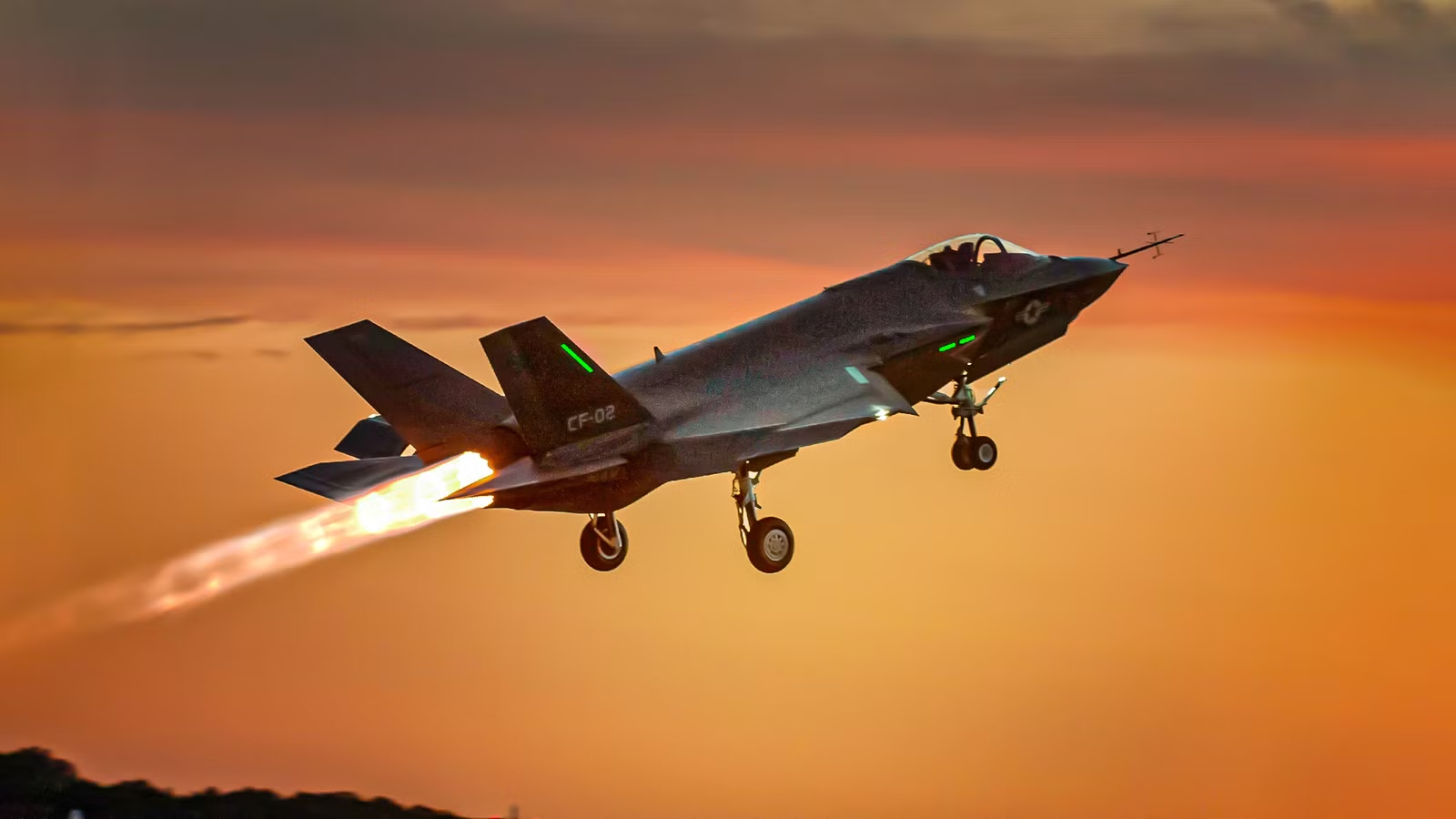
Asking a Lockheed Martin F-35 Lightning II fighter jet to fly at sustained high Mach speeds is something it can technically do, but it is not something it was especially built for or optimized around. The aircraft is mostly a subsonic “ninja,” quietly sensing the battle space and creating a “god’s eye view” and passing that awareness to other aircraft and systems.
The F-35 is designed to win a dogfight before it can happen, with the enemy jet not knowing there was a fight to be had and not knowing what hit it. The jet excels at jamming and electronic warfare. It is particularly designed for penetrating enemy air defenses and carrying out SEAD (Suppression of enemy air defenses) and DEAD (Destruction of enemy air defenses), often leveraging other platforms. That said, its powerful F135 does have an afterburner, and it can be used for specific scenarios.
What The F-35 Fighter Jet Was Meant To Do

The Lockheed Martin F-35 Lightning II strike fighter is widely regarded as the world’s most advanced fighter jet. However, it is important to note what it is and is not designed to do. The fighter jet is best understood as a flying supercomputer that conducts advanced sensor fusion and shares information across a network of airborne, naval, and ground platforms. The F-35 was not built to break aerobatic records; it was not built to be especially fast.
While the F-22 Raptor can supercruise at Mach 1.5 (approximately) and can reach speeds of around Mach 2.25 at altitude, the F-35 cannot. In fact, designers had initially planned for the F-35 to fly at Mach 1.8, but this was slowed down to Mach 1.6. It is not meant to be the most maneuverable or fastest airplane in the sky; it is intended to be the stealthiest and best connected with a “god’s eye view” of the battlespace.
That said, the F-35 does boast impressive high-alpha handling and performs impressive demonstrations, even though it wasn’t optimized for speed, sustained turn rate, or extreme kinematic performance. It wasn’t designed for a traditional dogfight; it was designed to find, classify, and engage targets before they knew it was there. This is not to say it can’t dogfight; it can, but it is not what it’s optimized for.
The F-35’s F135 Engine

Notably, the F-35 is a single-engined aircraft. It is powered by a single Pratt & Whitney F135 engine that provides around 28,000 lbf dry thrust and 43,000 lbf with afterburner (depending on the variant). This is the most powerful fighter jet engine ever put into production and was derived from the F-22 Raptor’s advanced F119 engine. The decision to equip the F-35 with a single engine was mostly driven by cost and weight considerations, coupled with the mission set the aircraft was designed for.
It wasn’t because engineers thought a single-engine design was somehow aerodynamically superior. While the F-22 Raptor was designed to be a high-end, cutting-edge, “no expenses spared” fighter jet, the F-35 was intended to be mass-produced and sold to a large number of allies. The US Air Force’s program of record for the F-35 is an order of magnitude greater than the number of F-22s it purchased and an order of magnitude greater than the number of F-47s it plans to purchase.
A second engine would have added cost, more fuel systems, more maintenance, more spare parts, and higher fuel consumption. It is worth noting that the engine has proven extremely reliable. With over 1,300 F-35s delivered and millions of flight hours, only two mishaps can be primarily attributed to engine failure. Other mishaps were due to other causes. For example, the F-35A crash in 2025 at Alaska’s Eielson Air Force Base was due to water-contaminated hydraulic fluid affecting the nose landing gear.
The F-35’s Range

One of the considerations in its design was range. Range was one of the biggest factors limiting the Marine Corps’ (and Royal Navy’s) fleet of AV-8B Harrier II jump jets and the Navy’s Super Hornets; it is also a significant limiting factor of the F-16 used by the Air Force. An F-35A can carry 18,250 lb (8,278 kg) of fuel, compared with the newest F-16 Block 70’s roughly 7,000 lbs and the upgraded and enlarged Saab Gripen E’s 7,500 lb (3,175 kg). The empty weight of an F-35A is 29,300 lb (13,290 kg), while an F-16 Block 70 is 21,000 lb (9,525 kg), and a Gripen E is around 17,600 lbs (7,983 kg).
The range of the F-35A is one of the benefits for use in Canada, where the distance is enormous. According to one USAF infographic, the large F-15E/EX has a combat radius of around 690 nautical miles (1,278 km), the F-22’s is around 590 nautical miles (1,092 km), the F-16 is just 400 nautical miles (741 km), the F-35A is around 670 nautical miles (1,241 km), and the upcoming F-47 will be over 1,000 nautical miles (1,852 km).
Select USAF fighter ranges | Nautical miles (per USAF infographic) |
|---|---|
F-15E/EX | 690 |
F-22 | 590 |
F-16 | 400 |
F-35A | 670 |
F-47 | 1,000+ (planned) |
The practical combat radius of fourth-generation fighters often depends heavily on external drop tanks. While these substantially extend range, they also increase drag, reduce acceleration and maneuverability, occupy hardpoints, and usually need to be jettisoned before entering combat. Fifth-generation aircraft such as the F-35 carry far more fuel internally while also carrying their weapons inside the fuselage, allowing them to retain most of their range and performance without relying on external tanks.
Other Considerations About Range

The United States Air Force boasts the world’s largest fleet of tanker aircraft. By some estimates (depending on counting methodology), it has around 75% of the world’s tankers, with a large percentage of the remainder operated by NATO allies. This meant engineers could also plan around the F-35s receiving in-air refueling, significantly boosting their range.
By contrast, Russia and China have small or modest dedicated fleets of aerial refuelers, and designers have not been able to plan around the jets receiving in-air refueling. In Russia, the country’s roughly Il-78 tankers are primarily tasked with refueling bomber patrols, not tactical fighter jets. This is why Russian fighters (like the Su-27 family) and Chinese fighters (like the J-20) have large internal fuel volumes.
During the Israeli and American campaigns over Iran in 2025 and 2026, destroying its limited fleet of tankers was a priority. Even so, increased air defense has become ever more important as tanker aircraft become more vulnerable and are pushed back further. It is also threatening ships and pushing aircraft carriers further out. This is partly why the Marines wanted to retire the Harriers, and why it wants the longer-ranged F-35Bs and F-35Cs, and the Navy wants longer-ranged F-35Cs, F/A-XX fighters, and MQ-25 tankers.
Supersonic Speed Is Rarely Used

In practice, fighter jets rarely use afterburners and rarely fly supersonic in combat, partly because range collapses. This is one reason the supercruising F-22 Raptor has a significant advantage over the older F-15. While the F-15 has a higher published maximum speed (around Mach 2.5 versus roughly Mach 2.25), reaching those speeds requires prolonged afterburner use. The F-22 can cruise supersonically without afterburner, making sustained high-speed flight far more practical while preserving considerably more fuel.
Another issue is that high Mach dramatically reduces an aircraft’s maneuverability. Post-Vietnam USAF analyses found that fighter engagements almost never occurred at very high Mach numbers (for example, above about Mach 1.5), despite aircraft such as the F-4 Phantom II being capable of more than Mach 2. They also found that pilots did not fly at high Mach to reach an urgent setting, because that dramatically reduced its range and loiter time on station.
The F-35 was built with these (and more) lessons in mind. It was built with the notion “you can’t run, but you can hide.” It is designed to fly at transonic speeds stealthily into battle undetected while preserving its range. A sense of its mission is indicated by its informal nickname in the RAF, “assassin,” while the Eurofighter Typhoon that it supports is nicknamed the “thug.”
How Much Fuel Is Burned With Full Afterburners?

How much fuel an F-35 uses with afterburner needs to be estimated, as there are no official fuel-flow figures. At typical cruise (around Mach 0.8 to 0.9), the F-35A’s 18,250 lbs (around 2,700 US gallons) of internal fuel allows for a combat radius of around 670 nautical miles (1,241 km) and longer with ferry flights. At full afterburner, a reasonable estimate is that the F135 engine will consume well over 260 US gallons (1,000 liters) per minute.
With the engine at full afterburner and producing around 43,000 lbfs, it might burn around 86,000 lb (39,008 kg) of fuel per hour. That said, without knowing the altitude, Mach number, inlet conditions, throttle setting, and engine design, it’s not possible to derive a credible figure. The F-35 can dash to Mach 1.2 on the afterburner for limited distances (e.g., 150 miles or 250 km), but reaching Mach 1.6 dramatically reduces its combat radius and time on station.
Afterburners are extremely inefficient because they inject additional fuel into the exhaust stream to produce extra thrust, dramatically increasing fuel consumption compared with military power (maximum dry thrust). They are therefore used mainly for take-off, short supersonic dashes, and high-performance combat maneuvers. Prolonged operation in full afterburner also subjects the engine to far higher thermal and mechanical stresses, consuming engine life much more rapidly and eventually reaching certified operating limits.