dailynewsnblog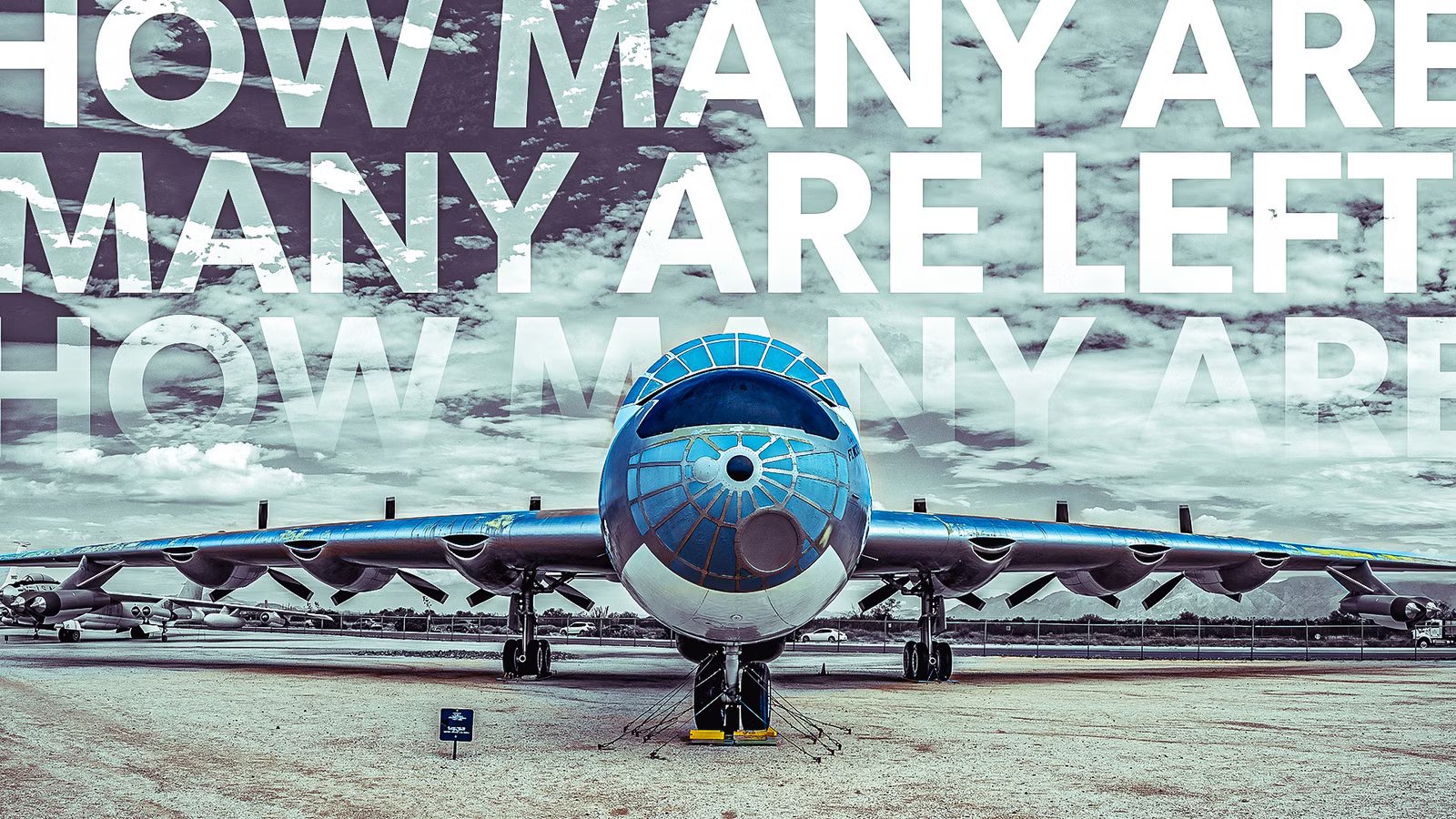
The B-36 could reach over 400 mph with ‘six turning and four burning,‘ as the slogan went. Today, only four examples remain in existence, with none in airworthy condition due to the complexity of the monstrously huge airplane. The B-36 ‘Peacemaker’ was one of the largest planes ever made, and the largest in US military service when it debuted.
A 1996 edition of the Smithsonian magazine has a detailed history of the B-36’s career with the United States Air Force. The writer of that story, Daniel Ford, quotes the Strategic Air Command’s (SAC) First Commanding Officer, George Kenney, who praised the airplane, saying that “the B-36 went higher, faster, and farther than anybody thought it would, and the pilots liked it. It was a lucky freak.”
The B-36 bridged the gap between the Second World War era of radial-engined bombers and modern jet-powered planes like the  Boeing B-52 Stratofortress. Convair built the B-36 as a successor to its own B-24 Liberator and the next evolution of air power after the Boeing B-29 Superfortress.
The B-36 Was Designed During The Second World War & Entered Service Afterward

The B-36 was designed by Consolidated Vultee in San Diego and intended to be a strategic bomber during the Second World War, according to the US Air Force. The plane spanned 230 feet from wingtip to wingtip, and was designed to cross the Atlantic, enter German airspace at 300 mph, and drop 10,000 pounds of bombs from 40,000 feet. The Army was extremely impressed with the promising design and ordered a pair of prototypes in 1941.
However, the B-36 would not be delivered in time to see action during the Second World War. Indeed, the first planes took flight in 1946, just as the American military was demobilizing. Daniel Ford’s report for the Smithsonian also records that Curtis Emerson LeMay, who took over as the Second Commander of SAC, once said that:
“The B-36 was often called an interim bomber. For my dough, every bomber which ever has been or ever will be is an interim bomber.”
The Peacemaker Provided Deterrence Through Power

During the Korean War, the B-36 would play a major role in deterring nuclear weapons use. Truman released nine atomic bombs to the military, which were under the control of the nuclear energy authorities at that time. The B-36 flew from Texas to airfields in the United Kingdom and Morocco in 1951 as a show of force to the Soviets. Only six airplanes were deployed, but Moscow and most of the Soviet Union fell under the combat radius of the nuclear-capable planes from their sites in a clear message.
In 1955, Convair was tasked to repurpose and strip the mega-bomber down to essentials only. It delivered the ‘featherweight’ B-36 with only two guns and no luxuries to maximize its range. All of the earlier models were modified to the new standard, becoming highly valuable reconnaissance platforms. SAC would ultimately receive 369 of the jet-piston hybrids, including all versions.
|
Surviving B-36 Peacemakers (Per Airplanes Online) |
|||
|---|---|---|---|
|
Facility |
Location |
Model |
Serial No. |
|
National Museum of the US Air Force |
Wright-Patterson Air Force Base Dayton, Ohio |
B-36J-1-CF |
52-2220 |
|
Pima Air & Space Museum |
Adjacent to Davis-Monthan Air Force Base Tucson, Arizona |
B-36J-10-CF |
52-2827 |
|
Strategic Air Command & Aerospace Museum |
Ashland, Nebraska |
B-36J-1-CF |
52-2217 |
|
Castle Air Museum |
Atwater, California |
RB-36H-30-CF |
51-13730 |
The RB-36 was the designation for the surveillance variant. It could carry an atomic bomb, but its principal weapon was a camera the size of a small car. It even had a photo studio that replaced the forward bomb bay, and the system had a roll of film 18 inches wide and 1,000 feet long. The camera could spot tanks, airplanes, missiles, and factories from eight miles above the ground. B-36 crews routinely flew extremely long endurance times, like 45-hour missions, soaring at an untouchable altitude.
Following the US withdrawal to the continental United States and the reveal of Joseph Stalin’s ambitions, the Strategic Air Command’s mission became more imperative. The B-36, with its long-range and high payload, was vital to the SAC, especially when the constant tension with the Soviet Union brought about the Cold War, and the Soviets repeatedly demonstrated that they would push their luck until they hit the limit of the Western powers, and especially, US patience.
At the end of the Second World War, only 27 Boeing B-29s had the ‘Silver Plate’ modifications needed to drop an atomic bomb, and these were assigned to the 509th Bomb Group. The US nuclear stockpile contained exactly 13 atomic weapons, controlled by the Atomic Energy Commission and President Truman.
In June 1948, Convair delivered the first operational B-36A to SAC’s 7th Bomb Group at Carswell Air Force Base. The two airplanes were the beginning of an era for the freshly established US Air Force, as well as America and the world. The need for weapons to support the nuclear triad under the mutually assured destruction strategy would see the greatest arms race in human history unfold.

Top 10 Active US Military Aircraft With The Longest Range
Endurance is a game-changer in modern combat missions—discover the ten US military aircraft the range envelope further than ever.
Why The Prop-Jet Combo?

The B-36B was the last reciprocating-engine bomber in the USAF. The turbojet had been developed during World War II for fast, high-flying fighters, but those engines burned fuel at prohibitive rates. A new generation of twin-spool turbojets with significantly improved fuel consumption and the invention of in-flight refueling would change everything. In 1949, Boeing’s B-47 Stratojet also entered production, and the legendary B-52 was already in development.
The Air Force requested that Convair attach two jet pods close to the wingtips of the B-36 because it was concerned about its vulnerability, and, by March, a B-36B equipped with four Allison J35s was in flight. Each pod on the production models that were unveiled in July carried two General Electric J-47-GE-19s that had been converted to run on gasoline, doubling the available horsepower of the aircraft.
For Congress’s benefit, the Air Force unveiled new performance figures for the jet-assisted B-36D, including a top speed of 435 mph, a ceiling of 50,000 feet, and up to 12,000 miles of range. LeMay went on to say that he personally promised the B-36 could fly to any target without the enemy noticing until the bombs struck.
An upgraded B-36B with six turrets and 20-millimeter cannons joined the strategic bomber force in 1948. John Bartlett flew to Hawaii on December 7, dropped a dummy bomb weighing 10,000 pounds, and came back without being detected by the island’s radar. The B variant also featured the ‘Grand Slam’ modifications required to transport a 43,000-pound, 30-foot-long hydrogen bomb.

A3D/A-3 Skywarrior: The US Navy’s 1st Twinjet Nuclear Bomber
The “Whale” was the largest plane to hit the deck when they took flight with US Navy in 1956 to form a formidable wing of the nuclear deterrent force.
The B-36 Was A Thin-Skinned, Temperamental Giant

The B-36A was a large, fault-prone bomber that had a total surface area greater than both wings of a B-24. It had an expansive plexiglas canopy enclosing its flight deck, and the pilot’s control input moved a trim tab in the opposite direction to force the control surfaces in the desired direction. The Peacemaker had six 4,360-cubic-inch engines, each with four rows of seven cylinders, earning it the nickname ‘corncob.’ The forward cabin had 10 crew stations, including the bombardier, navigator, radioman, and gunners.
Later models would have even larger crews with up to 22 on reconnaissance versions. Some of them even had two jobs, and the ground crew needed six hours to prepare the bomber for a mission before a one-hour preflight check. The remotely operated cannon was so dysfunctional that they were eventually eliminated, and the B-36A became a crew trainer for the B-36Bs.
The propellers were reversible for landing braking, but they occasionally reversed when the aircraft was in flight or accelerating to take off. At cruising speed, the cylinders overheated, and the stainless steel firewalls surrounding the engines shattered. A mechanic would have to carry a bucket of new spark plugs to service all six engines after a day and a half of flight, as lead in the fuel would foul them all – 336 spark plugs in total.
Some aircraft leaked so severely that fuel would flood the tarmac underneath it, as the ‘wet wing’ outboard fuel tank seals failed. Many pilots still had a favorable assessment of the B-36, and the majority of crew members praised it, although others loathed the assignment due to the plane’s litany of issues.

Only 7 Months: The US Consolidated B-32 Dominator’s Very Brief Service Life
The B-32 only flew some recon missions and engaged in some skirmishes in the closing days of WWII before being retired and scrapped.
The Jet Bomber Era Brought About The End Of The Peacemaker

The B-36 was a significant aircraft for the USAF’s strategy in the Cold War before its replacement by the B-52 Stratofortress. Convair attempted to beat out Boeing with the YB-60, which was a jet-powered redesign of the B-36, but to no avail. It starred in the Hollywood film Strategic Air Command, when it was flown by Jimmy Stewart, who was an actual Air Force Reserve brigadier general.
The B-36 remained in inventory while the new Stratofortress was being developed, which would transform SAC to an all-jet-powered force. The Peacemaker lived up to its name, never going to war or dropping a bomb in anger. It was created during a time when the atomic bomb redefined strategic air power, and the turbojet revolutionized flying performance, spanning a crossroads that divided two eras of aviation history.