dailynewsnblog
The Boeing 777X, like most widebody long-haul aircraft, has crew rest areas for the pilots and cabin crew. These are important so that they can try and get some sleep on long sectors, reducing fatigue and ensuring alertness and safety during flights. These special areas are hidden away from the main passenger deck, usually above in the aircraft’s crown or below in the cargo hold, accessed by a hidden door and a steep staircase.
In basic terms, there are three types of crew rest area according to the Federal Aviation Administration . Class one is the flight crew and cabin crew’s small rest areas with bunks, class two is a business class seat that can be moved into a flat bed (flight crew only), and class three is economy seats that recline and are curtained off, for cabin crew rest. What are the crew rest areas like on the Boeing 777X, and how do they differ from other aircraft types? Have any rules or certifications changed regarding their use? Let’s find out!
What Is A Crew Rest Area?

There are two crew rest areas on widebody aircraft, one for the pilots and one for the cabin crew. These are essential for getting some rest on long-haul flights. They are strictly off-limits to passengers and are for use only by crew members on duty. Crew rest is allocated between one hour and three and a half hours, usually, depending on the length of the flight.
If there is no crew rest area (on older types like the Boeing 767), then there will be a row of seats curtained off in economy for cabin crew and a business class seat, curtained off for flight crew. The flight crew rest area is near the cockpit so they can return to duty quickly if needed for an unusual situation. It contains two bunks and, sometimes, a business-class-style seat and an inflight entertainment screen. There are temperature controls, power outlets, a reading light, and hooks for hanging up uniforms.
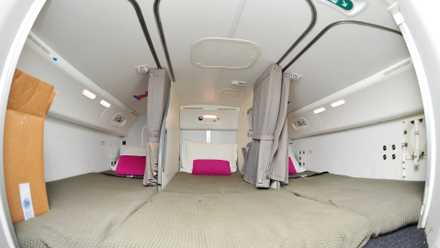
All bunks in all rest areas have seatbelts fitted for safety. There are intercom systems for communication with the entire crew, and seatbelt indicator signs are in use. The cabin crew rest area is a small room with usually four to eight bunk beds with padded mattresses at the rear of the aircraft, near the tail, or in the cargo hold, depending on aircraft type.
They can be in a one-up, one-down configuration or separated by an aisle, ‘coffin’ style. Blankets and pillows are provided. There are sound-dampening curtains for privacy. Sometimes, the cabin crew rest areas are claustrophobic and less comfortable than flight crew rest areas.
A Change In Rules

Although most crew rest areas are pretty similar, the rules vary slightly for newer types, such as the 777X. On most aircraft types, the crew rest areas are not to be used during taxi, takeoff, and landing. However, on the 777-9 and the 787-8 Dreamliner, the overhead flight crew rest area is certified by the FAA under special conditions to be used during these critical phases of flight. Only the seats may be used, not the bunks.
These rules need to ensure a safe evacuation of the overhead flight crew rest area in an emergency. It also has to have the appropriate signage and training for crew members to open the evacuation hatch. Emergency oxygen masks must be fitted in all areas of the flight crew rest area in case of decompression, for example, in the lavatory, sink area, bunks, and seats.
These special conditions, as detailed by Boeing, also mean that rescue crews and airport fire rescue teams must be alerted to the possibility that the crew rest area may be occupied during an emergency landing. Emergency documentation indicates that access for rescue personnel is also facilitated via certain cabin doors if needed.
Which Widebody Aircraft Have Dedicated Crew Rest Areas?
The secret areas hidden on a long haul aircraft, for the crew to get some much needed rest.
Crew Rest Area Specifics For The Boeing 777X

The Boeing 777X’s overhead flight crew rest area features two bunks and two seats, allowing four crew members to rest during a flight. However, during taxi, takeoff, and landing, only two crew members can be seated there and only in the seats and not in the bunks. Entry is through a concealed door and up the stairs. There is also a secondary evacuation hatch that opens up in the main passenger cabin.
The overhead flight crew rest area can also be fitted with a sink, lavatory, and storage area for cold drinks. For safety and emergency procedures, there is a smoke detection system, an emergency oxygen system, and a fire extinguisher. There is a seatbelt indication sign and an intercom for crew communication. These are all mandatory items for crew rest areas. There may be an inflight entertainment screen.
So, the question is, why can these crew rest areas now be occupied during critical phases of flight, when they were not allowed to be before? With newer aircraft types that offer greater range, an augmented crew (additional crew members) can operate ultra-long-haul routes without a layover and without exceeding flight time limits. The cabin crew rest area is at the rear of the aircraft and is of the standard design with ten bunks.
A Comparison Of Rest Areas

Although most crew rest areas are similar, the size of the aircraft, the position of crew rest areas, and the airline’s preference are also factors. The Airbus A380 at Emirates, for example, has its flight crew rest area above the passenger cabin instead of closer to the cockpit as other airlines have. The cabin crew rest area has 12 bunk beds underneath the main deck and an escape hatch for evacuation if the main door cannot be used. This is similar to the earlier Airbus A330 and A340.
The Airbus A350 has a flight crew rest area close to the cockpit and a six-bunk rest area for cabin crew at the rear. The Boeing 787 Dreamliner flight crew rest area is once again at the front of the aircraft behind the cockpit, and the cabin crew rest area is at the rear, but its location can be spotted by a fake overhead locker.
The Boeing 777 has between eight and ten cabin crew bunks at the rear of the aircraft with curtains to separate them. There is a shared wardrobe and mirror, and individual reading lights and airflow controls. The Airbus A380, A350, and Boeing 787 are often considered to have the most comfortable crew rest areas.
All About The Boeing 777X

The 777X will be Boeing’s newest and largest twin-engine widebody when it enters service. Its cabin architecture is expansive, with a broader fuselage cross-section than current members of the Boeing 777 family, and composite wings with folding wingtips. The windows are large and dimmable, and redesigned sidewalls make the cabin four inches wider. The sculpted ceiling gives a sense of space.
Its cabin is fully customizable to the airline and has different lighting, ceiling, and galley design, and the overhead bins are larger, and the cabin is quieter and has advanced air filter systems. The humidity is higher than on other commercial aircraft, and the cabin altitude has been lowered to 6,000 feet, making it more comfortable. The 777X combines the 777 and 787. General Electric GE9X engines power the aircraft.
Although the aircraft was launched in 2013, the Boeing 777X has been slow in the certification process, and there have been numerous delays. It first flew in January 2020. There have been hundreds of orders for the aircraft, including airlines such as  Lufthansa (the launch customer),
  Qatar Airways, Emirates and
  Singapore Airlines. However, deliveries are not expected to start until 2027. By October 2025, Boeing had amassed 619 orders from 12 customers.
The Bottom Line

There are two 777X variants, namely the 777-8 and the 777-9. The 777-8 can seat 395 passengers and has a range of 8,745 nautical miles, 10,064 miles, or 16,196 kilometers. The 777-9 can seat 426 passengers and has a range of 7,285 nautical miles, 8,383 miles, or 13,492 kilometers. While the 777-8 has more range, the 777-9 has more capacity.
Boeing describes the 777X as the “flight experience of the future.” It is the successor to the Boeing 777-200LR and 777-300ER and competes with the Airbus A350-1000. The Boeing 777X family was designed to maximize efficiency and improve environmental performance and to lead in the arena of cabin experience. The 777-9 has 20% lower fuel use and emissions, and 40% lower noise than the aircraft it replaces. It also boasts 10% lower operating costs.
With newer aircraft types with more fuel efficiency and longer range, there is no doubt that more comfortable crew rest areas will become the standard. Working longer shifts, both cabin crew and flight crew will need more rest time and somewhere to rest and sleep comfortably. There will probably be changes to rules regarding crew rest and the use of crew rest compartments and their certification, as we have already seen, to accommodate an augmented crew.