dailynewsnblog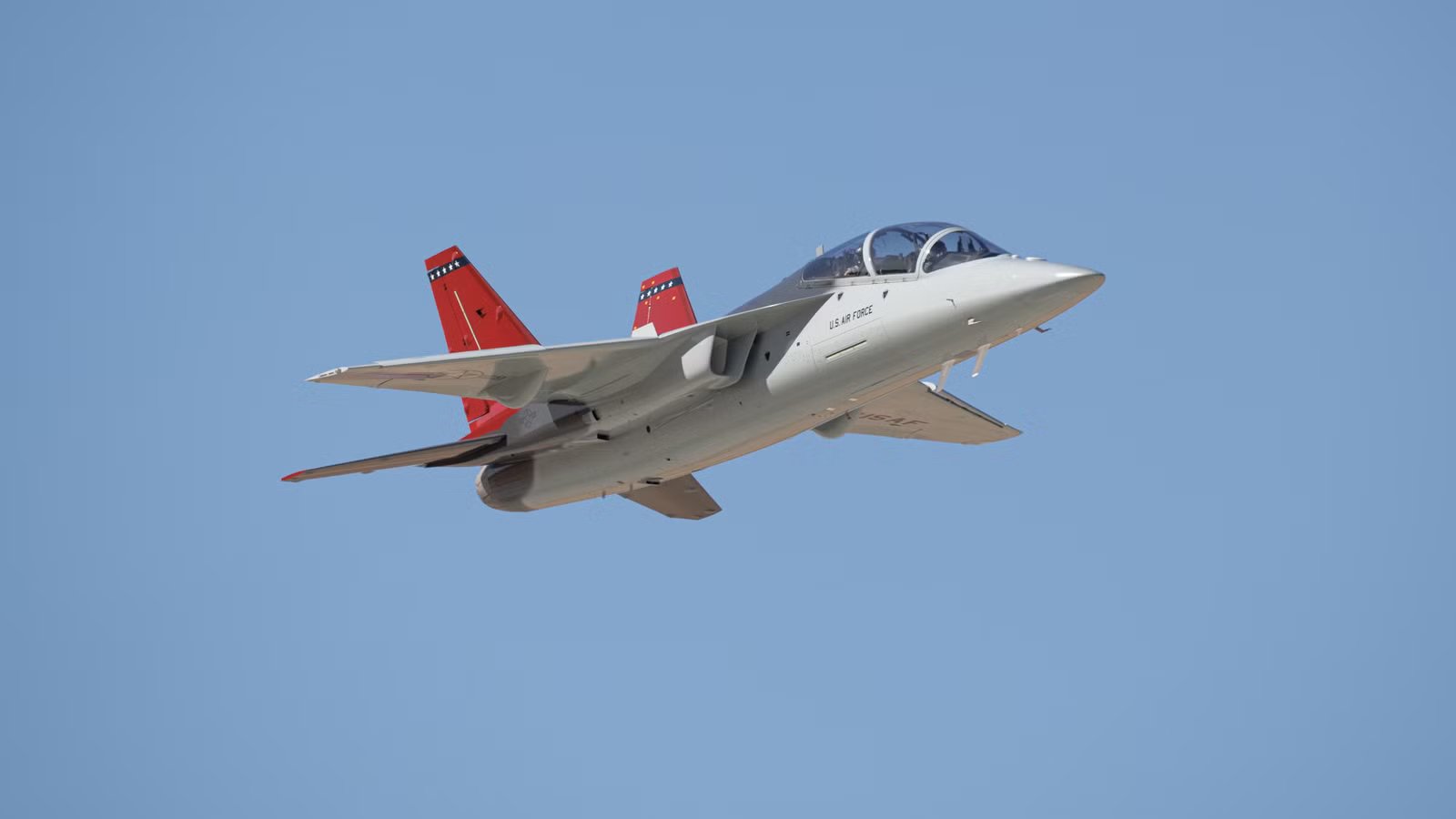
The popular online narrative that the Boeing T-7A Red Hawks’ revolutionary development methodology spells the end of the F-35 is hyped and often rests on bad-faith arguments. It can be argued that the T-7A is one of the first combat aircraft built using new “digital first” technologies. It can also be argued that the F-35 was one of the final aircraft built using expensive physical prototyping, although it did use advanced digital tools by the standards of the early 2000s. But this doesn’t end the F-35 era; the F-35’s developmental stage is now mostly behind it, and it is only now maturing into a mature weapons system.
Even though the Red Hawk is a comparatively simple, subsonic, advanced trainer that doesn’t have the enormous engineering constraints of the F-35’s stealthy design, it has been delayed, much like the F-35. That said, the T-7A has been developed using new digital tools that are reshaping the military aviation industry and the ability of aerospace companies to rapidly develop new prototype aircraft designs. While not a silver bullet, the Air Force is looking to these tools to significantly reduce development timelines and costs of its upcoming B-21, F-47, and Collaborative Combat Aircraft programs.

The Lockheed Martin F-35 was designed in the 2000s, and its development had to make use of the computing technologies of the day. Computing power and simulations had improved massively, but Lockheed was still compelled to build expensive prototypes and test them in the real world. After gathering data, Lockheed would have to enact a large number of expensive and time-consuming changes, and build another prototype, and test it again. Rinse and repeat.
In the 2010s and 2020s, new digital tools have been developed, enabling manufacturers to dramatically shorten this cycle. Model-Based Systems Engineering (MBSE), digital twins, high-fidelity simulation, 3D model-based definition, and integrated digital threads have matured significantly. The aircraft can be digitally prototyped with far greater fidelity. This means that when the first prototype is built, it requires comparatively fewer design changes.
The T-7A went from a conceptual design to its first flight in just 36 months. Technicians were able to join the rear fuselage to the forward fuselage in under 30 minutes, a process that can take days or weeks with previous aircraft due to misalignments. The aircraft’s digital engineering reduced traditional assembly errors by around 50%. This doesn’t mean the F-35 is outdated, but rather the processes initially used to develop it are outdated. This is true of all aircraft from the 2000s and earlier.
Catch what other flight trackers miss
Emergency squawks, holds, NOTAMs — live signals, no signup.
Open tracker
Catch what other flight trackers miss
Emergency squawks, holds, NOTAMs — live signals, no signup.
Open tracker
Small Military Aircraft Being Rapidly Prototyped

In 2024, Northrop Grumman’s subsidiary, Scaled Composites, unveiled its new Model 437 optionally manned autonomous combat aircraft. The company says, “The Model 437 first flew August 29, 2024, successfully demonstrating Northrop Grumman’s digital engineering tools and processes with the Digital Pathfinder wings. In just 21 months, this clean-sheet aircraft went from start of detailed design to first flight.”
Scaled Composites told The War Zone that Pathfinder used the digital environment to build the Model 437’s wing. The company said, “We built the wings fully in the digital ecosystem in St Augustine, Florida, and we shipped them to Mojave to join 437 at scale. And when they arrived, they fit perfectly the first time, which also speaks to the importance of the digital environment.“
The T-7A Red Hawk is part of this world of rapid prototyping. Rapid digital prototyping is now being employed to rapidly prototype and develop a wide range of advanced autonomous combat aircraft, like the Anduril YFQ-44, the General Atomics YFQ-42, and the Northrop Grumman YFQ-48. There are also numerous other autonomous combat systems being rapidly developed that haven’t received official designations, like the Shield AI X-Bat and the Lockheed Martin Vectis.
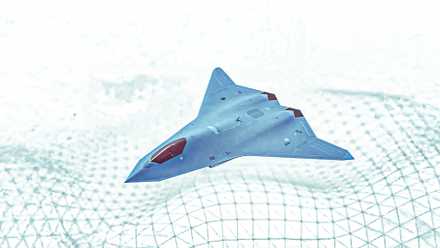
Boeing F-47: Everything We Know So Far
There’s been a lot of mystique around the F-47.
Large & Complicated Aircraft Also Rapidly Prototyped

It’s not just smaller aircraft like the Saab-Boeing T-7A and Collaborative Combat Aircraft being rapidly prototyped thanks to powerful new digital tools. Scaled Composites also told The War Zone that the digital engineering environment is being used to rapidly develop the Northrop Grumman B-21 Raider stealth bomber. The B-2 Spirit first flew in 1989 and entered service in 1997, around eight years later. The B-21 Raid first flew in 2023 and is expected to enter service in 2027, a lapse of around four years.
Another aircraft, the blended-wing-body JetZero Z4, is being rapidly developed with the aid of Northrop Grumman. JetZero maintains it is on course for the first full-scale demonstrator to fly in 2027. The extensive delays in certification with Boeing’s commercial MAX 7, MAX 10, and Boeing 777X may give the impression that Boeing is falling behind in aircraft development cycles. However, these lengthy certification timelines are influenced by both regulatory scrutiny and technical issues, making them a poor measure of pure design-and-development speed.
Select military aircraft | First flight | Entry into service | Years lapsed |
|---|---|---|---|
B-2 Spirit | 1989 | 1997 | 8 |
F-22 Raptor | 1997 | 2005 | 8 |
F-35 Lightning II | 2006 | 2015 | 9 |
T-7A Red Hawk | 2016 | 2027 (planned) | 11 |
B-21 Raider | 2023 | 2027 (planned) | 4 |
F-47 | 2028 (planned) | 2030-2035 | 2-7 |
In the military sphere, Boeing is also rapidly prototyping aircraft. Besides the T-7A trainer, an indication is the optimistic timeline the Air Force is indicating for the next-generation F-47 fighter jet. The F-47’s demonstrator first flew in 2019, and Boeing is now building the first representative prototype. It is expected to make its maiden flight in 2028 and enter service around 2030 or early 2030s. Only around two to seven years from the first flight.
The F-35’s Delays & Development

It is important to note that the T-7A advanced trainer and the F-35 joint strike fighter are not comparable platforms. The F-35 is an incredibly ambitious platform designed to carry out a wide range of missions. It was built to replace (or partially replace) the A-10, F-16, F/A-18 legacy Hornet, Panavia Tornado, Harrier jump jet, and even some F-15s. The F-35 was also designed to be a platform that could be progressively updated.
To win the contract, Lockheed Martin had to promise capabilities that were not mature or not developed at the time. The program adopted a high degree of concurrency, resulting in the aircraft entering production before testing and software development were fully complete. This was an enormously expensive and time-consuming endeavor. To some extent, F-35 delays and cost overruns speak to the sheer complexity and ambition of the project.
The F-35A first flew in 2006 and entered service in 2015, around nine years later. The aircraft was delayed by a range of factors. Not only was it designed before modern digital-engineering techniques had matured to their current state, but it also effectively promised tomorrow’s technology in some areas. The ongoing Block 4 upgrade is only now delivering on some of these long-awaited capabilities.
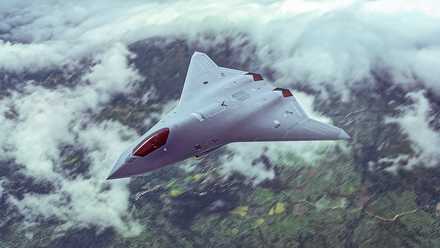
The World’s 6th-Generation Fighter Programs Ranked
The US, China and the UK/Japan/Italy coalition are leading the race to field 6th-gen fighter jets with some programs experiencing deep problems.
T-7A Red Hawk Delays & Digital Prototyping Woes

It is also important not to overstate the T-7A Red Hawk’s success. The initial digital design phase was blindingly fast, but once it entered the real world, it faced a slew of delays. The program has already slipped by about six to seven years beyond its original baseline schedule. This has cost Boeing around $1.8 billion in fixed-price losses. It has suffered from aerodynamic anomalies, safety system issues, and software integration hurdles.
Ironically, its digital-first foundation came back to haunt it as the aircraft’s physical flight systems and ground-based simulation software were found to be completely out of sync. This has resulted in delays and recoding. The first flight took place in 2016, and it is expected to enter service in 2027. That is a lapse of around 11 years, which is longer than the much more complex F-35 (first flight to IOC).
The Red Hawk is showing real progress. In May 2026, the Air Force awarded a contract for Lot 1 Low-Rate Initial Production for the first 14 aircraft. It expects initial operational capability in 2027. The rapid Red Hawk prototyping heralds what’s to come. But it also shows the limits of the usefulness, the real-world complications, and the teething issues in translating valuable new digital tools into tangible, faster development cycles.
The F-35 Is Too Big To Fail

The F-35 is not an aircraft frozen in time. It is constantly being upgraded and tweaked. It is becoming the backbone not only of the US Air Force’s offensive firepower but also of select allies (e.g., the UK, Norway, the Netherlands, Australia) and the US Navy. The massive scale and ambition of the F-35 have given it public attention, both positive and negative, that no other modern fighter jet approaches.
The F-35 has become both a symbol of US air power for some and a source of perceived military waste for others. Other fighter jet programs, like the Eurofighter, Rafale, Gripen, and Su-57, have experienced relatively similar (or worse) cost overruns, but they rarely receive the same reporting. The US’s generous transparency and unclassified GAO audits add to the F-35’s negative press. Any delays and cost overruns involving Chinese fighters are not reported because China is simply not transparent.
In 2025, Lockheed Martin delivered a comparable number of F-35s as all other non-Chinese fighter jets combined (Eurofighters, F-16s, F/A-18s, F-15EXs, Rafales, Su-30/34-35, Su-57, Gripens, Tejas, KF-21s). The F-35 has the momentum and investment to essentially brute force its way through engineering hurdles that other fighter jet programs don’t. The F-35 was designed before many of the digital-engineering techniques now being promoted across the aerospace industry had fully matured. It is also designed to be the mainstay of US airpower into the 2060s.