dailynewsnblog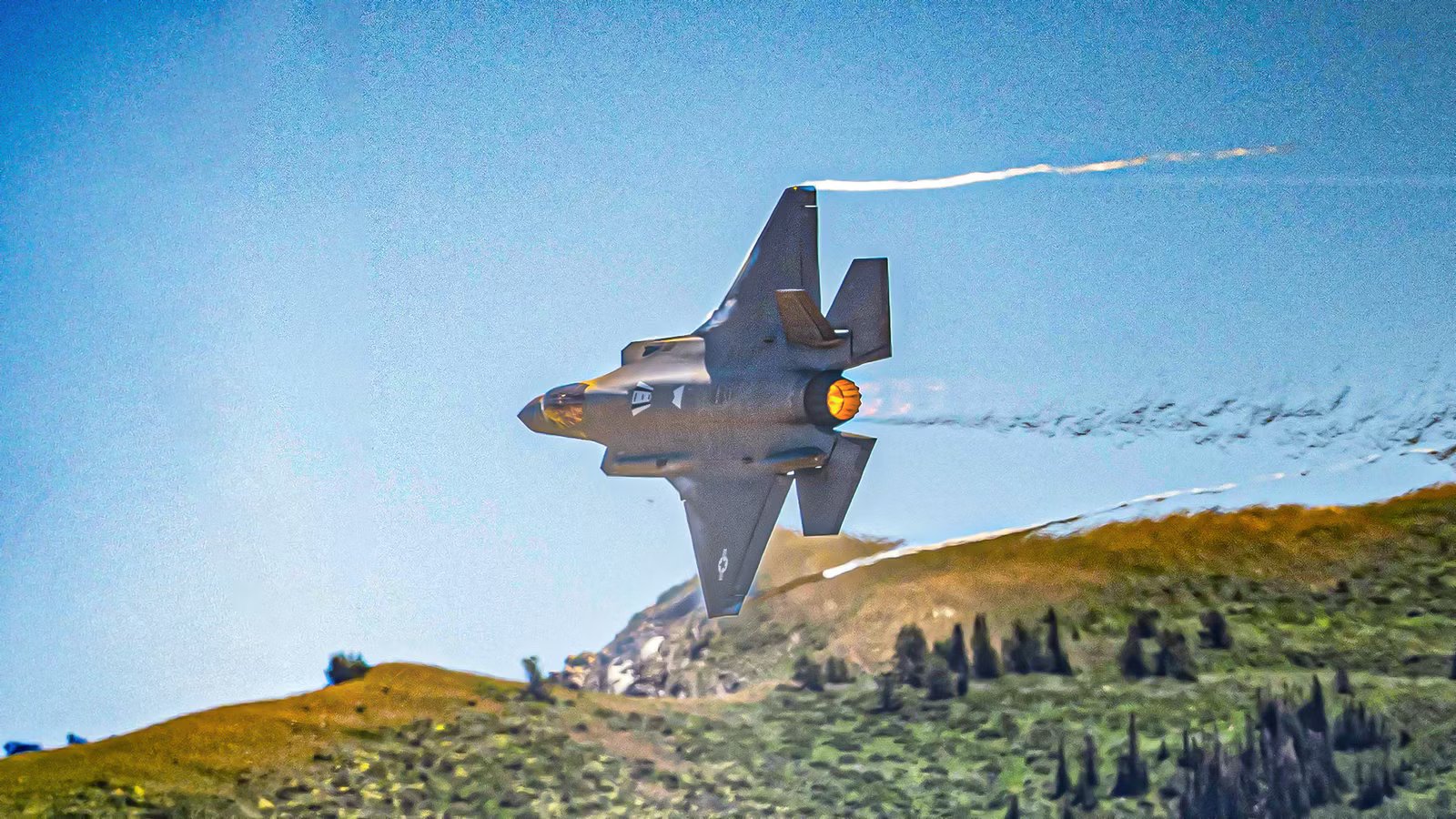
The primary reason that the US steered export partners towards the F-35 Lightning II rather than the F-22 Raptor was never just about which jet was better. The two aircraft fundamentally help build different kinds of airpower. The F-22, which was manufactured by defense prime Lockheed Martin, was conceived as a uniquely American air-dominance fighter, protected by law from being exported and never constructed for sale to foreign operators.
The F-35, by contrast, was designed from the outset as a multinational program. The plane was a fifth-generation aircraft that allies could buy, help build, sustain together, and operate as part of the same battlespace network. That distinction ultimately matters. Washington wanted to preserve the F-22’s most sensitive stealth and air-superiority advantages inside the United States force, all while using the F-35A to deepen alliance integration, lower costs through scale, and create a common platform across partner air forces.
It also became the only practical choice once the F-22 production line closed permanently and Congress kept the export ban firmly in place. In that sense, the export story is really a story about strategy as a whole. The F-22 represented exclusivity and technological sanctuary. The F-35 represented interoperability, burden-sharing, and coalition warfare. Let’s examine how the F-35A was not a second-choice export fighter, but rather the aircraft that was intentionally built to become the West’s shared fifth-generation standard.
What The F-35 Brings To The Table

The Lockheed Martin F-35 Lightning II is the United States’ fifth-generation multirole fighter family and was built to do more than just replace older aircraft. In basic terms, it is designed to survive in heavily defended airspace while also acting as a flying sensor and communications node for the wider force. The program includes three separate variants, including the F-35A for conventional runways, the F-35B for short takeoff and vertical landing, and the carrier-based F-35C.
As a result, the aircraft was both versatile and capable, making it an extremely valuable addition to any air force. It is not surprising that America’s allies were interested in acquiring the type. Of these many different variants, which have proven popular with operators, the F-35A is the main Air Force and export version. What ultimately makes the aircraft distinctive is its unique combination of stealth, advanced avionics, sensor fusion, and data sharing.
Rather than forcing the pilot to manage separate streams of radar, infrared, and electronic information, the capable stealth aircraft fuses them into a more unified picture of the battlefield. That ultimately makes the F-35 way less of a classical dogfighter and more of a platform designed exclusively around awareness, survivability, and networked combat power.
It was also built with allies in mind, which is why it has become the common fifth-generation platform across many US partner air forces. The F-35 today is not just a fighter jet, but a uniquely designed and endlessly malleable coalition combat system. One aircraft type is meant to strike, scout, share data, and tie allied airpower all together.
Diving Deeper Into The F-22 Raptor’s Role

The Lockheed Martin F-22 Raptor is a fifth-generation fighter designed primarily to achieve complete air superiority and unquestioned tactical dominance. The F-35 is a multirole coalition platform, and the F-22 is not remotely designed for multiple kinds of missions. The F-22 was primarily designed as the Air Force’s ultimate air-superiority aircraft. The jet is meant to seize control of the skies against even the most advanced enemy fighters and air defense systems.
The plane’s defining qualities are the combination of stealth, supercruise, high maneuverability, and integrated avionics systems. In practical terms, that means it can approach with very low observability, fly at supersonic speed without relying on fuel-hungry afterburners, and outmaneuver opponents while maintaining exceptional situational awareness. The plane was built to kill threats before being detached, a key reason why it has long been treated as one of America’s most sensitive combat aviation assets.
It was with this in mind that legislators were keen on making sure that this one-of-a-kind weapon never entered any allied fleets, according to Congressional reports. The aircraft can certainly perform air-to-ground strike missions if needed, but that has always been secondary to the plane’s core purpose. It is not primarily a strike workhorse or alliance-standard export platform. Rather, it is a specialist model that is optimized for the opening phase of a high-end war when the United States wants to break into contested airspace and dominate it.

Which Country Has The Most Powerful 5th-Generation Fighter Jets In The World?
The United States has the world’s most advanced fighter jets, with China also rapidly developing its own advanced fifth-generation fighters.
Why Is The F-22 Banned From Export?

The complicated backstory behind the F-22’s export ban begins back in the late 1990s, when the aircraft was still slowly emerging as America’s premier next-generation air superiority fighter. Lawmakers viewed the Raptor not as a normal fighter sale candidate, but as a uniquely sensitive national asset built around stealth, avionics, and performance advantages the United States did not want to see diffused abroad. Starting in 1998, lawmakers inserted what became known as the Obey Amendment into many large defense appropriations bills.
This stated that no funds could be used to approve the sale of the F-22 to a foreign government. That wording was then repeated year after year, ultimately turning the restriction into a standing political barrier rather than a one-off decision. The reasoning was broader than just secrecy. Congress was really worried about technological proliferation, which is the possibility that even close allies could accidentally expose sensitive features through compromise or espionage.
The risk that exporting such a high-end platform could unsettle regional balances proved to be far too high. The issue came up most seriously when Japan showed interest, but even then, the debate centered on whether the industrial, alliance, and interoperability benefits outweighed the danger of sharing America’s most protected fighter technologies. By the time the debate matured, the F-22 line was nearing closure, something which made overturning the ban even less likely.
Were Allies Genuinely Interested In The F-22?

Some American allies were genuinely interested in acquiring the F-22 Raptor, but that interest was extremely concentrated rather than universal in nature. The clearest and most persistent case was Japan, which, for years, sought to buy the aircraft and was discussed in Washington as a potential customer for roughly two squadrons or up to 40 jets. That was serious enough to trigger congressional debate, defense analysis, and some discussion of what an export-configured variant might cost.
Australia also showed real interest in the type, especially in the late 2000s, when its defense leadership publicly signaled a desire to pursue access to the Raptor itself. Israel was often mentioned alongside Japan and Australia as another interested ally, although the public record is less developed there than in Japan’s case. The important nuance is that allied interest did not mean the F-22 was ever close to becoming an actual export program.
The case of Japan was the most genuine in terms of overall procurement terms. Australia was also somewhat interested in the type but remained more so on an exploratory basis. Nonetheless, demand from allies was never large enough to overcome the legal ban, technology-security concerns, and the looming closure of the production line as a whole.

6 Aircraft That Represent The Future Of Air Combat
Discover six aircraft redefining modern air warfare, from stealth fighters to missile trucks, shaping the balance of air power in 2026 and beyond.
What Made The F-35 A Good Export Candidate?

What ultimately made the F-35 such a strong export candidate was the fact that it was built for export from the very beginning. Unlike the F-22 Raptor, which was conceived as a protected US-only air-dominance asset, the F-35 was structured as an international cooperative program with partner nations financially, industrially, and operationally tied directly into the program itself.
That gave allies a stake in the plane’s overall success and helped Washington sell it not just as an aircraft, but as a shared combat ecosystem. The F-35A in particular was attractive because it combined stealth, sensor fusion, strike capability, and interoperability in a conventional takeoff-and-landing format that many air forces could adopt more easily than a specialized platform.
In just as important a manner, a common fleet meant shared training, logistics, upgrades, and data links across allied militaries. That reduced overall friction in coalition warfare and made the aircraft politically valuable as well as useful in combat. To put it simply, the F-35 was a good export candidate because it was designed to bind allied air forces into a single modern, networked, and scalable fifth-generation framework.
The Bottom Line

At the end of the day, the F-35 Lightning II and the F-22 Raptor are both some of the highest-performing models to ever hit the market. The former has historically been and will certainly remain an export-oriented program, and there is a serious portion of the F-35’s story that would be incomplete without a discussion of foreign partners.
The F-22 Raptor could not be more different than the F-35 in this regard. The Raptor was designed for air dominance, and it has often been cited by industry analysts as the ultimate fighting machine. The aircraft is designed to be a unique top-secret weapon, and for these reasons, it has been restricted from allies.
There are, of course, other considerations to take into account. For example, the F-35’s operational history is far more complex than that of the F-22, primarily due to the jet’s foreign operators. Nonetheless, both remain core elements of the United States Air Force with a big role to play to this day.