dailynewsnblog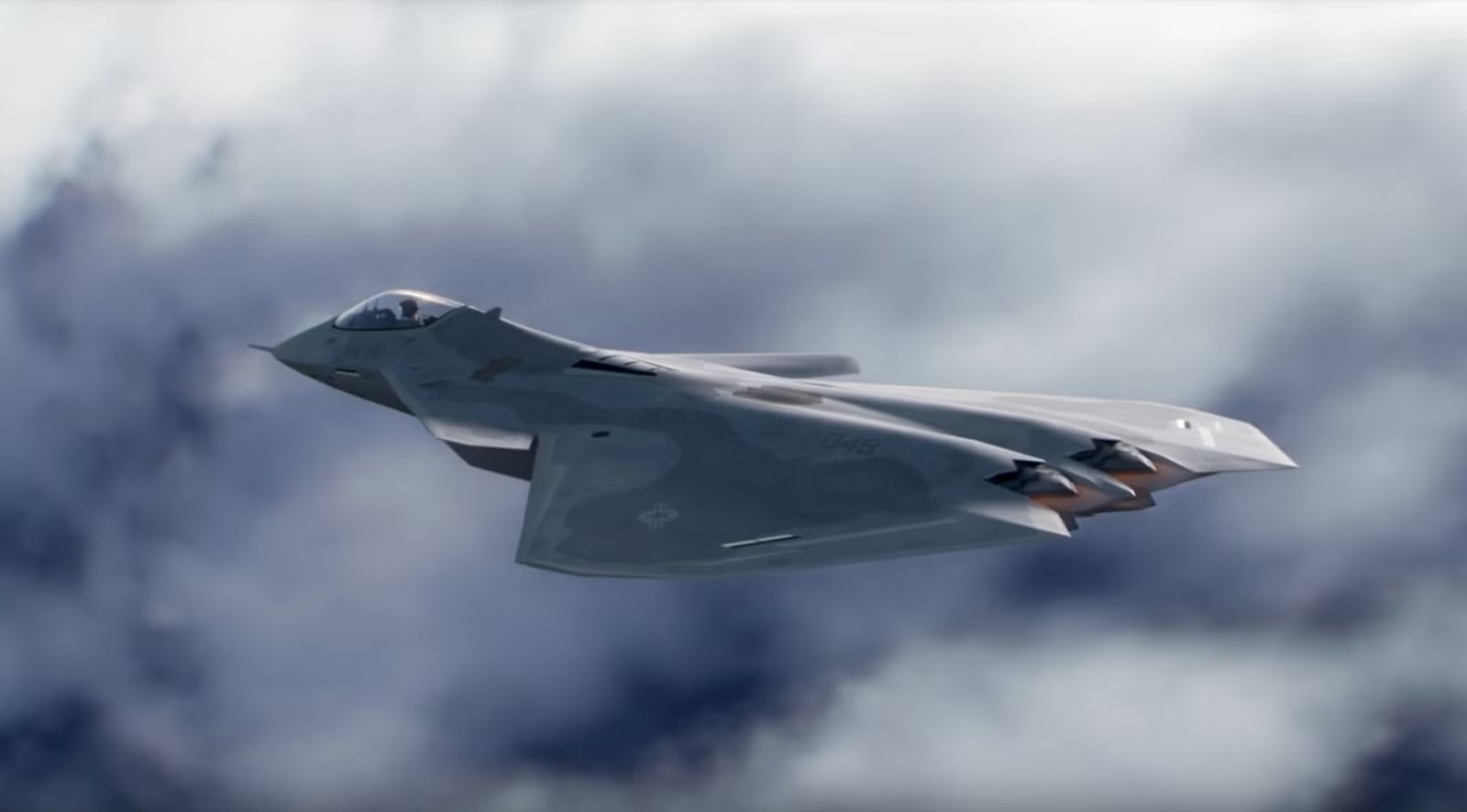
The US Air Force (USAF) has publicly disclosed precious little information about its first sixth-generation fighter jet, the upcoming Boeing F-47, or next-generation air dominance. The headline features include multispectral stealth and dramatically superior range compared to the preceding Lockheed Martin F-22 Raptor. Notably, it is also hardened to be less expensive, but it is unclear exactly what the price tag will be per airplane, or how many the USAF plans to buy.
Boeing was awarded the contract in 2025, and the USAF has since declared that it will procure “185+” with the first examples slated to achieve initial operating capability in 2029. That number has raised many questions with defense analysts, as it is almost the same as the production run of the F-22. Just like the notoriously expensive Northrop Grumman B-2 Spirit stealth bomber, the Raptor was very expensive per plane. That is because of the exceptionally high research and development investment and relatively low number of airframes that rolled off the line before the factory doors were shuttered.
So, based on a projected minimum fleet size that is similar to its predecessor, with every airplane being exponentially more advanced, it is unclear how Boeing can deliver F-47s at a lower price than the F-22. This has led to much speculation that the 185 figure is a baseline which will grow as the program matures, just like the B-21 fleet which could be increased by 150% or more.
The Only Official Number Is A Floor, Not A Plan

The macroeconomic and production calculus also gets quirkier when considering that the all-in price of a single F-22 is about $350 million, even though the fly-away cost per airframe is reported at just under $150 million. Most balked at the idea that the F-47 could beat this price point with the same production quantity and superior technology. In May, Air and Space Forces magazine released an analysis that showed the procurement program as designed by the USAF, and Boeing expects the average cost of an F-47 to be around $300 million.
Notably, nowhere in the initial Air Force fact sheet, nor in any subsequent budget submission, does the service specify how many F-47s it wants to purchase in any particular year. At the same time, the program is in its infancy, which has led to the consensus that the 185-strong fleet has been presented as a threshold the Air Force intends to exceed, not a target it intends to stop at.
That ambiguity is itself deliberate, according to reporting from The War Zone, which noted that then-Secretary of the Air Force Frank Kendall had floated a construction built around roughly 200 NGAD aircraft as far back as 2023. This was before General Kenneth Wilsbach, head of Air Combat Command, said in mid-2024 that there was no longer a firm timeline for replacing the F-22 at all. If the baseline number has been unstable for two years and counting, why has the service not proposed 250 or 300?
The Anchor Is The F-22, Not A New Requirements Study

The original F-22 initiative was meant to be a procurement program that would produce 750 fighter jets. As the Cold War came to an abrupt and peaceful conclusion as the Soviet Union fell, the Raptor lost its adversary. Thus, lawmakers decided to opt out of fulfilling the full contract plans. In all likelihood, the only thing that 185+ represents is continuity. As the successor to the Raptor, the NGAD will begin to replace the aging fifth-generation fighters as soon as it arrives in the early 2030s.
As more of them are delivered, the last of the F-22s will be sunset, but that doesn’t limit how many F-47s could arrive. 19FortyFive’s analysis went further, arguing plainly that 185 was chosen for continuity with the F-22, not because an independent requirements analysis concluded that number would be sufficient to fight and win a sustained great-power air war.
That framing, replacing the Raptor fleet with a same-sized fleet of nominally superior jets, has an obvious appeal to Pentagon planners trying to sell a $300 million-per-copy aircraft to Congress. But it leaves the strategic question unanswered. Is a one-for-one swap adequate for the mission the F-47 is actually being asked to perform: sustained air superiority against China in the Pacific?
Independent Analysts Are Already Arguing For A Double Order

The question of strategic priorities versus economics has led to the sharpest divide in opinions to date. The Mitchell Institute for Aerospace Studies has advocated that the Air Force should build 300 F-47s alongside 200 B-21 Raiders, according to Defense Watch. A total fighter strength of that scale would expand the currently planned fleet by 62%. Such a force would have the capacity to provide capacity for simultaneous operations across multiple theaters while maintaining homeland defense commitments.
A National Security Journal piece argued that analysts should be thinking in terms of a force that can absorb losses, cover multiple theaters, and still have jets left for training and testing. This kind of force structure further suggests a range of 250 to 300 aircraft is the true floor rather than ceiling. It also ties directly into the ‘pivot to the Pacific’, where the US Air Force and America’s Armed Forces in general are reorienting their force structure and hardware. Optimizing the F-47 for ACE and long-range missions is fundamental to the strategy.
The F-22 Raptor was originally built for Europe during the Cold War, where targets were relatively close together. It has a short combat radius of only about 590 nautical miles (1,093 km). The Pacific Ocean is massive. Flying from safe US bases to a conflict zone in the South China Sea requires a massive distance. The new F-47 NGAD is being built with a combat radius exceeding 1,000 nautical miles (1,852 km).
While its massive unrefueled range allows it to fight across the Pacific without constantly relying on vulnerable airborne refueling tankers, there still need to be enough of these fighters to effectively cover the gigantic theater. In order to help with that, the USAF plans to assign a minimum of two Advanced drones to each F-47, known as the collaborative combat aircraft. The service has probably stated that it wants to procure 1,000 of these, lending further credence to a larger planned NGAD fleet.
Budget Documents Show Momentum, Not A Fleet Commitment

Currently, there is clear urgency within the Pentagon to get the F-47 into production quickly rather than committing to any particular fleet ceiling. Development funding has climbed sharply, and sightings are already popping up from Area 51 of what are alleged to be tested airframes. Defense Daily reported the Air Force received nearly $2.6 billion for the F-47 in base fiscal 2026 appropriations, plus a $400 million reconciliation-bill boost to accelerate the move to production, before requesting more than $5 billion for fiscal 2027.
A Sputnik analysis of 2027 budget filings put the precise figure at $5.03 billion, a 65% increase over the roughly $3.05 billion allocated in 2026. The Defense News outlet reported that budget projections show annual F-47 spending remaining above $3.2 billion through 2030 and peaking near $5.3 billion in FY2028, with cumulative program spending reaching nearly $8.5 billion by the end of FY2027.
Still, none of those figures translate into a stated procurement quantity per year, and Congress has already shown it is prepared to overrule the administration’s preferences in the other direction. So, with money flowing heavily into development, but few details about progress, does the schedule itself offer any clearer picture of when a real fleet size would emerge?
The Schedule Makes Any 2035 Total Unreliable

To date, it has not. First flight is targeted for 2028, a goal General Dale White, the Air Force’s director of critical major weapon systems programs, reaffirmed in July 2026. Initial operational capability is targeted for 2029, alongside the first CCAs. However, the adaptive-cycle engines, being developed under the separate Next Generation Adaptive Propulsion program, are not expected to be ready for aircraft integration before 2030.
That would mean that the 2028 initial flight tests will use an interim engine configuration. That mismatch means the more consequential milestone, the first flight with the actual production engine and a combat-representative mission system, could land well into the 2030s, pushing full operational fielding into the middle of the decade at the earliest.
Assuming a production rate of 12 to 18 units per year, ramping to a peak of 30 to 40 units annually would allow Boeing to reach the 185-aircraft threshold by the second half of the 2030s. Even at the high end of that range, hitting 185 jets by 2035 would demand an uninterrupted ramp-up with no more schedule slips. That is a prospect that is widely regarded as doubtful based on the recent history of both Boeing’s defense and commercial divisions.
What Happens To The Number Depends On The Budget

The only concrete answer to how large the F-47 fleet becomes will not come from a fact sheet but from whether Congress keeps funding it at the pace the Air Force is requesting. There does appear to be strong support from the current administration, hence the rapid launch in 2025 following China’s sixth-generation prototype debut in 2024.
It does not, however, resolve the gap TWZ called out in early 2025: a still-evolving vision of what next-gen air superiority will actually require. Until the Air Force announces its intentions, the range for the 2030s fleet remains purely speculative. A floor of roughly 185 to 200 jets is confirmed, but whether the final F-47 fleet will be anywhere from 250 to 750 airframes is still up for debate.
Catch what other trackers miss
Emergency squawks, holds, NOTAMs — live signals, no signup.
Open tracker
Catch what other trackers miss
Emergency squawks, holds, NOTAMs — live signals, no signup.
Open tracker