dailynewsnblog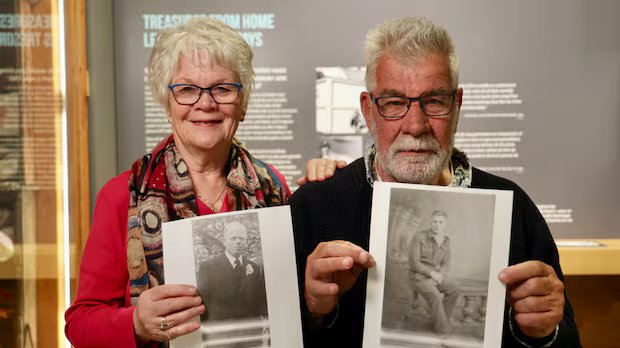

Listen to this article
Estimated 4 minutes
The audio version of this article is generated by AI-based technology. Mispronunciations can occur. We are working with our partners to continually review and improve the results.
When Dina Van Dommelen-Samson and Nico Peltenburg met for the first time earlier this month, it felt like a family reunion instead of two strangers getting acquainted.
“He looked at me, he opened up his arms and I [did] too, and we had a little cry and a big, big hug,” said Van Dommelen-Samson with tears in her eyes.
Peltenburg was in Nova Scotia with some of his family on a visit to Canada. But he also hoped to meet the family of the man who hid his father, Jan Peltenburg, during the German occupation of the Netherlands during the Second World War.
“To believe that someone who was poor helped people in war against Germany,” Nico Peltenburg said in Halifax.
“[Johannes Van Dommelen] didn’t know my dad, and he said, ‘Come into my house, you’re safe.'”
Dina Van Dommelen-Samson and Peltenburg recently retold the remarkable story to CBC News of how the kindness of strangers like Johannes Van Dommelen saved Jan Peltenburg and his two brothers from returning to forced labour camps.

On June 2, 1943, the three Peltenburg brothers — all carpenters — received an order to report to an internment camp in North Holland before being sent to Berlin and assigned to Organization Todt, a paramilitary organization that used forced labour to expand war efforts.
Peltenburg said his father and one of his uncles were eventually sent to a forced labour camp in Finland for about eight months. The third brother was sent to Estonia and Lithuania.
People in the labour camps experienced lice, overcrowded barracks and food scarcity, said Julie Thomas, chief curator at the Army Museum Halifax Citadel.
“You would be punished, beatings, solitary confinement, all that type of thing would be happening to you,” she said.
Thomas added that time off could be earned through “good behaviour.”
A chance at freedom
On April 10, 1944, the three Peltenburg brothers were granted leave on the condition they report back to work after three weeks.
They didn’t.
Instead, said Peltenburg, the brothers escaped to Brabant in the south of the Netherlands, where churches and members of the Dutch resistance helped find families willing to hide them in the village of Erp.
The brothers were split up, with Jan Peltenburg going to stay on the Van Dommelen family farm, where he lived until the liberation of the Netherlands in 1945.
Though the three brothers returned to Schoonhoven, Jan Peltenburg occasionally returned to the Van Dommelen farm to visit before the family immigrated to Cape Breton in the mid-1950s.
Jan Peltenburg died later that decade, sick from his time in the labour camp in Finland, said Nico Peltenburg.
Long-awaited meeting
The two families didn’t make contact with each other again until 2021, when one of Jan Peltenburg’s sons sent an email to Van Dommelen-Samson asking if she was related to the family that helped hide his father during the war.
Van Dommelen-Samson, who was just two years old when her family immigrated to Nova Scotia, said initially she wasn’t sure.
While waiting for two of her siblings to confirm, she asked for a photo of Jan Peltenburg. When it arrived, Van Dommelen-Samson had goosebumps.
She knew the photo from when she was a little girl. It had been among the photos of family members on display in her childhood home. Once, she asked her mother who the man in the photo was and she was told he wasn’t related to them. Nothing more was said.
“So that’s all I knew about this man, and when [the Peltenburgs] heard that their father was in Canada on display for about 40 years, if not longer, just made them very emotional,” she said.
Now a new, yet familiar, bond has formed some 70 years after their family members parted ways.
“We just really bonded like brother and sister truly and honestly, because we have our parents in common,” said Van Dommelen-Samson.
“I just think they’re up there laughing at us, saying, ‘Well, you two took long enough.'”
MORE TOP STORIES